



 Chat with AI
Exam 13: Reactions of Alkanes, Radicals

Exam 1: Remembering General Chemistry: Electronic Structure and Bonding81 Questions
Exam 2: Acids and Bases: Central to Understanding Organic Chemistry37 Questions
Exam 3: An Introduction to Organic Compounds123 Questions
Exam 4: Isomers: the Arrangement of Atoms in Space111 Questions
Exam 5: Alkenes Thermodynamics and Kinetics76 Questions
Exam 6: Reactions of Alkenes93 Questions
Exam 7: Reactions of Alkynes Introduction to Multistep Synthesis119 Questions
Exam 8: Electron Delocalization, Resonance, and Aromaticity More About Molecular Orbital Theory166 Questions
Exam 9: Substitution Reactions of Alkyl Halides118 Questions
Exam 10: Elimination Reactions of Alkyl Halides Competition Between Substitution and Elimination94 Questions
Exam 11: Reactions of Alcohols, Ethers, Epoxides, and Sulfur-Containing Compounds100 Questions
Exam 12: Organometallic Compounds57 Questions
Exam 13: Reactions of Alkanes, Radicals130 Questions
Exam 14: Mass Spectrometry, Infrared Spectroscopy, and Uvvis Spectroscopy127 Questions
Exam 15: Nmr Spectroscopy110 Questions
Exam 16: Reactions of Carboxylic Acids and Carboxylic Acid Derivatives128 Questions
Exam 17: Reactions of Aldehydes and Ketones116 Questions
Exam 18: Reactions at the Alpha Carbon of Carbonyl Compounds113 Questions
Exam 19: Reactions of Benzene and Substituted Benzenes155 Questions
Exam 20: More About Amines Heterocylic Compounds115 Questions
Exam 21: Carbohydrates100 Questions
Exam 22: Amino Acids, Peptides, and Proteins105 Questions
Exam 23: Catalysis85 Questions
Exam 24: The Organic Mechanisms of the Coenzymes92 Questions
Exam 25: The Chemistry of Metabolism94 Questions
Exam 26: Nucleosides, Nucleotides, and Nucleic Acids85 Questions
Exam 27: Synthetic Polymers106 Questions
Exam 28: Pericyclic Reactions92 Questions
Select questions type


Calculate the overall ΔH° for the reaction shown given the bond dissociation energies (in kcal/mol)below: (CH3)3C-H + Cl-Cl → (CH3)3C - Cl + H-Cl
91 58 78.5 103
(Multiple Choice)
4.8/5  (67)
(67) The major type of reactions that alkanes undergo is ________.
(Multiple Choice)
4.8/5 (80)
(80) When 1,1,3,3-tetramethylcyclobutane is brominated at 125°C, the relative reactivity of the 1°: 2° :3° hydrogens is approximately 1: 82: 1600. Estimate the amount of each monobromination product.
(Essay)
4.9/5 (84)
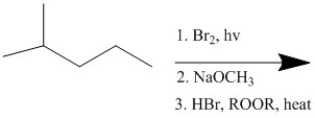
(84) What sequence of reagents can be used to accomplish the conversion shown below? 
(Essay)
4.9/5 (81)
(81) 
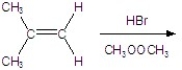
Which of the following statements concerning the use of hydrocarbons as fuels is not correct?
(Multiple Choice)
4.8/5 (82)
(82) Rank the free radicals (I-III)shown below in order of decreasing stability (i.e., from most stable to least stable). 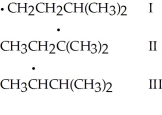
(Multiple Choice)
4.8/5 (74)
(74) 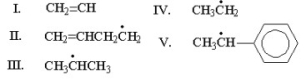
Which of the following is the initiation step for the monobromination of cyclohexane? 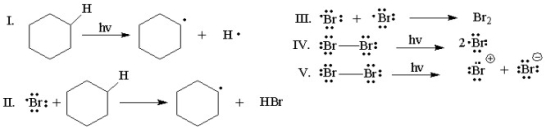
(Multiple Choice)
4.9/5 (70)
(70) 
Filters
- Essay(0)
- Multiple Choice(0)
- Short Answer(0)
- True False(0)
- Matching(0)