



 Chat with AI
Exam 11: Reactions of Alcohols, Ethers, Epoxides, and Sulfur-Containing Compounds

Exam 1: Remembering General Chemistry: Electronic Structure and Bonding81 Questions
Exam 2: Acids and Bases: Central to Understanding Organic Chemistry37 Questions
Exam 3: An Introduction to Organic Compounds123 Questions
Exam 4: Isomers: the Arrangement of Atoms in Space111 Questions
Exam 5: Alkenes Thermodynamics and Kinetics76 Questions
Exam 6: Reactions of Alkenes93 Questions
Exam 7: Reactions of Alkynes Introduction to Multistep Synthesis119 Questions
Exam 8: Electron Delocalization, Resonance, and Aromaticity More About Molecular Orbital Theory166 Questions
Exam 9: Substitution Reactions of Alkyl Halides118 Questions
Exam 10: Elimination Reactions of Alkyl Halides Competition Between Substitution and Elimination94 Questions
Exam 11: Reactions of Alcohols, Ethers, Epoxides, and Sulfur-Containing Compounds100 Questions
Exam 12: Organometallic Compounds57 Questions
Exam 13: Reactions of Alkanes, Radicals130 Questions
Exam 14: Mass Spectrometry, Infrared Spectroscopy, and Uvvis Spectroscopy127 Questions
Exam 15: Nmr Spectroscopy110 Questions
Exam 16: Reactions of Carboxylic Acids and Carboxylic Acid Derivatives128 Questions
Exam 17: Reactions of Aldehydes and Ketones116 Questions
Exam 18: Reactions at the Alpha Carbon of Carbonyl Compounds113 Questions
Exam 19: Reactions of Benzene and Substituted Benzenes155 Questions
Exam 20: More About Amines Heterocylic Compounds115 Questions
Exam 21: Carbohydrates100 Questions
Exam 22: Amino Acids, Peptides, and Proteins105 Questions
Exam 23: Catalysis85 Questions
Exam 24: The Organic Mechanisms of the Coenzymes92 Questions
Exam 25: The Chemistry of Metabolism94 Questions
Exam 26: Nucleosides, Nucleotides, and Nucleic Acids85 Questions
Exam 27: Synthetic Polymers106 Questions
Exam 28: Pericyclic Reactions92 Questions
Select questions type


Provide the major organic product of the reaction below. 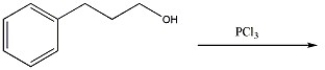

Free
(Essay)
4.8/5  (69)
(69) Correct Answer: Verified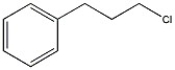
What is the major product of the following reaction? 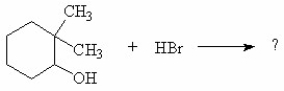
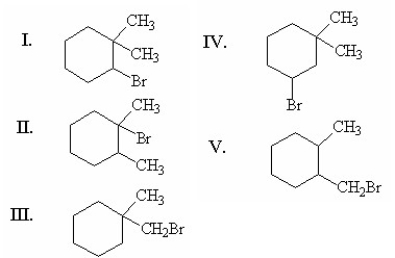
Free
(Multiple Choice)
4.9/5 (68)
(68) Correct Answer:Verified
VerifiedB
Why are alcohols typically poor electrophiles?
Free
(Essay)
4.8/5 (84)
(84) Correct Answer:Verified
VerifiedThe hydroxide ion, a relatively strong base, is a very poor leaving group.
Which of the following alcohols, when heated with H2SO4, will undergo dehydration more rapidly? Explain. 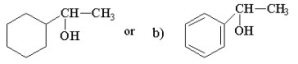
(Essay)
5.0/5 (88)
(88) A compound (A)C4H10O is optically active. (A)reacts with HCl and ZnCl2 (Lucas test)to form a cloudy product within 10 minutes. Deduce the structure of (A).
(Essay)
4.7/5 (65)
(65) Provide the structure of the major organic product in the reaction below. 
(Essay)
4.7/5 (66)
(66) 
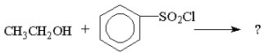
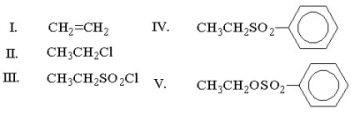
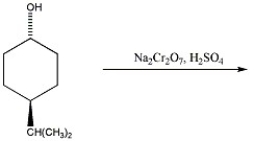
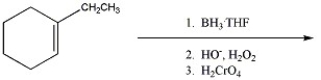
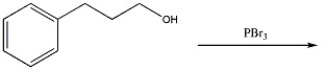
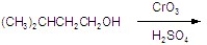
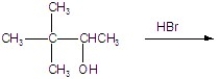
Provide the structure of the major organic product in the reaction below. 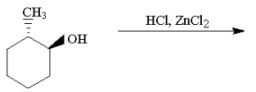
(Essay)
4.8/5 (87)
(87) Provide the sequence of reagents needed to carry out the following conversion.
CH3C  CH→ CH3CH2CH2CH2CH2OH
 (Essay)
4.9/5 (82)
(82) When (R)-2-butanol is treated with TsCl in pyridine, the product formed is ________.
(Multiple Choice)
4.9/5 (83)
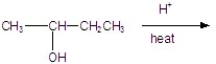
(83) 
Provide the structure of the major organic product of the following reaction. 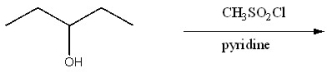
(Essay)
4.8/5 (76)
(76) Propose a detailed, step-by-step mechanism for the reaction pathway shown below. 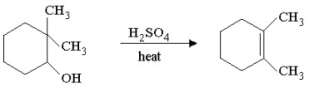
(Essay)
4.8/5 (92)
(92) Provide the structure of the major organic product of the following reaction. 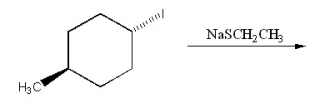
(Essay)
4.9/5 (94)
(94) 
Filters
- Essay(0)
- Multiple Choice(0)
- Short Answer(0)
- True False(0)
- Matching(0)