



 Chat with AI
Exam 22: Amino Acids, Peptides, and Proteins

Exam 1: Remembering General Chemistry: Electronic Structure and Bonding81 Questions
Exam 2: Acids and Bases: Central to Understanding Organic Chemistry37 Questions
Exam 3: An Introduction to Organic Compounds123 Questions
Exam 4: Isomers: the Arrangement of Atoms in Space111 Questions
Exam 5: Alkenes Thermodynamics and Kinetics76 Questions
Exam 6: Reactions of Alkenes93 Questions
Exam 7: Reactions of Alkynes Introduction to Multistep Synthesis119 Questions
Exam 8: Electron Delocalization, Resonance, and Aromaticity More About Molecular Orbital Theory166 Questions
Exam 9: Substitution Reactions of Alkyl Halides118 Questions
Exam 10: Elimination Reactions of Alkyl Halides Competition Between Substitution and Elimination94 Questions
Exam 11: Reactions of Alcohols, Ethers, Epoxides, and Sulfur-Containing Compounds100 Questions
Exam 12: Organometallic Compounds57 Questions
Exam 13: Reactions of Alkanes, Radicals130 Questions
Exam 14: Mass Spectrometry, Infrared Spectroscopy, and Uvvis Spectroscopy127 Questions
Exam 15: Nmr Spectroscopy110 Questions
Exam 16: Reactions of Carboxylic Acids and Carboxylic Acid Derivatives128 Questions
Exam 17: Reactions of Aldehydes and Ketones116 Questions
Exam 18: Reactions at the Alpha Carbon of Carbonyl Compounds113 Questions
Exam 19: Reactions of Benzene and Substituted Benzenes155 Questions
Exam 20: More About Amines Heterocylic Compounds115 Questions
Exam 21: Carbohydrates100 Questions
Exam 22: Amino Acids, Peptides, and Proteins105 Questions
Exam 23: Catalysis85 Questions
Exam 24: The Organic Mechanisms of the Coenzymes92 Questions
Exam 25: The Chemistry of Metabolism94 Questions
Exam 26: Nucleosides, Nucleotides, and Nucleic Acids85 Questions
Exam 27: Synthetic Polymers106 Questions
Exam 28: Pericyclic Reactions92 Questions
Select questions type


What is the product obtained from the mild oxidation of the thiol shown below? mild
2 R-SH 
(Multiple Choice)
4.9/5  (84)
(84) Rate the following amino acids in decreasing order of migration towards the cathode (negative electrode)when separated by electrophoresis in a solution of pH= 7.3.
I. lysine: pI= 9.87
II. alanine: pI= 6.02
III. aspartate: pI= 5.95
(Short Answer)
4.8/5 (68)
(68) Which type of protein, globular or fibrous, tends to function primarily as structural parts of an organism?
(Short Answer)
4.8/5 (81)
(81) Draw vertical lines through the peptide bonds in the decapeptide below that will be cleaved by cyanogen bromide.
Try-Ser-Ala-Met-Ser-Pro-Met-Gly-Gly-Asp
(Essay)
4.9/5 (83)
(83) Describe what a β-pleated sheet is and explain the difference between parallel and anti-parallel β-pleated sheets.
(Essay)
4.7/5 (70)
(70) Which of the following amino acids has a heterocyclic R group?
(Multiple Choice)
5.0/5 (79)
(79) Which of the following amino acids has the highest isoelectric point?
(Multiple Choice)
4.7/5 (77)
(77) Which of the following protein structures does denaturation destroy?
(Multiple Choice)
4.7/5 (92)
(92) Which of the following best represents the structure of an amino acid in basic solution (pH = 11)?
(Multiple Choice)
4.9/5 (84)
(84) Draw and name the amino acids which may be described as heterocyclic.
(Essay)
4.8/5 (72)
(72) Which of the following amino acids will be closest to the origin when separated by thin-layer chromatography? 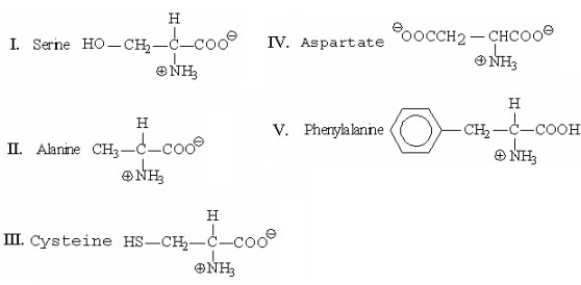
(Multiple Choice)
4.8/5 (70)
(70) The monomeric units that make up peptides and protein polymers are ________.
(Multiple Choice)
4.9/5 (73)
(73) 
Filters
- Essay(0)
- Multiple Choice(0)
- Short Answer(0)
- True False(0)
- Matching(0)