



 Chat with AI
Exam 15: Nmr Spectroscopy

Exam 1: Remembering General Chemistry: Electronic Structure and Bonding81 Questions
Exam 2: Acids and Bases: Central to Understanding Organic Chemistry37 Questions
Exam 3: An Introduction to Organic Compounds123 Questions
Exam 4: Isomers: the Arrangement of Atoms in Space111 Questions
Exam 5: Alkenes Thermodynamics and Kinetics76 Questions
Exam 6: Reactions of Alkenes93 Questions
Exam 7: Reactions of Alkynes Introduction to Multistep Synthesis119 Questions
Exam 8: Electron Delocalization, Resonance, and Aromaticity More About Molecular Orbital Theory166 Questions
Exam 9: Substitution Reactions of Alkyl Halides118 Questions
Exam 10: Elimination Reactions of Alkyl Halides Competition Between Substitution and Elimination94 Questions
Exam 11: Reactions of Alcohols, Ethers, Epoxides, and Sulfur-Containing Compounds100 Questions
Exam 12: Organometallic Compounds57 Questions
Exam 13: Reactions of Alkanes, Radicals130 Questions
Exam 14: Mass Spectrometry, Infrared Spectroscopy, and Uvvis Spectroscopy127 Questions
Exam 15: Nmr Spectroscopy110 Questions
Exam 16: Reactions of Carboxylic Acids and Carboxylic Acid Derivatives128 Questions
Exam 17: Reactions of Aldehydes and Ketones116 Questions
Exam 18: Reactions at the Alpha Carbon of Carbonyl Compounds113 Questions
Exam 19: Reactions of Benzene and Substituted Benzenes155 Questions
Exam 20: More About Amines Heterocylic Compounds115 Questions
Exam 21: Carbohydrates100 Questions
Exam 22: Amino Acids, Peptides, and Proteins105 Questions
Exam 23: Catalysis85 Questions
Exam 24: The Organic Mechanisms of the Coenzymes92 Questions
Exam 25: The Chemistry of Metabolism94 Questions
Exam 26: Nucleosides, Nucleotides, and Nucleic Acids85 Questions
Exam 27: Synthetic Polymers106 Questions
Exam 28: Pericyclic Reactions92 Questions
Select questions type


Deduce the identity of the following compound from the spectral data given.
C7H10O2: 1H NMR, δ 1.16 (3H, singlet), 2.21 (2H, singlet); 13C NMR, δ 216.25 (singlet), 52.57 (singlet), 34.51 (triplet), 20.22 (quartet)
(Short Answer)
4.8/5  (76)
(76) Deduce the identity of the following compound from the 1H NMR data given.
C8H10O: δ 3.4 (3H, singlet), 4.5 (2H, singlet), 7.2 (5H, singlet)
(Short Answer)
4.8/5 (82)
(82) How many distinct carbon signals are expected in the proton-decoupled 13C NMR spectrum of the compound below? 
(Short Answer)
4.9/5 (80)
(80) Give the splitting pattern for each proton in the 1H NMR spectrum. 
(Multiple Choice)
4.7/5 (78)
(78) Deduce the identity of the following compound from the spectral data given.
C4H8O2: 1H NMR, δ 1.23 (3H, triplet), 2.00 (3H, singlet), 4.02 (2H, quartet); IR, 2980, 1740 cm-1
(Essay)
4.8/5 (80)
(80) How many signals would you expect to see in the 1H NMR spectrum of the following compound? 
(Multiple Choice)
4.8/5 (75)
(75) Provide the structure that is consistent with the data below.
C6H10
IR (cm-1): 2950, 2230
1H NMR (d): 2.0 (1H, septet), 1.8 (3H, s), 0.9 (6H, d)
13C NMR (d): 78 (s), 72 (s), 45 (d), 18 (q), 15 (q)
(Essay)
4.7/5 (80)
(80) An unknown compound, C9H12, gave the following NMR spectrum: Triplet at 1.21 ppm (3H)Singlet at 2.30 ppm (3H)Quartet at 2.60 ppm (2H)Singlet at 7.04 ppm (4H)
What is the structure of the compound? 
(Multiple Choice)
4.9/5 (67)
(67) Which of the following compounds gives the highest chemical shift value (farthest downfield)in the NMR spectrum? 
(Multiple Choice)
4.8/5 (68)
(68) Give the integration and splitting pattern for the indicated signals in the 1H NMR spectrum. 
(Multiple Choice)
4.8/5 (83)
(83) Predict the number of signals expected, their splitting, and their relative area in the 1H NMR spectrum of (CH3)3CCHO.
(Short Answer)
4.8/5 (67)
(67) Predict the integration for each proton in the 1H NMR spectrum. 
(Multiple Choice)
4.9/5 (65)
(65) Mark with an asterisk each carbon that would not produce a signal in the DEPT 13C NMR spectrum of the compound below. 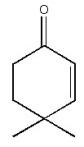
(Essay)
5.0/5 (92)
(92) Which of the following technique(s)can readily distinguish between:  ?
? (Multiple Choice)
5.0/5 (84)
(84) Deduce the identity of the following compound from the spectral data given.
C9H12 : 13C NMR, δ 21.3 (quartet), 127.2 (doublet), 138.0 (singlet)(ppm)
(Short Answer)
4.8/5 (74)
(74) Which of the following compounds has a triplet at 9.8 in its 1H NMR spectrum? 
(Essay)
4.7/5 (83)
(83) Deduce the identity of the following compound from the 1H NMR spectral data given.
C9H10O2 : δ 2.2 (3H, singlet), 5.0 (2H, singlet), 7.2 (5H, multilet)(ppm)
(Essay)
4.8/5 (78)
(78) Give the structurre for the compound that has a formula of C11H16O and the following 1H NMR and 13C NMR spectra. Label the hydrogens and the carbons.
1H NMR spectrum: 1.3 ppm, (d, 6H); 3.1 ppm (sept, 1H); 3.2 ppm (s, 3H); 4.6 ppm (s, 2H), 7.1 ppm (d, 2H), 7.1 ppm (d, 2H)
13C NMR spectrum: 24.4 ppm (CH3); 31.7 ppm (CH); 53.5 ppm (CH3); 77.9 ppm (CH2); 126.2 ppm (CH); 127.3 ppm (CH); 134.4 ppm (C); and 147.8 ppm (C).
(Essay)
4.8/5 (79)
(79) The chair form of cyclohexane has protons in two distinct environments, axial and equatorial. When the proton NMR of cyclohexane is run on a 100 MHz instrument at 23°C, only one signal for the compound is observed. Explain this apparent contradiction.
(Essay)
4.9/5 (72)
(72) How many signals would you expect to see in the 1H NMR spectrum of the following compound? 
(Multiple Choice)
4.7/5 (81)
(81) 
Filters
- Essay(0)
- Multiple Choice(0)
- Short Answer(0)
- True False(0)
- Matching(0)