



 Chat with AI
Exam 15: Nmr Spectroscopy

Exam 1: Remembering General Chemistry: Electronic Structure and Bonding81 Questions
Exam 2: Acids and Bases: Central to Understanding Organic Chemistry37 Questions
Exam 3: An Introduction to Organic Compounds123 Questions
Exam 4: Isomers: the Arrangement of Atoms in Space111 Questions
Exam 5: Alkenes Thermodynamics and Kinetics76 Questions
Exam 6: Reactions of Alkenes93 Questions
Exam 7: Reactions of Alkynes Introduction to Multistep Synthesis119 Questions
Exam 8: Electron Delocalization, Resonance, and Aromaticity More About Molecular Orbital Theory166 Questions
Exam 9: Substitution Reactions of Alkyl Halides118 Questions
Exam 10: Elimination Reactions of Alkyl Halides Competition Between Substitution and Elimination94 Questions
Exam 11: Reactions of Alcohols, Ethers, Epoxides, and Sulfur-Containing Compounds100 Questions
Exam 12: Organometallic Compounds57 Questions
Exam 13: Reactions of Alkanes, Radicals130 Questions
Exam 14: Mass Spectrometry, Infrared Spectroscopy, and Uvvis Spectroscopy127 Questions
Exam 15: Nmr Spectroscopy110 Questions
Exam 16: Reactions of Carboxylic Acids and Carboxylic Acid Derivatives128 Questions
Exam 17: Reactions of Aldehydes and Ketones116 Questions
Exam 18: Reactions at the Alpha Carbon of Carbonyl Compounds113 Questions
Exam 19: Reactions of Benzene and Substituted Benzenes155 Questions
Exam 20: More About Amines Heterocylic Compounds115 Questions
Exam 21: Carbohydrates100 Questions
Exam 22: Amino Acids, Peptides, and Proteins105 Questions
Exam 23: Catalysis85 Questions
Exam 24: The Organic Mechanisms of the Coenzymes92 Questions
Exam 25: The Chemistry of Metabolism94 Questions
Exam 26: Nucleosides, Nucleotides, and Nucleic Acids85 Questions
Exam 27: Synthetic Polymers106 Questions
Exam 28: Pericyclic Reactions92 Questions
Select questions type


What type of 2-D NMR spectrum indicates which carbon atoms are coupled to which hydrogen atoms?
(Multiple Choice)
4.9/5  (86)
(86) An unknown compound, C3H5Cl3, gave the following proton NMR data:
Doublet at 1.70 ppm (3H)
Multiplet at 4.32 ppm (1H)
Doublet at 5.85 ppm (1H)
What is the structure of the compound?
(Essay)
4.8/5 (72)
(72) Provide the structure that is consistent with the data below.
C4H8O
IR (cm-1): 2950
1H NMR (δ): 3.5 (4H, d), 1.6 (1H, m), 1.0 (3H, d)
13C NMR (δ): 62 (t), 35 (d), 15 (q)
(Essay)
5.0/5 (66)
(66) How many signals would you expect to see in the 1H NMR spectrum of the following compound? 
(Multiple Choice)
4.8/5 (78)
(78) Deduce the identity of the following compound from the 1H NMR spectral data given.
C3H3Cl5 : δ 4.5 (1H, triplet), 6.1 (2H, doublet)(ppm)
(Short Answer)
5.0/5 (85)
(85) Which of the following methyl groups will exhibit the most downfield (highest)chemical shift in 1H NMR spectroscopy? 
(Multiple Choice)
4.8/5 (81)
(81) Deduce the identity of the following compound from the spectral data given.
C4H6O2 : 1H NMR, δ 2.28 (2H, multiplet), 2.50 (2H, triplet), 4.35 (2H, triplet); 13C NMR, δ 177.81 (singlet), 68.58 (triplet), 27.70 (triplet), 22.17 (triplet)(ppm)
(Short Answer)
4.7/5 (77)
(77) H-H coupling is observed in the 1H NMR spectrum of CH3CH2OCH3 and the signal from the methylene H's does not appear as a single peak. How does this signal appear? Explain in detail what is occurring.
(Essay)
4.7/5 (89)
(89) Provide the structure that is consistent with the data below.
C5H12O
IR (cm-1): 3200-3600 (broad), 2950
1H NMR (δ): 3.4 (2H, s), 2.9 (1H, broad s), 0.9 (9H, s)
13C NMR (δ): 64 (t), 39 (s), 14 (q)
(Essay)
4.9/5 (81)
(81) Predict the splitting pattern in the proton coupled 13C NMR spectrum for the following compound. 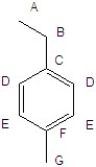
(Multiple Choice)
4.8/5 (84)
(84) If two signals differ by 3 ppm, how do they differ in Hertz in a 60 MHz spectrometer?
(Multiple Choice)
4.8/5 (93)
(93) Predict the number of signals expected, their splitting, and their relative area in the 1H NMR spectrum of 1,2-dichloroethane (ClCH2CH2Cl).
(Short Answer)
4.8/5 (65)
(65) Which of the following compounds has a signal disappear when D2O is added to it, ethyl alcohol or ethyl chloride?
(Essay)
4.9/5 (76)
(76) What is indicated by a cross peak in the COSY spectrum of a compound?
(Essay)
4.8/5 (78)
(78) How many distinct triplets would you expect in the 1H NMR of the compound below? 
(Multiple Choice)
4.8/5 (69)
(69) Provide the structure that is consistent with the data below.
C6H11N
IR (cm-1): 2950, 2230
1H NMR (δ): 1.7 (quintet, 1H), 1.2 (m, 4H), 0.9 (t, 6H)
13C NMR (δ): 95 (s), 45 (d), 25 (t), 18 (q)
(Essay)
4.8/5 (71)
(71) What is the ratio of the protons in the following compound? 
(Multiple Choice)
4.8/5 (72)
(72) Predict the number of signals expected, their splitting, and their relative area in the 1H NMR spectrum of CH3CH2OCH3.
(Essay)
5.0/5 (65)
(65) Give the structure of a compound that has a formula of C5H10O2, and has a triplet (3H, 1.1 ppm), sextet (2H, 1.8 ppm), triplet (2H, 2.3 ppm)and a singlet (3H, 3.8 ppm)in the 1H NMR spectrum.
(Multiple Choice)
4.8/5 (78)
(78) Deduce the identity of the compound from the data provided. C7H12: IR (cm-1): 3300, 2950, 2220; 13C NMR: 5 signals
(Multiple Choice)
4.8/5 (87)
(87) 
Filters
- Essay(0)
- Multiple Choice(0)
- Short Answer(0)
- True False(0)
- Matching(0)