



 Chat with AI
Exam 20: Dienes, Conjugated Systems, and Pericyclic Reactions

Exam 1: Covalent Bonding and Shapes of Molecules115 Questions
Exam 2: Alkanes and Cycloalkanes95 Questions
Exam 3: Stereoisomerism and Chirality93 Questions
Exam 4: Acids and Bases94 Questions
Exam 5: Alkenes: Bonding, Nomenclature, and Properties86 Questions
Exam 6: Reactions of Alkenes98 Questions
Exam 7: Alkynes100 Questions
Exam 8: Haloalkanes, Halogenation, and Radical Reactions76 Questions
Exam 9: Nucleophilic Substitution and Beta-Elimination111 Questions
Exam 10: Alcohols98 Questions
Exam 11: Ethers, Epoxides, and Sulfides93 Questions
Exam 12: Infrared Spectroscopy67 Questions
Exam 13: Nuclear Magnetic Resonance Spectroscopy102 Questions
Exam 14: Mass Spectrometry65 Questions
Exam 15: An Introduction to Organometallic Compounds66 Questions
Exam 16: Aldehydes and Ketones119 Questions
Exam 17: Carboxylic Acids71 Questions
Exam 18: Functional Derivatives of Carboxylic Acids112 Questions
Exam 19: Enolate Anions and Enamines93 Questions
Exam 20: Dienes, Conjugated Systems, and Pericyclic Reactions69 Questions
Exam 21: Benzene and the Concept of Aromaticity85 Questions
Exam 22: Reactions of Benzene and Its Derivatives107 Questions
Exam 23: Amines88 Questions
Exam 24: Catalytic Carbon-Carbon Bond Formation77 Questions
Exam 25: Carbohydrates60 Questions
Exam 26: Lipids54 Questions
Exam 27: Amino Acids and Proteins70 Questions
Exam 28: Nucleic Acids52 Questions
Exam 29: Organic Polymer Chemistry60 Questions
Select questions type


What is the systematic IUPAC name of the following compound? 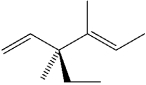
(Multiple Choice)
4.8/5  (77)
(77) What are the two major organic products obtained from the following reaction? 
(Essay)
4.8/5 (77)
(77) Which of 1,3-cyclohexadiene and 1,4-cyclohexadiene has the greatest heat of hydrogenation (i.e., the most exothermic reaction with H2 in the presence of a catalyst). Provide a brief explanation for your choice ?
(Essay)
4.9/5 (81)
(81) Consider the following structure. 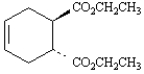 This substance could be produced by the reaction of the following diene and dienophile.
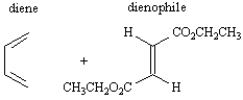
This substance could be produced by the reaction of the following diene and dienophile. (True/False)
4.8/5 (82)
(82) Consider the reaction below to answer the following question(s): 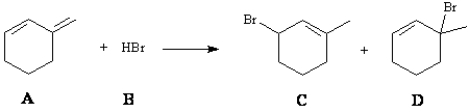 Enter the appropriate letter in the blank for each the following statements.
-The electrophile in this reaction is ____.
Enter the appropriate letter in the blank for each the following statements.
-The electrophile in this reaction is ____. (Multiple Choice)
4.8/5 (93)
(93) Draw two resonance structures of the reactive intermediate that accounts for the formation of 1,2- and 1,4-addition products upon reaction of 1,3-butadiene with one equivalent of HBr.
(Essay)
4.8/5 (67)
(67) When an organic molecule is irradiated with ultraviolet radiation, the energy absorbed by the molecule corresponds to the amount necessary to excite electrons from one molecular orbital to another.
(True/False)
4.9/5 (97)
(97) Which of the following reaction coordinate diagrams explains the formation of different thermodynamic (T) and kinetic products from the same reactants (R)? 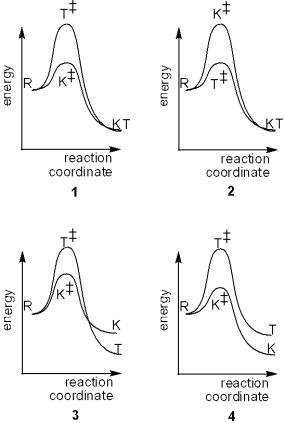
(Multiple Choice)
4.8/5 (71)
(71) Draw two resonance structures of the reactive intermediate that accounts for the formation of 1,2- and 1,4-addition products upon reaction of 1,3-butadiene with one equivalent of bromine.
(Essay)
4.7/5 (88)
(88) Which of the following electronic transitions is (are) apparent in the ultraviolet-visible spectrum of acrolein, H2C=CHCHO?
1)n *
2) *
3) *
(Multiple Choice)
5.0/5 (85)
(85) Provide the structures of the constitutional isomers of the two major organic products obtained from the following reaction? 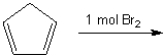
(Essay)
4.9/5 (86)
(86) What is the correct order of exothermicity for hydrogenation of the following hexadienes upon treatment with H2/Pd (more exothermic > less exothermic)? 
(Multiple Choice)
4.7/5 (82)
(82) Which of the following energy diagrams represents the electronic state of the ground state of 1,3-butadiene? 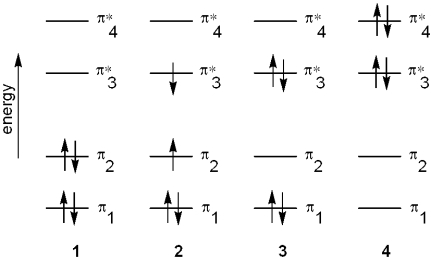
(Multiple Choice)
5.0/5 (83)
(83) Which of the following laws relates absorbance to the concentration of a sample and the pathlength in ultraviolet-visible spectroscopy?
(Multiple Choice)
4.9/5 (79)
(79) The following two compounds could be easily distinguished by NMR, IR, UV or MS spectra. 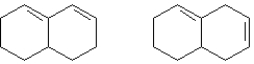
(True/False)
4.8/5 (84)
(84) What are the units of absorbance, A, in ultraviolet-visible spectroscopy?
(Multiple Choice)
4.9/5 (65)
(65) 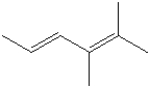
What quantity is abbreviated as in ultraviolet-visible spectroscopy?
(Multiple Choice)
4.9/5 (85)
(85) The following compound could act as a diene in a Diels-Alder reaction. 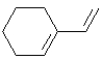
(True/False)
4.9/5 (71)
(71) Which of the following is(are) formed upon addition of 1 mol of Br2 to 1,3-cyclohexane? 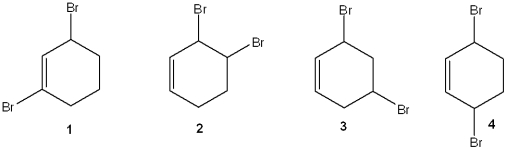
(Multiple Choice)
4.9/5 (60)
(60) 
Filters
- Essay(0)
- Multiple Choice(0)
- Short Answer(0)
- True False(0)
- Matching(0)