



 Chat with AI
Exam 20: Dienes, Conjugated Systems, and Pericyclic Reactions

Exam 1: Covalent Bonding and Shapes of Molecules115 Questions
Exam 2: Alkanes and Cycloalkanes95 Questions
Exam 3: Stereoisomerism and Chirality93 Questions
Exam 4: Acids and Bases94 Questions
Exam 5: Alkenes: Bonding, Nomenclature, and Properties86 Questions
Exam 6: Reactions of Alkenes98 Questions
Exam 7: Alkynes100 Questions
Exam 8: Haloalkanes, Halogenation, and Radical Reactions76 Questions
Exam 9: Nucleophilic Substitution and Beta-Elimination111 Questions
Exam 10: Alcohols98 Questions
Exam 11: Ethers, Epoxides, and Sulfides93 Questions
Exam 12: Infrared Spectroscopy67 Questions
Exam 13: Nuclear Magnetic Resonance Spectroscopy102 Questions
Exam 14: Mass Spectrometry65 Questions
Exam 15: An Introduction to Organometallic Compounds66 Questions
Exam 16: Aldehydes and Ketones119 Questions
Exam 17: Carboxylic Acids71 Questions
Exam 18: Functional Derivatives of Carboxylic Acids112 Questions
Exam 19: Enolate Anions and Enamines93 Questions
Exam 20: Dienes, Conjugated Systems, and Pericyclic Reactions69 Questions
Exam 21: Benzene and the Concept of Aromaticity85 Questions
Exam 22: Reactions of Benzene and Its Derivatives107 Questions
Exam 23: Amines88 Questions
Exam 24: Catalytic Carbon-Carbon Bond Formation77 Questions
Exam 25: Carbohydrates60 Questions
Exam 26: Lipids54 Questions
Exam 27: Amino Acids and Proteins70 Questions
Exam 28: Nucleic Acids52 Questions
Exam 29: Organic Polymer Chemistry60 Questions
Select questions type


What is (are) the major organic product(s) formed in the following reaction? 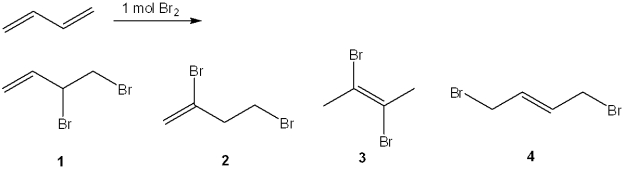
(Multiple Choice)
4.8/5  (76)
(76) Electrophilic addition reaction of conjugated dienes that occur at high temperature and/or long reaction times (reversible conditions) are said to be under kinetic control.
(True/False)
4.8/5 (73)
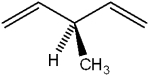
(73) 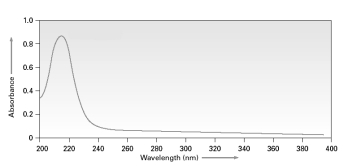
Which of the following electronic transitions is apparent in the ultraviolet-visible spectrum of 1,3-butadiene?
(Multiple Choice)
4.8/5 (72)
(72) Which of the following is not a major organic product obtained from the addition of 1 mole of bromine to (E)-1,3-pentadiene?
(Multiple Choice)
4.9/5 (69)
(69) Sigmatropic shifts, cycloaddition reactions and anuulation reactions are all examples of pericyclic reactions.
(True/False)
4.8/5 (76)
(76) For a diene to undergo a Diels-Alder reaction it must be able to adopt an s-trans conformation.
(True/False)
4.9/5 (68)
(68) What is (are) the major organic product(s) formed in the following reaction? 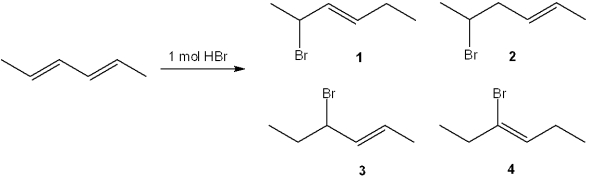
(Multiple Choice)
4.7/5 (95)
(95) 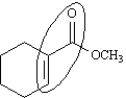
What is the thermodynamic product obtained from the addition of 1 mole of bromine to 1,3-butadiene?
(Multiple Choice)
4.9/5 (79)
(79) Consider the reaction below to answer the following question(s): 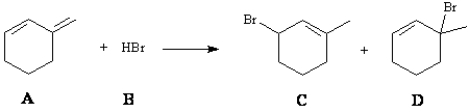 Enter the appropriate letter in the blank for each the following statements.
-The product that results from 1,4-addition is _____.
Enter the appropriate letter in the blank for each the following statements.
-The product that results from 1,4-addition is _____. (Multiple Choice)
4.7/5 (79)
(79) For Diels-Alder cycloaddition reactions to take place most rapidly and in highest yield a dienophile must be substituted with electron-donating groups.
(True/False)
4.9/5 (78)
(78) What is the major organic product obtained from the following reaction? 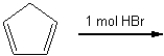
(Essay)
4.8/5 (87)
(87) Consider the reaction below to answer the following question(s). 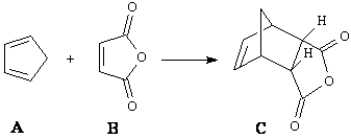 Fill in the blank in the question with the appropriate letter.
-The dienophile in the reaction is ____.
Fill in the blank in the question with the appropriate letter.
-The dienophile in the reaction is ____. (Multiple Choice)
4.8/5 (72)
(72) What is (are) the major organic product(s) formed in the following reaction? 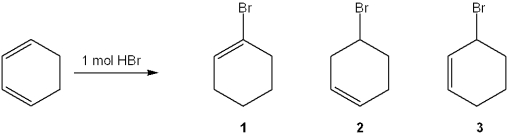
(Multiple Choice)
4.9/5 (85)
(85) Consider the reaction below to answer the following question(s): Enter the appropriate letter in the blank for each the following statements.
-Based on the following table.
Compound
max (nm)
W
190
X
340
Y
560
Z
250
Compound ______ has the largest energy difference between the HOMO and LUMO.
Enter the appropriate letter in the blank for each the following statements.
-Based on the following table.
Compound
max (nm)
W
190
X
340
Y
560
Z
250
Compound ______ has the largest energy difference between the HOMO and LUMO. (Short Answer)
4.9/5 (68)
(68) Which of the following energy diagrams represents the electronic state of butadiene after absorption of radiation? 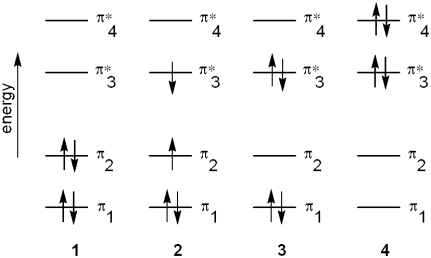
(Multiple Choice)
4.8/5 (68)
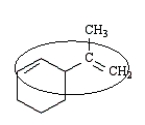
(68) 
What are the units of max in ultraviolet-visible spectroscopy?
(Multiple Choice)
4.8/5 (53)
(53) 
Filters
- Essay(0)
- Multiple Choice(0)
- Short Answer(0)
- True False(0)
- Matching(0)