



 Chat with AI
Exam 12: Infrared Spectroscopy

Exam 1: Covalent Bonding and Shapes of Molecules115 Questions
Exam 2: Alkanes and Cycloalkanes95 Questions
Exam 3: Stereoisomerism and Chirality93 Questions
Exam 4: Acids and Bases94 Questions
Exam 5: Alkenes: Bonding, Nomenclature, and Properties86 Questions
Exam 6: Reactions of Alkenes98 Questions
Exam 7: Alkynes100 Questions
Exam 8: Haloalkanes, Halogenation, and Radical Reactions76 Questions
Exam 9: Nucleophilic Substitution and Beta-Elimination111 Questions
Exam 10: Alcohols98 Questions
Exam 11: Ethers, Epoxides, and Sulfides93 Questions
Exam 12: Infrared Spectroscopy67 Questions
Exam 13: Nuclear Magnetic Resonance Spectroscopy102 Questions
Exam 14: Mass Spectrometry65 Questions
Exam 15: An Introduction to Organometallic Compounds66 Questions
Exam 16: Aldehydes and Ketones119 Questions
Exam 17: Carboxylic Acids71 Questions
Exam 18: Functional Derivatives of Carboxylic Acids112 Questions
Exam 19: Enolate Anions and Enamines93 Questions
Exam 20: Dienes, Conjugated Systems, and Pericyclic Reactions69 Questions
Exam 21: Benzene and the Concept of Aromaticity85 Questions
Exam 22: Reactions of Benzene and Its Derivatives107 Questions
Exam 23: Amines88 Questions
Exam 24: Catalytic Carbon-Carbon Bond Formation77 Questions
Exam 25: Carbohydrates60 Questions
Exam 26: Lipids54 Questions
Exam 27: Amino Acids and Proteins70 Questions
Exam 28: Nucleic Acids52 Questions
Exam 29: Organic Polymer Chemistry60 Questions
Select questions type


Which of the following carbon-carbon bonds undergoes stretching at the highest frequency?
(Multiple Choice)
4.9/5  (73)
(73) Which of the following bonds gives the weakest peak in the infrared spectrum for a stretching vibration? 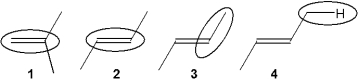
(Multiple Choice)
4.9/5 (85)
(85) MATCH each of the following groups of bond-types to the region of the infrared spectrum in which their absorptions occur. Place the letter of the region in the blank to the left of the bond-type.
-_____ C-C, C-O, C-N, and C-X single-bond vibrations.
(Multiple Choice)
4.8/5 (83)
(83) Which of the following functional groups is likely to be present in a molecule that has peaks in the infrared spectrum at 1630-1820 cm-1 (strong, broad), but does not have peaks at 3200-3650 or 1000-1250 cm-1
(Multiple Choice)
4.7/5 (71)
(71) The region of the IR spectrum between 1500 - 400 cm-1 would be significantly different for the following two substances? 
(True/False)
4.9/5 (70)
(70) Provide the structure of four compounds with the molecular formula C5H10O which give a strong absorption peak at 1700-1740 cm-1 in the infrared spectrum, but no significant peaks at 1600-1640 cm-1 .
(Essay)
4.9/5 (83)
(83) MATCH each of the following groups of bond-types to the region of the infrared spectrum in which their absorptions occur. Place the letter of the region in the blank to the left of the bond-type.
-_____ C=O, C=N, and C=C bond absorptions.
(Multiple Choice)
4.8/5 (72)
(72) MATCH a structure from the list below to the following IR spectra. Place the letter of the structure in the blank provided.
-_____ 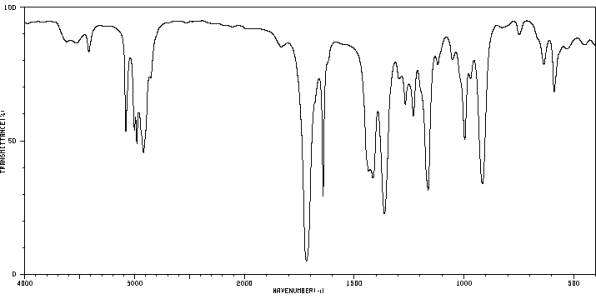 Spectrum obtained from: SDBSWeb: http://www.aist.go.jp/RIODB/SDBS/
 (Multiple Choice)
4.8/5 (78)
(78) An IR spectrum of an unknown organic molecule having the formula which contains carbon, hydrogen, and oxygen reveals a strong absorption at 1715-1725 cm-1. This molecule is most likely an ether.
(True/False)
4.7/5 (86)
(86) Which of the following bonds (circled) gives a very weak or no stretching absorption in the infrared spectrum? 
(Multiple Choice)
4.9/5 (81)
(81) What is required for a bond to give an infrared absorption?
(Multiple Choice)
4.7/5 (84)
(84) Provide a brief explanation to account for the observation that 1-butyne gives a significantly stronger peak at ~1250 cm-1 in the infrared spectrum than 2-butyne..
(Essay)
4.8/5 (76)
(76) he amount of energy in infrared light corresponds to the amount of energy needed to increase certain molecular motions, such as bond vibrations, in organic molecules.
(True/False)
4.9/5 (85)
(85) Which of the following compounds gives a carbonyl bond absorption at the highest frequency? 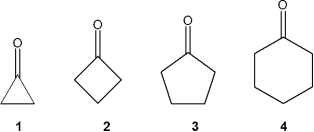
(Multiple Choice)
4.8/5 (85)
(85) In terms of the electromagnetic spectrum, 2870 cm-1represents lower energy than 2.91 * 1016 Hz.
(True/False)
4.8/5 (82)
(82) Which of the following regions in the electromagnetic spectrum corresponds to the radiation with the longest wavelength?
(Multiple Choice)
4.8/5 (84)
(84) Which of the following bonds gives rise to a medium strength absorbance at approximately 1600-1680 cm-1 in the infrared spectrum?
(Multiple Choice)
4.9/5 (79)
(79) Provide a brief explanation to account for the observation that the frequency of the C=O stretching absorption in the infrared spectrum of N,N-dimethylacetamide, CH3CON(CH3)2, is higher than that of methyl acetate, CH3CO2CH3.
(Essay)
4.9/5 (80)
(80) Provide a brief explanation to account for the observation that the frequency of the C=O stretching absorption in the infrared spectrum of 2-butanone is higher than that of 3-buten-2-one.
(Essay)
4.8/5 (76)
(76) Which of the following regions in the electromagnetic spectrum corresponds to the radiation with the highest energy?
(Multiple Choice)
4.9/5 (73)
(73) 
Filters
- Essay(0)
- Multiple Choice(0)
- Short Answer(0)
- True False(0)
- Matching(0)