



 Chat with AI
Exam 12: Infrared Spectroscopy

Exam 1: Covalent Bonding and Shapes of Molecules115 Questions
Exam 2: Alkanes and Cycloalkanes95 Questions
Exam 3: Stereoisomerism and Chirality93 Questions
Exam 4: Acids and Bases94 Questions
Exam 5: Alkenes: Bonding, Nomenclature, and Properties86 Questions
Exam 6: Reactions of Alkenes98 Questions
Exam 7: Alkynes100 Questions
Exam 8: Haloalkanes, Halogenation, and Radical Reactions76 Questions
Exam 9: Nucleophilic Substitution and Beta-Elimination111 Questions
Exam 10: Alcohols98 Questions
Exam 11: Ethers, Epoxides, and Sulfides93 Questions
Exam 12: Infrared Spectroscopy67 Questions
Exam 13: Nuclear Magnetic Resonance Spectroscopy102 Questions
Exam 14: Mass Spectrometry65 Questions
Exam 15: An Introduction to Organometallic Compounds66 Questions
Exam 16: Aldehydes and Ketones119 Questions
Exam 17: Carboxylic Acids71 Questions
Exam 18: Functional Derivatives of Carboxylic Acids112 Questions
Exam 19: Enolate Anions and Enamines93 Questions
Exam 20: Dienes, Conjugated Systems, and Pericyclic Reactions69 Questions
Exam 21: Benzene and the Concept of Aromaticity85 Questions
Exam 22: Reactions of Benzene and Its Derivatives107 Questions
Exam 23: Amines88 Questions
Exam 24: Catalytic Carbon-Carbon Bond Formation77 Questions
Exam 25: Carbohydrates60 Questions
Exam 26: Lipids54 Questions
Exam 27: Amino Acids and Proteins70 Questions
Exam 28: Nucleic Acids52 Questions
Exam 29: Organic Polymer Chemistry60 Questions
Select questions type


Label three peaks in the following spectrum with the bond that gives rise to them, and identify the functional group that is present in the compound (the compound has a formula of C5H10O2)? 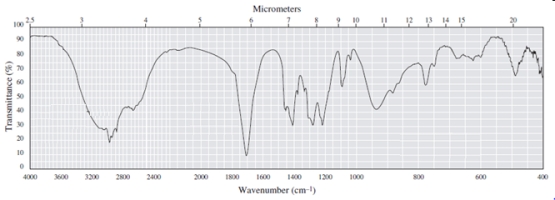
(Essay)
4.8/5  (73)
(73) Which of the following compounds gives an infrared spectrum with a peak at ~1750 cm-1, but no significant peaks at 3000-3500 cm-1 or 1050-1250 cm-1? 
(Multiple Choice)
4.9/5 (71)
(71) Which of the following functional groups is likely to be present in a molecule that has peaks in the infrared spectrum at 1630-1820 cm-1 (strong, broad) and 1000-1250 cm-1; but does not have peaks at 3200-3650 cm-1?
(Multiple Choice)
4.8/5 (73)
(73) Which of the following compounds gives an infrared spectrum with peaks at 1000-1250 cm-1 (strong), but does not have peaks at 3200-3650 or 1630-1820 cm-1 (sharp, weak peak)? 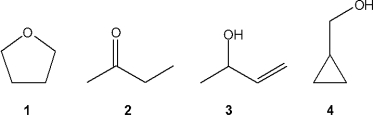
(Multiple Choice)
4.9/5 (87)
(87) Which of the following bonds gives rise to an absorbance at approximately 2700-3300 cm-11 in the infrared spectrum?
(Multiple Choice)
4.8/5 (82)
(82) Which of the following compounds gives a carbonyl bond absorption at the highest frequency? 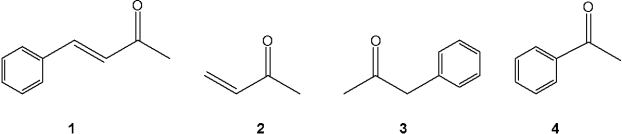
(Multiple Choice)
4.8/5 (90)
(90) MATCH a structure from the list below to the following IR spectra. Place the letter of the structure in the blank provided.
-_____ 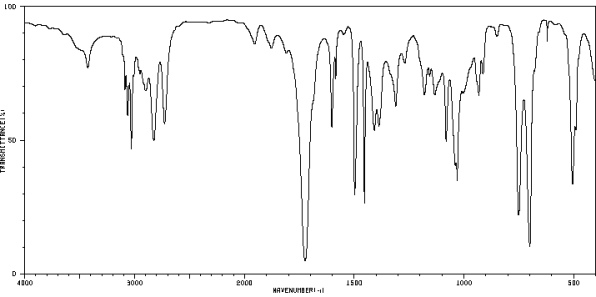 Spectrum obtained from: SDBSWeb: http://www.aist.go.jp/RIODB/SDBS/
 (Multiple Choice)
4.7/5 (89)
(89) The radio wave region of the electromagnetic spectrum would have sufficient energy to produce the following energy transition. 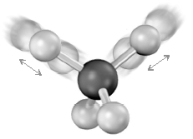
(True/False)
4.8/5 (80)
(80) Label three peaks in the following spectrum with the bond that gives rise to them, and identify the functional group that is present in the compound (the compound has a formula of C6H14O)? 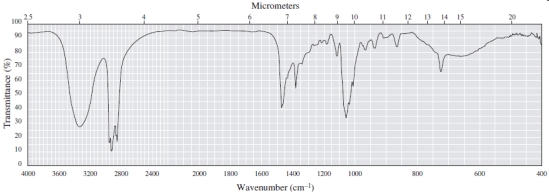
(Essay)
4.9/5 (85)
(85) Which of the following relationships is not valid as applied to infrared spectroscopy?
(Multiple Choice)
4.8/5 (78)
(78) Which of the following compounds gives an infrared spectrum with peaks at 3300 cm-1 (sharp peak) and 2150 cm-1 (sharp peak)? 
(Multiple Choice)
4.7/5 (78)
(78) Examining the infrared spectrum of a compound allows us to determine the nature of the conjugated pi electron system in the compound.
(True/False)
4.7/5 (65)
(65) The vertical axis on an IR spectrum represents the percent transmission and the horizontal axis measures frequency (wavenumber).
(True/False)
4.7/5 (66)
(66) Which of the following compounds gives an infrared spectrum with a peak in the range of 1630-1820 cm-1 (strong peak), but does not have peaks at 3200-3650 or 1000-1250 cm-1? 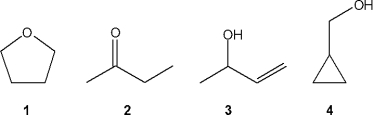
(Multiple Choice)
4.8/5 (80)
(80) What are the units of wavenumber,  , in infrared spectroscopy?
 (Multiple Choice)
4.9/5 (77)
(77) Which of the following compounds gives a carbonyl bond absorption at the lowest frequency? 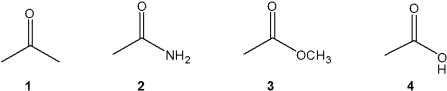
(Multiple Choice)
4.7/5 (86)
(86) What range of wavelengths corresponds to the infrared region of the electromagnetic spectrum?
(Multiple Choice)
4.9/5 (81)
(81) Assume you are carrying out the conversion of 1-bromobutane to 1-butanol. How could you use IR spectroscopy to determine when the reaction is complete?  As the reaction progress the 3400-3640 cm-1IR band should increase in intensity.
 (True/False)
4.8/5 (77)
(77) Which of the following compounds does not give an infrared spectrum with peak at ~1750 cm-1? 
(Multiple Choice)
4.9/5 (72)
(72) 
Filters
- Essay(0)
- Multiple Choice(0)
- Short Answer(0)
- True False(0)
- Matching(0)