



 Chat with AI
Exam 19: Chemical Thermodynamics

Exam 1: Introduction: Matter and Measurement163 Questions
Exam 2: Atoms, Molecules, and Ions250 Questions
Exam 3: Stoichiometry: Calculations With Chemical Formulas and Equations178 Questions
Exam 4: Aqueous Reactions and Solution Stoichiometry180 Questions
Exam 5: Thermochemistry154 Questions
Exam 6: Electronic Structure of Atoms186 Questions
Exam 7: Periodic Properties of the Elements176 Questions
Exam 8: Basic Concepts of Chemical Bonding147 Questions
Exam 9: Molecular Geometry and Bonding Theories183 Questions
Exam 10: Gases175 Questions
Exam 11: Liquids and Intermolecular Forces124 Questions
Exam 12: Solids and Modern Materials84 Questions
Exam 13: Properties of Solutions160 Questions
Exam 14: Chemical Kinetics134 Questions
Exam 15: Chemical Equilibrium97 Questions
Exam 16: Acid-Base Equilibria139 Questions
Exam 17: Additional Aspects of Aqueous Equilibria116 Questions
Exam 18: Chemistry of the Environment126 Questions
Exam 19: Chemical Thermodynamics125 Questions
Exam 20: Electrochemistry114 Questions
Exam 21: Nuclear Chemistry178 Questions
Exam 22: Chemistry of the Nonmetals194 Questions
Exam 23: Transition Metals and Coordination Chemistry165 Questions
Exam 24: The Chemistry of Life: Organic and Biological Chemistry131 Questions
Select questions type


Which one of the following processes produces a decrease of the entropy of the system?
(Multiple Choice)
4.9/5  (81)
(81) Consider the reaction: Ag+ (aq) + Cl- (aq) → AgCl (s)
Given the following table of thermodynamic data at 298 K: 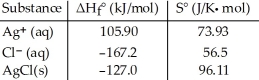 The value of K for the reaction at 25 °C is ________.
 (Multiple Choice)
4.8/5 (83)
(83) The value of ΔS° for the decomposition of gaseous sulfur dioxide to solid elemental sulfur and gaseous oxygen, SO2 (g) → S (s, rhombic) + O2 (g)
Is ________ J/K ∙ mol.
(Multiple Choice)
4.8/5 (66)
(66) The value of ΔG° at 181.0 °C for the formation of calcium chloride from its constituent elements: Ca (s)+ Cl2 (g) → CaCl2 (s)
Is ________ kJ/mol. At 25.0 °C for this reaction, ΔH° is -795.8 kJ/mol, ΔG° is -748.1 kJ/mol, and ΔS° is -159.8 J/K.
(Multiple Choice)
4.8/5 (83)
(83) For the reaction C(s) + H2O(g) → CO(g) + H2(g)
ΔH° = 133.3 kJ/mol and ΔS° = 121.6 J/K ∙ mol at 298 K. At temperatures greater than ________ °C this reaction is spontaneous under standard conditions.
(Multiple Choice)
4.8/5 (84)
(84) For a given reaction with ΔH = -28.1 kJ/mol, the ΔG = 0 at 372 K. The value of ΔS must be ________ J/K-mol, assuming that ΔH and ΔS do not vary with temperature.
(Multiple Choice)
4.8/5 (80)
(80) Find the temperature (in K)above which a reaction with a ΔH of 53.00 kJ/mol and a ΔS of 100.0 J/K ∙ mol becomes spontaneous.
(Short Answer)
4.9/5 (81)
(81) The combustion of ethene in the presence of excess oxygen yields carbon dioxide and water: C2H4 (g) + 3O2 (g) → 2CO2 (g) + 2H2O (l)
The value of ΔS° for this reaction is ________ J/K ∙ mol.
(Multiple Choice)
4.8/5 (88)
(88) The more negative ΔG° is for a given reaction, the larger the value of the corresponding equilibrium constant, K.
(True/False)
4.9/5 (79)
(79) Calculate ΔG∘ (in kJ/mol)for the following reaction at 1 atm and 25 °C:
C2H6 (g)+ O2 (g)→ CO2 (g)+ H2O (l) (unbalanced)
ΔHf∘ C2H6 (g)= -84.7 kJ/mol; S∘ C2H6 (g)= 229.5 J/K ∙ mol;
ΔHf∘ CO2 (g)= -393.5 kJ/mol; S∘ CO2 (g)= 213.6 J/K ∙ mol;
ΔHf∘ H2O (l)= -285.8 kJ/mol; S∘ H2O (l)= 69.9 J/K ∙ mol;
S∘ O2 (g)= 205.0 J/K ∙ mol
(Short Answer)
4.9/5 (82)
(82) The value of ΔH° for the decomposition of POCl3 into its constituent elements, 2POCl3 (g) → P2 (g) + O2 (g) + 3Cl2 (g)
Is ________ kJ/mol.
(Multiple Choice)
4.9/5 (85)
(85) Given the following table of thermodynamic data, 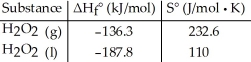 complete the following sentence. The vaporization of PCl3 (l)is ________.
 (Multiple Choice)
4.8/5 (86)
(86) The value of ΔG° at 25 °C for the decomposition of calcium chloride into its constituent elements, CaCl2 (s) → Ca (s) + Cl2 (g)
Is ________ kJ/mol.
(Multiple Choice)
4.7/5 (96)
(96) For a given reaction, ΔH = +74.6 kJ/mol, and the reaction is spontaneous at temperatures above the crossover temperature, 449 K. The value of ΔS = ________ J/mol · K, assuming that ΔH and ΔS do not vary with temperature.
(Multiple Choice)
4.9/5 (83)
(83) Which one of the following processes produces a decrease in the entropy of the system?
(Multiple Choice)
5.0/5 (79)
(79) Use the table below to answer the questions that follow.
Thermodynamic Quantities for Selected Substances at 298.15 K (25 °C)
Substance ΔH°f (kJ/mol)ΔG°f (kJ/mol)S (J/K-mol)
Carbon
C (s, diamond)1.88 2.84 2.43
C (s, graphite)0 0 5.69
C2H2 (g)226.7 209.2 200.8
C2H4 (g)52.30 68.11 219.4
C2H6 (g)-84.68 -32.89 229.5
CO (g)-110.5 -137.2 197.9
CO2 (g)-393.5 -394.4 213.6
Hydrogen
H2( g)0 0 130.58
Oxygen
O2 (g)0 0 205.0
H2O (l)-285.83 -237.13 69.91
-The value of ΔS° for the oxidation of carbon to carbon dioxide, C (s, graphite) + O2 (g) → CO2(g)
Is ________ J/K ∙ mol. The combustion of carbon, as in charcoal briquettes, in the presence of abundant oxygen produces carbon dioxide.
(Multiple Choice)
4.9/5 (86)
(86) For the reaction 2 C4H10 (g) + 13 O2 (g)→ 8 CO2 (g) + 10 H2O (g)
ΔH° is -125 kJ/mol and ΔS° is +253 J/K ∙ mol. This reaction is ________.
(Multiple Choice)
4.8/5 (82)
(82) 
Filters
- Essay(0)
- Multiple Choice(0)
- Short Answer(0)
- True False(0)
- Matching(0)