



 Chat with AI
Exam 19: Chemical Thermodynamics

Exam 1: Introduction: Matter and Measurement163 Questions
Exam 2: Atoms, Molecules, and Ions250 Questions
Exam 3: Stoichiometry: Calculations With Chemical Formulas and Equations178 Questions
Exam 4: Aqueous Reactions and Solution Stoichiometry180 Questions
Exam 5: Thermochemistry154 Questions
Exam 6: Electronic Structure of Atoms186 Questions
Exam 7: Periodic Properties of the Elements176 Questions
Exam 8: Basic Concepts of Chemical Bonding147 Questions
Exam 9: Molecular Geometry and Bonding Theories183 Questions
Exam 10: Gases175 Questions
Exam 11: Liquids and Intermolecular Forces124 Questions
Exam 12: Solids and Modern Materials84 Questions
Exam 13: Properties of Solutions160 Questions
Exam 14: Chemical Kinetics134 Questions
Exam 15: Chemical Equilibrium97 Questions
Exam 16: Acid-Base Equilibria139 Questions
Exam 17: Additional Aspects of Aqueous Equilibria116 Questions
Exam 18: Chemistry of the Environment126 Questions
Exam 19: Chemical Thermodynamics125 Questions
Exam 20: Electrochemistry114 Questions
Exam 21: Nuclear Chemistry178 Questions
Exam 22: Chemistry of the Nonmetals194 Questions
Exam 23: Transition Metals and Coordination Chemistry165 Questions
Exam 24: The Chemistry of Life: Organic and Biological Chemistry131 Questions
Select questions type


Calculate ΔG° (in kJ/mol)for the following reaction at 1 atm and 25 °C:
C2H6 (g)+ O2 (g)→ CO2 (g)+ H2O (l) (unbalanced)
ΔGf° C2H6 (g)= -32.89 kJ/mol; ΔGf° CO2 (g)= -394.4 kJ/mol; ΔGf° H2O (l)= -237.13 kJ/mol
(Short Answer)
4.7/5  (84)
(84) Use the table below to answer the questions that follow.
Thermodynamic Quantities for Selected Substances at 298.15 K (25 °C)
Substance ΔH°f (kJ/mol)ΔG°f (kJ/mol)S (J/K-mol)
Carbon
C (s, diamond)1.88 2.84 2.43
C (s, graphite)0 0 5.69
C2H2 (g)226.7 209.2 200.8
C2H4 (g)52.30 68.11 219.4
C2H6 (g)-84.68 -32.89 229.5
CO (g)-110.5 -137.2 197.9
CO2 (g)-393.5 -394.4 213.6
Hydrogen
H2( g)0 0 130.58
Oxygen
O2 (g)0 0 205.0
H2O (l)-285.83 -237.13 69.91
-The combustion of acetylene in the presence of excess oxygen yields carbon dioxide and water: 2C2H2 (g) + 5O2 (g) → 4CO2 (g) + 2H2O (l)
The value of ΔS° for this reaction is ________ J/K ∙ mol.
(Multiple Choice)
4.7/5 (69)
(69) Of the following, the entropy of gaseous ________ is the largest at 25 °C and 1 atm.
(Multiple Choice)
4.8/5 (87)
(87) Which reaction produces a decrease in the entropy of the system?
(Multiple Choice)
4.9/5 (77)
(77) The value of ΔG° at 25 °C for the following reaction: C2H4 (g) + H2 (g) → C2H6 (g)
Is ________ kJ/mol. At 298 K, ΔH° for this reaction is -137.5 kJ/mol, and ΔS° is +120.5 J/K.
(Multiple Choice)
5.0/5 (84)
(84) The value of ΔH° for the decomposition of gaseous sulfur trioxide to its component elements, 2SO3 (g) → 2S (s, rhombic) + 3O2 (g)
Is ________ kJ/mol.
(Multiple Choice)
4.9/5 (72)
(72) Which one of the following is always positive when a spontaneous process occurs?
(Multiple Choice)
4.8/5 (75)
(75) The equilibrium constant for the following reaction is 3.0 × 10⁸ at 25 °C. N2 (g) + 3H2 (g)  2NH3 (g)
The value of ΔG° for this reaction is ________ kJ/mol.
2NH3 (g)
The value of ΔG° for this reaction is ________ kJ/mol. (Multiple Choice)
4.8/5 (83)
(83) Consider the reaction: NH3 (g) + HCl (g) → NH4Cl (s)
Given the following table of thermodynamic data, 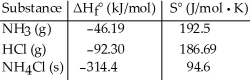 determine the temperature (in °C)above which the reaction is nonspontaneous.
 (Multiple Choice)
4.9/5 (77)
(77) Phosphorous and chlorine gases combine to produce phosphorous trichloride: P2 (g) + 3Cl2 (g) → 2PCl3 (g)
ΔG° at 298 K for this reaction is -642.9 kJ/mol. The value of ΔG at 298 K for a reaction mixture that consists of 1.9 atm P2, 1.6 atm Cl2, and 0.65 atm PCl3 is ________.
(Multiple Choice)
5.0/5 (81)
(81) The value of ΔS° for the formation of phosphorous trichloride from its constituent elements, P2 (g) + 3Cl2 (g) → 2PCl3 (g)
Is ________ J/K ∙ mol.
(Multiple Choice)
4.9/5 (77)
(77) For a given reaction, ΔH = +22.2 kJ/mol and ΔS = +81.1 J/K-mol. The reaction is spontaneous ________. Assume that ΔH and ΔS do not vary with temperature.
(Multiple Choice)
4.9/5 (88)
(88) The combustion of ethane in the presence of excess oxygen yields carbon dioxide and water: 2C2H6 (g) + 7O2 (g) → 4CO2 (g) + 6H2O (l)
The value of ΔS° for this reaction is ________ J/K ∙ mol.
(Multiple Choice)
4.9/5 (83)
(83) Which reaction produces an increase in the entropy of the system?
(Multiple Choice)
4.7/5 (72)
(72) A reversible change produces the maximum amount of ________ that can be achieved by the system on the surroundings.
(Short Answer)
4.8/5 (74)
(74) Consider the reaction: Ag+ (aq) + Cl- (aq) → AgCl (s)
Given the following table of thermodynamic data, 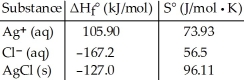 determine the temperature (in °C)above which the reaction is nonspontaneous under standard conditions.
 (Multiple Choice)
5.0/5 (83)
(83) 
Filters
- Essay(0)
- Multiple Choice(0)
- Short Answer(0)
- True False(0)
- Matching(0)