



 Chat with AI
Exam 19: Chemical Thermodynamics

Exam 1: Introduction: Matter and Measurement163 Questions
Exam 2: Atoms, Molecules, and Ions250 Questions
Exam 3: Stoichiometry: Calculations With Chemical Formulas and Equations178 Questions
Exam 4: Aqueous Reactions and Solution Stoichiometry180 Questions
Exam 5: Thermochemistry154 Questions
Exam 6: Electronic Structure of Atoms186 Questions
Exam 7: Periodic Properties of the Elements176 Questions
Exam 8: Basic Concepts of Chemical Bonding147 Questions
Exam 9: Molecular Geometry and Bonding Theories183 Questions
Exam 10: Gases175 Questions
Exam 11: Liquids and Intermolecular Forces124 Questions
Exam 12: Solids and Modern Materials84 Questions
Exam 13: Properties of Solutions160 Questions
Exam 14: Chemical Kinetics134 Questions
Exam 15: Chemical Equilibrium97 Questions
Exam 16: Acid-Base Equilibria139 Questions
Exam 17: Additional Aspects of Aqueous Equilibria116 Questions
Exam 18: Chemistry of the Environment126 Questions
Exam 19: Chemical Thermodynamics125 Questions
Exam 20: Electrochemistry114 Questions
Exam 21: Nuclear Chemistry178 Questions
Exam 22: Chemistry of the Nonmetals194 Questions
Exam 23: Transition Metals and Coordination Chemistry165 Questions
Exam 24: The Chemistry of Life: Organic and Biological Chemistry131 Questions
Select questions type


The entropy change accompanying any process is given by the equation:
(Multiple Choice)
4.8/5  (86)
(86) For a reaction to be spontaneous at low temperature, the signs of ΔH° and ΔS° must be ________ and ________, respectively.
(Multiple Choice)
4.9/5 (85)
(85) The value of ΔG° for a reaction conducted at 25 °C is 3.05 kJ/mol. The equilibrium constant for a reaction is ________ at this temperature.
(Multiple Choice)
4.9/5 (76)
(76) The normal boiling point of C2Cl3F3 is 47.6 °C and its molar enthalpy of vaporization is 27.49 kJ/mol. What is the change in entropy in the system in J/K when 28.6 grams of C2Cl3F3 vaporizes to a gas at the normal boiling point?
(Multiple Choice)
4.9/5 (88)
(88) The normal boiling point of methanol is 64.7 °C and the molar enthalpy of vaporization if 71.8 kJ/mol. The value of ΔS when 1.75 mol of CH3OH (l)vaporizes at 64.7 °C is ________ J/K.
(Multiple Choice)
4.9/5 (75)
(75) The value of ΔG° at 261.0 °C for the formation of phosphorous trichloride from its constituent elements, P2 (g)+ 3Cl2 (g) → 2PCl3 (g)
Is ________ kJ/mol. At 25.0 °C for this reaction, ΔH° is -720.5 kJ/mol, ΔG° is -642.9 kJ/mol, and ΔS° is -263.7 J/K.
(Multiple Choice)
4.9/5 (80)
(80) The standard Gibbs free energy of formation of ________ is zero. (a) H2O (l)
(b) O (g)
(c) Cl2 (g)
(Multiple Choice)
4.8/5 (77)
(77) The value of ΔS° for the oxidation of solid elemental sulfur to gaseous sulfur dioxide, S (s, rhombic)+ O2(g) → SO2(g)
Is ________ J/K ∙ mol.
(Multiple Choice)
4.8/5 (63)
(63) The value of ΔS° for the decomposition of POCl3 into its constituent elements, 2POCl3 (g) → P2 (g) + O2 (g) + 3Cl2 (g)
Is ________ J/K ∙ mol.
(Multiple Choice)
4.9/5 (79)
(79) Use the table below to answer the questions that follow.
Thermodynamic Quantities for Selected Substances at 298.15 K (25 °C)
Substance ΔH°f (kJ/mol)ΔG°f (kJ/mol)S (J/K-mol)
Carbon
C (s, diamond)1.88 2.84 2.43
C (s, graphite)0 0 5.69
C2H2 (g)226.7 209.2 200.8
C2H4 (g)52.30 68.11 219.4
C2H6 (g)-84.68 -32.89 229.5
CO (g)-110.5 -137.2 197.9
CO2 (g)-393.5 -394.4 213.6
Hydrogen
H2( g)0 0 130.58
Oxygen
O2 (g)0 0 205.0
H2O (l)-285.83 -237.13 69.91
-The value of ΔS° for the catalytic hydrogenation of ethene to ethane, C2H4 (g) + H2(g) → C2H6 (g)
Is ________ J/K ∙ mol.
(Multiple Choice)
4.9/5 (70)
(70) The value of ΔG° at 373 K for the oxidation of solid elemental sulfur to gaseous sulfur dioxide, S (s, rhombic) + O2 (g) → SO2 (g)
Is ________ kJ/mol. At 298 K, ΔH° for this reaction is -269.9 kJ/mol, and ΔS° is +11.6 J/K.
(Multiple Choice)
4.8/5 (67)
(67) The value of ΔH° for the decomposition of gaseous sulfur dioxide to solid elemental sulfur and gaseous oxygen, SO2 (g) → S (s,rhombic) + O2 (g)
Is ________ kJ/mol.
(Multiple Choice)
4.8/5 (66)
(66) Consider the reaction: NH3 (g) + HCl (g) → NH4Cl (s)
Given the following table of thermodynamic data at 298 K: 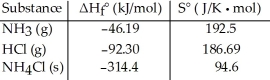 The value of K for the reaction at 25 °C is ________.
 (Multiple Choice)
4.8/5 (76)
(76) The value of ΔH° for the formation of phosphorous trichloride from its constituent elements, P2 (g) + 3Cl2 (g) → 2PCl3 (g)
Is ________ kJ/mol
(Multiple Choice)
4.7/5 (82)
(82) The value of ΔG° at 25 °C for the decomposition of gaseous sulfur trioxide to solid elemental sulfur and gaseous oxygen, 2SO3 (g) → 2S (s, rhombic) + 3O2 (g)
Is ________ kJ/mol.
(Multiple Choice)
4.8/5 (58)
(58) Consider the reaction: FeO (s) + Fe (s) + O2 (g) → Fe2O3 (s)
Given the following table of thermodynamic data, 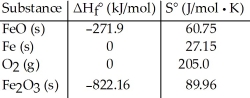 determine the temperature (in °C)above which the reaction is nonspontaneous.
 (Multiple Choice)
4.9/5 (90)
(90) The value of ΔG° at 25 °C for the oxidation of solid elemental sulfur to gaseous sulfur dioxide, S (s, rhombic) + O2(g) → SO2 (g)
Is ________ kJ/mol.
(Multiple Choice)
4.8/5 (80)
(80) Which one of the following correctly indicates the relationship between the entropy of a system and the number of different arrangements, W, in the system?
(Multiple Choice)
4.9/5 (95)
(95) 
Filters
- Essay(0)
- Multiple Choice(0)
- Short Answer(0)
- True False(0)
- Matching(0)