



 Chat with AI
Exam 19: Chemical Thermodynamics

Exam 1: Introduction: Matter and Measurement163 Questions
Exam 2: Atoms, Molecules, and Ions250 Questions
Exam 3: Stoichiometry: Calculations With Chemical Formulas and Equations178 Questions
Exam 4: Aqueous Reactions and Solution Stoichiometry180 Questions
Exam 5: Thermochemistry154 Questions
Exam 6: Electronic Structure of Atoms186 Questions
Exam 7: Periodic Properties of the Elements176 Questions
Exam 8: Basic Concepts of Chemical Bonding147 Questions
Exam 9: Molecular Geometry and Bonding Theories183 Questions
Exam 10: Gases175 Questions
Exam 11: Liquids and Intermolecular Forces124 Questions
Exam 12: Solids and Modern Materials84 Questions
Exam 13: Properties of Solutions160 Questions
Exam 14: Chemical Kinetics134 Questions
Exam 15: Chemical Equilibrium97 Questions
Exam 16: Acid-Base Equilibria139 Questions
Exam 17: Additional Aspects of Aqueous Equilibria116 Questions
Exam 18: Chemistry of the Environment126 Questions
Exam 19: Chemical Thermodynamics125 Questions
Exam 20: Electrochemistry114 Questions
Exam 21: Nuclear Chemistry178 Questions
Exam 22: Chemistry of the Nonmetals194 Questions
Exam 23: Transition Metals and Coordination Chemistry165 Questions
Exam 24: The Chemistry of Life: Organic and Biological Chemistry131 Questions
Select questions type


For the reaction C2H6 (g) → C2H4 (g) + H2 (g)
ΔH° is +137 kJ/mol and ΔS° is +120 J/K ∙ mol. This reaction is ________.
(Multiple Choice)
4.8/5  (82)
(82) The equilibrium position corresponds to which letter on the graph of G vs. f (course of reaction)below? 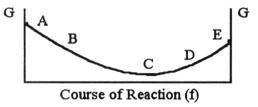
(Multiple Choice)
4.9/5 (81)
(81) The thermodynamic quantity that expresses the extent of randomness in a system is ________.
(Multiple Choice)
4.9/5 (85)
(85) Use the table below to answer the questions that follow.
Thermodynamic Quantities for Selected Substances at 298.15 K (25 °C)
Substance ΔH°f (kJ/mol)ΔG°f (kJ/mol)S (J/K-mol)
Carbon
C (s, diamond)1.88 2.84 2.43
C (s, graphite)0 0 5.69
C2H2 (g)226.7 209.2 200.8
C2H4 (g)52.30 68.11 219.4
C2H6 (g)-84.68 -32.89 229.5
CO (g)-110.5 -137.2 197.9
CO2 (g)-393.5 -394.4 213.6
Hydrogen
H2( g)0 0 130.58
Oxygen
O2 (g)0 0 205.0
H2O (l)-285.83 -237.13 69.91
-The value of ΔS° for the reaction 2C (s, diamond) + O2 (g) → 2CO (g)
Is ________ J/K ∙ mol.
(Multiple Choice)
4.9/5 (66)
(66) The value of ΔS° for the formation of POCl3 from its constituent elements, P2 (g) + O2 (g) + 3Cl2 (g) → 2POCl3 (g)
Is ________ J/K ∙ mol.
(Multiple Choice)
4.9/5 (66)
(66) The value of ΔH° for the oxidation of solid elemental sulfur to gaseous sulfur trioxide, 2S (s, rhombic) + 3O2( g) → 2SO3 (g)
Is ________ kJ/mol.
(Multiple Choice)
4.9/5 (67)
(67) The value of ΔH° for the oxidation of solid elemental sulfur to gaseous sulfur dioxide, S (s, rhombic) + O2 (g) → SO2 (g)
Is ________ kJ/mol.
(Multiple Choice)
5.0/5 (75)
(75) The value of ΔG° at 25 °C for the formation of phosphorous trichloride from its constituent elements, P2 (g) + 3Cl2 (g) → 2PCl3 (g)
Is ________ kJ/mol.
(Multiple Choice)
4.8/5 (87)
(87) A reaction that is not spontaneous at low temperature can become spontaneous at high temperature if ΔH is ________ and ΔS is ________.
(Multiple Choice)
4.7/5 (88)
(88) The value of ΔH° for the decomposition of calcium chloride into its constituent elements, CaCl2 (s) → Ca (s) + Cl2 (g)
Is ________ kJ/mol.
(Multiple Choice)
4.9/5 (81)
(81) Given the thermodynamic data in the table below, calculate the equilibrium constant (at 298 K)for the reaction: 2 SO2 (g) + O2 (g)  2 SO3 (g)
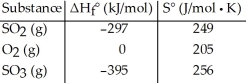
2 SO3 (g) (Multiple Choice)
4.9/5 (88)
(88) Find the temperature (in K)above which a reaction with a ΔH of 123.0 kJ/mol and a ΔS of 90.00 J/K ∙ mol becomes spontaneous.
(Short Answer)
4.9/5 (79)
(79) The normal boiling point of water is 100.0 °C and its molar enthalpy of vaporization is 40.67 kJ/mol. What is the change in entropy in the system in J/K when 24.7 grams of steam at 1 atm condenses to a liquid at the normal boiling point?
(Multiple Choice)
4.9/5 (78)
(78) For a given reaction, ΔH = -24.2 kJ/mol and ΔS = -55.5 J/K-mol. The reaction will have ΔG = 0 at ________K. Assume that ΔH and ΔS do not vary with temperature.
(Multiple Choice)
4.8/5 (70)
(70) The value of ΔG° (kJ/mol)at 25 °C is -57.5. What is the equilibrium constant for this reaction at this temperature expressed with 2 significant digits?
(Multiple Choice)
4.8/5 (92)
(92) The standard Gibbs free energy of formation of ________ is zero. (a) H2O (l)
(b) Fe (s)
(c) I2 (s)
(Multiple Choice)
4.8/5 (79)
(79) The standard Gibbs free energy of formation of ________ is zero. (a) Mn (s)
(b) I2 (s)
(c) Cu (s)
(Multiple Choice)
5.0/5 (67)
(67) 
Filters
- Essay(0)
- Multiple Choice(0)
- Short Answer(0)
- True False(0)
- Matching(0)