



 Chat with AI
Exam 19: Electrochemistry

Exam 1: Chemistry: The Study of Change153 Questions
Exam 2: Atoms, Molecules, and Ions141 Questions
Exam 3: Mass Relationships in Chemical Reactions168 Questions
Exam 4: Reactions in Aqueous Solution161 Questions
Exam 5: Gases109 Questions
Exam 6: Thermo-Chemistry111 Questions
Exam 7: Quantum Theory and the Electronic Structure of Atoms115 Questions
Exam 8: Periodic Relationships Among the Elements119 Questions
Exam 9: Chemical Bonding I: Basic Concepts118 Questions
Exam 10: Chemical Bonding Ii: Molecular Geometry and Hybridization of Atomic Orbitals122 Questions
Exam 11: Intermolecular Forces and Liquids and Solids140 Questions
Exam 12: Physical Properties of Solutions109 Questions
Exam 13: Chemical Kinetics114 Questions
Exam 14: Chemical Equilibrium100 Questions
Exam 15: Acids and Bases163 Questions
Exam 16: Acid-Base Equilibria and Solubility Equilibria110 Questions
Exam 17: Chemistry in the Atmosphere41 Questions
Exam 18: Entropy, Free Energy, and Equilibrium112 Questions
Exam 19: Electrochemistry138 Questions
Exam 20: Metallurgy and the Chemistry of Metals58 Questions
Exam 21: Nonmetallic Elements and Their Compounds41 Questions
Exam 22: Transition Metal Chemistry and Coordination Compounds80 Questions
Exam 23: Nuclear Chemistry112 Questions
Exam 24: Organic Chemistry57 Questions
Exam 25: Synthetic and Natural Organic Polymers42 Questions
Select questions type


Consider an electrochemical cell constructed from the following half cells, linked by an external circuit and by a KCl salt bridge. • an Al(s)electrode in 1.0 M Al(NO3)3 solution
• a Pb(s)electrode in 1.0 M Pb(NO3)2 solution
The balanced overall (net)cell reaction is
(Multiple Choice)
4.9/5  (71)
(71) Calculate the cell emf for the following reaction at 25°C:
2Ag+(0.010 M)+ H2(1 atm) 2Ag(s)+ 2H+(pH = 6.0)
(Short Answer)
4.8/5 (79)
(79) Calculate the cell emf for the following reaction at 25°C: 2Ag+(0.010 M)+ H2(1 atm) 2Ag(s)+ 2H+(pH = 10.0)
(Multiple Choice)
4.8/5 (80)
(80) How long will it take to produce 78 g of Al metal by the reduction of Al3+ in an electrolytic cell with a current of 2.0 A?
(Multiple Choice)
4.8/5 (86)
(86) For the electrochemical cell Pt(s)| H2(1 atm)| H+(1 M)|| Cu2+(1 M)| Cu(s), which one of the following changes will cause an increase in the cell voltage?
(Multiple Choice)
4.9/5 (71)
(71) Consider the following standard reduction potentials in acid solution: 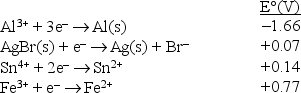 The strongest reducing agent among those shown above is
 (Multiple Choice)
4.9/5 (62)
(62) A certain electrochemical cell has for its cell reaction: Zn + HgO ZnO + Hg
Which is the half-reaction occurring at the anode?
(Multiple Choice)
4.8/5 (77)
(77) Consider an electrochemical cell based on the spontaneous reaction 2AgCl(s)+ Zn(s) 2Ag(s)+ 2Cl- + Zn2+.
If the zinc ion concentration is kept constant at 1 M, and the chlorine ion concentration is decreased from 1 M to 0.001 M, the cell voltage should
(Multiple Choice)
4.9/5 (92)
(92) Given the following standard reduction potentials,  calculate the solubility product of AgCN at 25°C.
 (Multiple Choice)
5.0/5 (75)
(75) The half-reaction that occurs at the cathode during electrolysis of an aqueous CuCl2 solution is
(Multiple Choice)
4.7/5 (79)
(79) Predict the products obtained from electrolysis of a 1 M AlBr3 solution. Note that 2H2O(l)+ 2e- H2(g)+ 2OH-(aq), E°red = -0.83 V, and
O2(g)+ 4H+(aq)+ 4e- 2H2O(l), E°red = +1.23 V
(Multiple Choice)
4.9/5 (75)
(75) Consider the reaction Fe + Sn2+(1 10-3 M) Fe2+(1.0 M)+ Sn. Calculate the voltage theoretically generated by the cell.
(Short Answer)
4.8/5 (81)
(81) Complete and balance the following redox equation. When properly balanced using the smallest whole-number coefficients, the coefficient of S is H2S + HNO3 S + NO (acidic solution)
(Multiple Choice)
4.8/5 (78)
(78) A current of 0.80 A was applied to an electrolytic cell containing molten CdCl2 for 2.5 hours.Calculate the mass of cadmium metal deposited.
(Multiple Choice)
4.9/5 (74)
(74) If the measured voltage of the cell Zn(s)| Zn2+(aq)|| Ag+(aq)| Ag(s)is 1.37 V when the concentration of Zn2+ ion is 0.010 M, what is the Ag+ ion concentration?
(Multiple Choice)
4.9/5 (77)
(77) Which one of the following reagents is capable of transforming Fe3+ (1 M)to Fe2+ (1 M)?
(Multiple Choice)
5.0/5 (79)
(79) For the reaction Ni2+(aq)+ 2Fe2+(aq) Ni(s)+ 2Fe3+(aq), the standard cell potential E°cell is
(Multiple Choice)
4.8/5 (86)
(86) Which of these metals will not be oxidized in hydrochloric acid under standard conditions at 25°C?
(Multiple Choice)
4.8/5 (66)
(66) Consider an electrochemical cell with the following cell reaction where all reactants and products are at standard-state conditions: Cu2+(aq)+ H2(g) Cu(s)+ 2H+(aq).Predict the effect on the emf of this cell of adding NaOH solution to the hydrogen half-cell until the pH equals 7.0.
(Multiple Choice)
4.8/5 (85)
(85) Which one of the following reagents is capable of transforming Cu(s)to Cu2+ (1 M)?
(Multiple Choice)
5.0/5 (78)
(78) 
Filters
- Essay(0)
- Multiple Choice(0)
- Short Answer(0)
- True False(0)
- Matching(0)