



 Chat with AI
Exam 19: Electrochemistry

Exam 1: Chemistry: The Study of Change153 Questions
Exam 2: Atoms, Molecules, and Ions141 Questions
Exam 3: Mass Relationships in Chemical Reactions168 Questions
Exam 4: Reactions in Aqueous Solution161 Questions
Exam 5: Gases109 Questions
Exam 6: Thermo-Chemistry111 Questions
Exam 7: Quantum Theory and the Electronic Structure of Atoms115 Questions
Exam 8: Periodic Relationships Among the Elements119 Questions
Exam 9: Chemical Bonding I: Basic Concepts118 Questions
Exam 10: Chemical Bonding Ii: Molecular Geometry and Hybridization of Atomic Orbitals122 Questions
Exam 11: Intermolecular Forces and Liquids and Solids140 Questions
Exam 12: Physical Properties of Solutions109 Questions
Exam 13: Chemical Kinetics114 Questions
Exam 14: Chemical Equilibrium100 Questions
Exam 15: Acids and Bases163 Questions
Exam 16: Acid-Base Equilibria and Solubility Equilibria110 Questions
Exam 17: Chemistry in the Atmosphere41 Questions
Exam 18: Entropy, Free Energy, and Equilibrium112 Questions
Exam 19: Electrochemistry138 Questions
Exam 20: Metallurgy and the Chemistry of Metals58 Questions
Exam 21: Nonmetallic Elements and Their Compounds41 Questions
Exam 22: Transition Metal Chemistry and Coordination Compounds80 Questions
Exam 23: Nuclear Chemistry112 Questions
Exam 24: Organic Chemistry57 Questions
Exam 25: Synthetic and Natural Organic Polymers42 Questions
Select questions type


An electroplating solution is made up of nickel(II)sulfate.How much time would it take to deposit 0.500 g of metallic nickel on a custom car part using a current of 3.00 A?
(Short Answer)
4.9/5  (87)
(87) How many coulombs would be required to electroplate 35.0 grams of chromium by passing an electrical current through a solution containing CrCl3?
(Multiple Choice)
4.7/5 (82)
(82) The half-reaction that should occur at the anode during electrolysis of an aqueous potassium bromide solution is
(Multiple Choice)
4.8/5 (100)
(100) Consider an electrochemical cell constructed from the following half cells, linked by a KCl salt bridge. • a Fe electrode in 1.0 M FeCl2 solution
• a Sn electrode in 1.0 M Sn(NO3)2 solution
When the cell is running spontaneously, which choice includes only true statements and no false ones?
(Multiple Choice)
4.9/5 (74)
(74) Consider the following standard reduction potentials in acid solution:  The strongest oxidizing agent listed above is
 (Multiple Choice)
4.7/5 (67)
(67) How many grams of copper are deposited on the cathode of an electrolytic cell if an electric current of 2.00 A is passed through a solution of CuSO4 for a period of 19.0 min?
(Short Answer)
4.7/5 (87)
(87) Which one of the following reagents is capable of transforming Cu2+(1 M)to Cu(s)?
(Multiple Choice)
4.9/5 (67)
(67) The measured voltage of the cell Pt(s)| H2 (1.0 atm)| H+(aq)|| Ag+(1.0 M)| Ag(s)is 1.02 V at 25°C. Calculate the pH of the solution.
(Multiple Choice)
4.9/5 (84)
(84) How many coulombs (C)of electrical charge must pass through an electrolytic cell to reduce 0.44 mol Ca2+ ion to calcium metal?
(Multiple Choice)
4.7/5 (71)
(71) Consider the reaction Fe + Sn2+(1 10-3 M) Fe2+(1.0 M)+ Sn. In what direction do the Cl- ions in the KCl salt bridge flow?
(Essay)
4.8/5 (71)
(71) Given the following standard reduction potentials in acid solution  write a balanced equation for a spontaneous reaction which involves the tin and zinc redox couples.
 (Essay)
4.8/5 (80)
(80) The half-cell reaction for the oxidation of H2O(l)to O2(g)is given below. 2H2O(l) O2(g)+ 4H+(aq)+ 4e-
Which choice lists all of the following species that can oxidize H2O to O2(g)under standard-state conditions?
MnO4-(aq), Cl2(g), Pb2+(aq), Cl- (aq), Ag+(aq)
(Multiple Choice)
4.8/5 (71)
(71) Determine the equilibrium constant for the following reaction at 25°C.
2I- (aq)+ Br2(l)  I2(s)+ 2Br-(aq).
 (Short Answer)
4.9/5 (74)
(74) Calculate the cell emf for the following reaction at 25°C: Ni(s)+ 2Cu2+(0.010 M) Ni2+(0.0010 M)+ 2Cu+(1.0 M)
(Multiple Choice)
4.8/5 (76)
(76) Calculate the standard cell emf for the following cell: Mg | Mg2+ || NO3- (acid soln)| NO(g)| Pt
(Multiple Choice)
4.9/5 (78)
(78) Complete and balance the following redox equation. The sum of the smallest whole-number coefficients is MnO4- + H+ + Br- Mn2+ + Br2 + H2O (acidic solution)
(Multiple Choice)
4.8/5 (69)
(69) The half-reaction that occurs at the cathode during electrolysis of an aqueous sodium iodide solution is
(Multiple Choice)
4.9/5 (79)
(79) If the cell emf of a Zn-Cu cell is 0.80 V when the concentration of Zn2+ is 2.0 M, what is the concentration of Cu2+?
(Short Answer)
4.9/5 (89)
(89) Consider the following standard reduction potentials in acid solution: 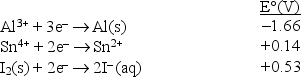 Which is the weakest oxidizing agent in this list?
 (Multiple Choice)
4.8/5 (86)
(86) Find the emf of the cell described by the cell diagram Ni | Ni2+ (0.750 M)|| Cu2+ (0.0500 M)| Cu
(Multiple Choice)
4.9/5 (83)
(83) 
Filters
- Essay(0)
- Multiple Choice(0)
- Short Answer(0)
- True False(0)
- Matching(0)