



 Chat with AI
Exam 12: Physical Properties of Solutions

Exam 1: Chemistry: The Study of Change153 Questions
Exam 2: Atoms, Molecules, and Ions141 Questions
Exam 3: Mass Relationships in Chemical Reactions168 Questions
Exam 4: Reactions in Aqueous Solution161 Questions
Exam 5: Gases109 Questions
Exam 6: Thermo-Chemistry111 Questions
Exam 7: Quantum Theory and the Electronic Structure of Atoms115 Questions
Exam 8: Periodic Relationships Among the Elements119 Questions
Exam 9: Chemical Bonding I: Basic Concepts118 Questions
Exam 10: Chemical Bonding Ii: Molecular Geometry and Hybridization of Atomic Orbitals122 Questions
Exam 11: Intermolecular Forces and Liquids and Solids140 Questions
Exam 12: Physical Properties of Solutions109 Questions
Exam 13: Chemical Kinetics114 Questions
Exam 14: Chemical Equilibrium100 Questions
Exam 15: Acids and Bases163 Questions
Exam 16: Acid-Base Equilibria and Solubility Equilibria110 Questions
Exam 17: Chemistry in the Atmosphere41 Questions
Exam 18: Entropy, Free Energy, and Equilibrium112 Questions
Exam 19: Electrochemistry138 Questions
Exam 20: Metallurgy and the Chemistry of Metals58 Questions
Exam 21: Nonmetallic Elements and Their Compounds41 Questions
Exam 22: Transition Metal Chemistry and Coordination Compounds80 Questions
Exam 23: Nuclear Chemistry112 Questions
Exam 24: Organic Chemistry57 Questions
Exam 25: Synthetic and Natural Organic Polymers42 Questions
Select questions type


Explain the following, on the basis of osmosis or osmotic pressure: An effective way to kill a snail or slug in your garden is to sprinkle it with salt.
(Essay)
4.8/5  (76)
(76) The density of a 20.3 M CH3OH (methanol)solution is 0.858 g/mL. What is the molality of this solution? H2O is the solvent.
(Multiple Choice)
5.0/5 (77)
(77) Dissolving a solute such as KOH in a solvent such as water results in
(Multiple Choice)
4.8/5 (75)
(75) A 15.00 % by mass solution of lactose (C12H22O11, 342.30 g/mol)in water has a density of 1.0602 g/mL at 20°C.What is the molarity of this solution?
(Multiple Choice)
4.9/5 (79)
(79) Calculate the percent by mass of potassium nitrate in a solution made from 45.0 g KNO3 and 295 mL of water. The density of water is 0.997 g/mL.
(Multiple Choice)
4.8/5 (64)
(64) What volume of water should be added to 600.mL of ethanol in order to have a solution that boils at 95.0°C? (For ethanol, Kb = 1.22 °C/m, density = 0.789 g/cm3, boiling point = 78.4°C)
(Multiple Choice)
4.8/5 (79)
(79) What is the molarity of a solution that is 7.00% by mass magnesium sulfate and has a density of 1.071 g/mL?
(Multiple Choice)
4.9/5 (80)
(80) For dilute aqueous solutions, the concentration units molarity and molality have almost the same values.
(True/False)
4.7/5 (71)
(71) What volume of ethanol (density = 0.7893 g/cm3)should be added to 450.mL of water in order to have a solution that freezes at -15.0°C? (For water, Kf = 1.86 °C/m.)
(Multiple Choice)
4.8/5 (83)
(83) In which of the following solvents would you expect KBr to be most soluble?
(Multiple Choice)
5.0/5 (88)
(88) What is the freezing point of a solution that contains 10.0 g of glucose (C6H12O6)in 100.g of H2O? Kf for water is 1.86°C/m.
(Multiple Choice)
4.8/5 (71)
(71) 
Arrange the following aqueous solutions in order of increasing boiling points: 0.050 m Mg(NO3)2; 0.100 m ethanol; 0.090 m NaCl.
(Multiple Choice)
4.9/5 (72)
(72) What is the molality of a solution that is 3.68 % by mass calcium chloride.
(Multiple Choice)
4.8/5 (104)
(104) A 9.50 % by mass solution of acetone (C3H6O)in water has a density of 0.9849 g/mL at 20°C.What is the molarity of this solution?
(Multiple Choice)
4.8/5 (84)
(84) Plasma is the fluid portion of blood.The concentration of acetylsalicylic acid (aspirin, C9H8O4, molar mass = 180.g/mol)in your plasma is found to be 2.99 * 10-4 M after you take two tablets of aspirin.If the volume of your plasma is 5.85 L, how many grams of aspirin are in your blood? (Assume that the density of plasma is 1.00 g/mL.)
(Short Answer)
4.8/5 (84)
(84) What is the percent CsCl by mass in a 0.711 M CsCl solution that has a density of 1.091 g/mL?
(Multiple Choice)
4.8/5 (70)
(70) Calculate the mass of solute in the following solution: 50.0 mL of 0.0300 M C12H22O11.
(Short Answer)
4.7/5 (70)
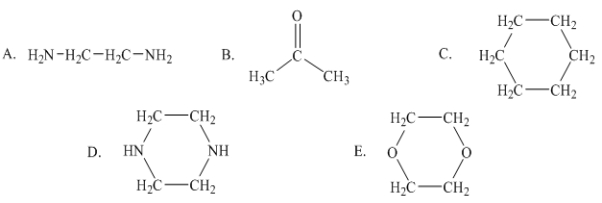
(70) 
Filters
- Essay(0)
- Multiple Choice(0)
- Short Answer(0)
- True False(0)
- Matching(0)