



 Chat with AI
Exam 9: Chemical Bonding I: Basic Concepts

Exam 1: Chemistry: the Study of Change168 Questions
Exam 2: Atoms, Molecules, and Ions156 Questions
Exam 3: Mass Relationships in Chemical Reactions194 Questions
Exam 4: Reactions in Aqueous Solutions186 Questions
Exam 5: Gases121 Questions
Exam 6: Thermochemistry118 Questions
Exam 7: Quantum Theory and the Electronic Structure of Atoms136 Questions
Exam 8: Periodic Relationships Among the Elements144 Questions
Exam 9: Chemical Bonding I: Basic Concepts137 Questions
Exam 10: Chemical Bonding Ii: Molecular Geometry and Hybridization of Atomic Orbitals147 Questions
Exam 11: Intermolecular Forces and Liquids and Solids149 Questions
Exam 12: Physical Properties of Solutions122 Questions
Exam 13: Chemical Kinetics130 Questions
Exam 14: Chemical Equilibrium109 Questions
Exam 15: Acids and Bases178 Questions
Exam 16: Acid-Base Equilibria and Solubility Equilibria131 Questions
Exam 17: Entropy Free Energy and Equilibrium128 Questions
Exam 18: Electrochemistry154 Questions
Exam 19: Nuclear Chemistry133 Questions
Exam 20: Chemistry in the Atmosphere50 Questions
Exam 21: Metallurgy and the Chemistry of Metals63 Questions
Exam 22: Nonmetallic Elements and Their Compounds52 Questions
Exam 23: Transition Metal Chemistry and Coordination Compounds92 Questions
Exam 24: Organic Chemistry67 Questions
Exam 25: Synthetic and Natural Organic Polymers50 Questions
Select questions type


How many covalent bonds will be drawn to bromine in BrO3- for the dot structure that expands the octet to minimize formal charge and if necessary places negative formal charges on the most electronegative atom(s).
(Multiple Choice)
4.8/5  (81)
(81) Of the following substances, KCl, KBr, and KF, KF will have the highest melting point.
(True/False)
4.8/5 (79)
(79) Classify the C - Cl bond in CCl4 as ionic, polar covalent, or nonpolar covalent.
(Multiple Choice)
4.9/5 (81)
(81) List all types of bonding present in the compound CaCO3 I.ionic bond
II.polar covalent bond
III.nonpolar covalent bond
(Multiple Choice)
4.9/5 (72)
(72) Which one of the following compounds does not follow the octet rule?
(Multiple Choice)
4.7/5 (76)
(76) Carbonic acid, H2CO3, is a weak acid that contributes to the taste and produces the carbon dioxide bubbles in all carbonated beverages.Write a Lewis structure for H2CO3,
(Essay)
5.0/5 (77)
(77) Write a Lewis structure for the chlorate ion, ClO3-, that expands the octet to minimize formal charge and if necessary places negative formal charges on the most electronegative atom(s).
(Essay)
4.8/5 (78)
(78) Which of the following is a useful guideline for the application of formal charges in neutral molecules?
(Multiple Choice)
4.8/5 (74)
(74) List all types of bonding present in the ion SO42- I.ionic bond
II.polar covalent bond
III.nonpolar covalent bond
(Multiple Choice)
4.7/5 (84)
(84) Use bond energies to estimate the enthalpy change for the reaction of one mole ofCH4 with chlorine gas to give CH3Cl and hydrogen chloride. BE(C-H)= 414 kJ/mol
BE(C-Cl)= 326 kJ/mol
BE(H-Cl)= 432 kJ/mol
BE(Cl-Cl)= 243 kJ/mol
(Multiple Choice)
4.9/5 (80)
(80) Use the Born-Haber cycle to calculate the lattice energy of NaBr(s)given the
following data:
H(sublimation)Na = 109 kJ/mol
I1 (Na)= 496 kJ/mol
Bond energy (Br-Br)= 192 kJ/mol
EA (Br)= 324 kJ/mol
Hf (NaBr(s))= -361 kJ/mol
(Short Answer)
4.9/5 (83)
(83) Which of the following ionic solids would have the largest lattice energy?
(Multiple Choice)
4.9/5 (92)
(92) Which of the elements listed below is most likely to exhibit an expanded octet in its compounds?
(Multiple Choice)
4.9/5 (65)
(65) The Lewis structure reveals a double bond in which of the following molecules?
(Multiple Choice)
4.7/5 (80)
(80) Use the bond enthalpy data given to estimate the heat released when 50.0 g of propane gas, C3H8, burns in excess oxygen to yield carbon dioxide and water vapor at 25°C. BE(C-C)= 347 kJ/mol
BE(C=O in CO2)= 799 kJ/mol
BE(C-H)= 414 kJ/mol
BE(O-H)= 460 kJ/mol
BE(O=O)= 498.7 kJ/mol
(Multiple Choice)
4.8/5 (86)
(86) Calculate the energy change for the reaction K(g)+ I(g) K+(g)+ I - (g)
Given the following ionization energy (IE)and electron affinity (EA)values. 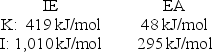
(Multiple Choice)
4.8/5 (88)
(88) What is the formal charge on phosphorus in a Lewis structure for the phosphate ion that satisfies the octet rule?
(Multiple Choice)
4.9/5 (85)
(85) Which of the following ionic solids would have the largest lattice energy?
(Multiple Choice)
5.0/5 (89)
(89) Assuming the octet rule is obeyed, how many covalent bonds will a neon atom form to give a formal charge of zero?
(Multiple Choice)
4.8/5 (88)
(88) 
Filters
- Essay(0)
- Multiple Choice(0)
- Short Answer(0)
- True False(0)
- Matching(0)