



 Chat with AI
Exam 6: Energy Relationships in Chemical Reactions

Exam 1: Introduction153 Questions
Exam 2: Atoms, Molecules, and Ions141 Questions
Exam 3: Stoichiometry168 Questions
Exam 4: Reactions in Aqueous Solution156 Questions
Exam 5: Gases109 Questions
Exam 6: Energy Relationships in Chemical Reactions105 Questions
Exam 7: The Electronic Structure of Atoms115 Questions
Exam 8: The Periodic Table119 Questions
Exam 9: Chemical Bonding I: the Covalent Bond118 Questions
Exam 10: Chemical Bonding Ii: Molecular Geometry and Hybridization of Atomic Orbitals120 Questions
Exam 11: Introduction to Organic Chemistry57 Questions
Exam 12: Intermolecular Forces and Liquids and Solids138 Questions
Exam 13: Physical Properties of Solutions109 Questions
Exam 14: Chemical Kinetics114 Questions
Exam 15: Chemical Equilibrium99 Questions
Exam 16: Acids and Bases163 Questions
Exam 17: Acid-Base Equilibria and Solubility Equilibria92 Questions
Exam 18: Thermodynamics112 Questions
Exam 19: Redox Reactions and Electrochemistry138 Questions
Exam 20: The Chemistry of Coordination Compounds76 Questions
Exam 21: Nuclear Chemistry112 Questions
Exam 22: Organic Polymerssynthetic and Natural42 Questions
Select questions type


The bond enthalpy of the Br-Cl bond is equal to H° for the reaction BrCl(g) Br(g)+ Cl(g).
Use the following data to find the bond enthalpy of the Br-Cl bond. 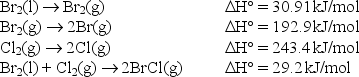
(Multiple Choice)
4.8/5  (83)
(83) During volcanic eruptions, hydrogen sulfide gas is given off and oxidized by air according to the following chemical equation: 2H2S(g)+ 3O2(g) 2SO2(g)+ 2H2O(g)
Calculate the standard enthalpy change for the above reaction given:
3S(s)+ 2H2O(g) 2H2S(g)+ SO2(g) H° = 146.9 kJ/mol
S(s)+ O2(g) SO2(g) H° = -296.4 kJ/mol
(Multiple Choice)
4.9/5 (77)
(77) At body temperature 2,404 joules of energy are required to evaporate 1.00 g of water. After vigorous exercise, a person feels chilly because the body is giving up heat to evaporate the perspiration. A typical person perspires 25 mL of water after 20. minutes of exercise. How much body heat is this person using to evaporate this water?
(Essay)
4.9/5 (81)
(81) Given the thermochemical equation 2SO2 + O2 2SO3, H°rxn = -198 kJ/mol, what is the standard enthalpy change for the decomposition of one mole of SO3?
(Multiple Choice)
4.9/5 (83)
(83) The combustion of butane produces heat according to the equation 2C4H10(g)+ 13O2(g) 8CO2(g)+ 10H2O(l) H°rxn= -5,314 kJ/mol
How many grams of CO2 are produced per 1.00 * 104 kJ of heat released?
(Multiple Choice)
4.9/5 (66)
(66) Calculate the standard enthalpy change for the reaction 2C8H18(l)+ 21O2(g) 8CO(g)+ 8CO2(g)+ 18H2O(l).
Given:
2C8H18(l)+ 25O2(g) 16CO2(g)+ 18H2O(l) H° = -11,020 kJ/mol
2CO(g)+ O2(g) 2CO2(g) H° = -566.0 kJ/mol
(Multiple Choice)
4.9/5 (87)
(87) When 18.5 g of HgO(s)is decomposed to form Hg(l)and O2(g), 7.75 kJ of heat is absorbed at standard-state conditions. What is the standard enthalpy of formation ( H°f)of HgO(s)?
(Multiple Choice)
4.8/5 (74)
(74) Find the standard enthalpy of formation of ethylene, C2H4(g), given the following data: heat of combustion of C2H4(g) = -1411 kJ/mol; H°f[CO2(g)] = -393.5 kJ/mol; H°f[H2O(l)] = -285.8 kJ/mol.
(Multiple Choice)
4.8/5 (90)
(90) How much heat is required to raise the temperature of 2,500 g of water from 27°C to 72°C? The specific heat of water is 4.184 J/g·°C.
(Multiple Choice)
4.8/5 (80)
(80) Chemical reactions in a bomb calorimeter occur at constant pressure.
(True/False)
4.8/5 (77)
(77) How many degrees of temperature rise will occur when a 25.0 g block of aluminum absorbs 10.0 kJ of heat? The specific heat of Al is 0.900 J/g·°C.
(Multiple Choice)
4.7/5 (82)
(82) Calculate the amount of work done against an atmospheric pressure of 1.00 atm when 500.0 g of zinc dissolves in excess acid at 30.0°C. Zn(s)+ 2H+(aq) Zn2+(aq)+ H2(g)
(Multiple Choice)
4.9/5 (85)
(85) At 25°C, the standard enthalpy of formation of anhydrous sodium carbonate is -1130.9 kJ/mol, whereas the standard enthalpy of formation of sodium carbonate monohydrate is -1430.1 kJ/mol. Determine H° at 25°C for the reaction Na2CO3(s)+ H2O(l) Na2CO3·H2O(s).
(Given: H°f[H2O(l)] = -285.8 kJ/mol)
(Multiple Choice)
4.9/5 (79)
(79) The work done on the surroundings by the expansion of a gas is w = -P V.
(True/False)
4.9/5 (92)
(92) If 325 g of water at 4.2°C absorbs 12.28 kJ, what is the final temperature of the water? The specific heat of water is 4.184 J/g·°C.
(Multiple Choice)
4.7/5 (59)
(59) The enthalpy of combustion of acetylene C2H2 is described by
C2H2(g)+ (5/2)O2(g) 2CO2(g)+ H2O(l) H°rxn= -1299 kJ/mol
Calculate the enthalpy of formation of acetylene, given the following enthalpies of formation
H°f[CO2(g)] = -393.5 kJ/mol
H°f[H2O(l)] = -285.8 kJ/mol
(Short Answer)
4.8/5 (76)
(76) To which one of the following reactions occurring at 25°C does the symbol H°f[H2SO4(l)] refer?
(Multiple Choice)
4.9/5 (75)
(75) Given 2Al(s)+ (3/2)O2(g) Al2O3(s), H°f = -1,670 kJ/mol for Al2O3 (s). Determine H° for the reaction 2Al2O3(s) 4Al(s)+ 3O2(g).
(Multiple Choice)
4.8/5 (78)
(78) 
Filters
- Essay(0)
- Multiple Choice(0)
- Short Answer(0)
- True False(0)
- Matching(0)