



 Chat with AI
Exam 11: Microbial Genetics and Infectious Disease

Exam 1: What is Microbiology and Why Does it Matter?17 Questions
Exam 2: Fundamental Chemistry for Microbiology40 Questions
Exam 3: Essentials of Metabolism52 Questions
Exam 4: An Introduction to Cell Structure and Host-Pathogen Relationships49 Questions
Exam 5: Requirements for Infection43 Questions
Exam 6: Transmission of Infection, the Compromised Host, Epidemiology, and Diagnosing Infections41 Questions
Exam 7: Principles of Disease30 Questions
Exam 8: Emerging and Re-Emerging Infectious Disease37 Questions
Exam 9: The Clinical Significance of Bacterial Anatomy51 Questions
Exam 10: Bacterial Growth52 Questions
Exam 11: Microbial Genetics and Infectious Disease67 Questions
Exam 12: The Structure and Infection Cycle of Viruses22 Questions
Exam 13: Viral Infection28 Questions
Exam 14: Parasitic and Fungal Infections43 Questions
Exam 15: The Innate Immune Response63 Questions
Exam 16: The Adaptive Immune Response45 Questions
Exam 17: Failures of the Immune Response23 Questions
Exam 18: Control of Microbial Growth with Disinfectants and Antiseptics28 Questions
Exam 19: Antibiotics and Antimicrobial Drugs28 Questions
Exam 20: Antibiotic Resistance37 Questions
Exam 21: Infections of the Respiratory System49 Questions
Exam 22: Infections of the Digestive System59 Questions
Exam 23: Infections of the Genitourinary System58 Questions
Exam 24: Infections of the Central Nervous System47 Questions
Exam 25: Infections of the Blood and Lymph52 Questions
Exam 26: Infections of the Skin and Eyes40 Questions
Select questions type


An alteration in the position of genetic elements within a genome is called
(Multiple Choice)
4.9/5  (87)
(87) A set of genes involved in a common metabolic pathway in prokaryotic cells is called a(n)
(Multiple Choice)
4.9/5 (71)
(71) Answer true or false to the following statement: The rate of DNA synthesis is directly correlated to the processivity of the particular polymerase.
(True/False)
4.9/5 (90)
(90) Rearrange the following events in the order in which they occur during DNA proofreading.Which is the second event?
(Multiple Choice)
4.7/5 (79)
(79) A sugar with -OH on the 3' but not the 2' carbon is a component of
(Multiple Choice)
5.0/5 (69)
(69) Identify the similarities and differences between the repressor proteins of the lactose and tryptophan operons.
(Essay)
4.7/5 (94)
(94) The open reading frame of a portion of mRNA.
Use the figure below to answer the following questions.
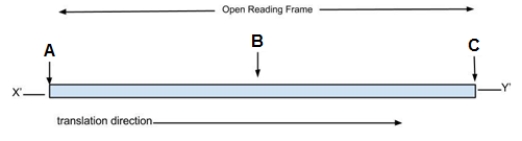 -In the figure which letter (A-C)refers to the codon at the 3' end of the messenger RNA?
 (Short Answer)
5.0/5 (85)
(85) Identify the three types of RNA that are made in bacterial cells.How are they similar and what is the specific function of each?
(Essay)
4.8/5 (80)
(80) The uptake of naked DNA by "competent" recipient cells is called
(Multiple Choice)
4.9/5 (84)
(84) Answer true or false to the following statement: No errors are made during DNA replication
(True/False)
4.9/5 (79)
(79) Protein synthesis occurs on _____,which form the base for translation of _____.
(Multiple Choice)
4.9/5 (82)
(82) The site where regulatory proteins bind to DNA and affect transcription activity is called the
(Multiple Choice)
4.9/5 (78)
(78) When DNA replication is taking place,the single DNA strands called _____ unwind and pair with short RNA _____.
(Multiple Choice)
4.8/5 (84)
(84) Rearrange the following events in the order in which they occur during DNA proofreading.Which is the third event?
(Multiple Choice)
4.8/5 (69)
(69) A point mutation causing a nucleotide to change from an adenine to a guanine is a(n)
(Multiple Choice)
4.9/5 (95)
(95) Explain how the lac operon functions and is regulated.Include the following terms in your description:

(Essay)
4.8/5 (79)
(79) Answer true or false to the following statement: Proofreading of bases added takes place at the 3' end of the new strand because the DNA polymerase contains an exonuclease component.
(True/False)
4.9/5 (83)
(83) 
Filters
- Essay(0)
- Multiple Choice(0)
- Short Answer(0)
- True False(0)
- Matching(0)