



 Chat with AI
Exam 5: Gases

Exam 1: Chemistry: The Study of Change175 Questions
Exam 2: Atoms Molecules and Ions156 Questions
Exam 3: Mass Relationships in Chemical Reactions194 Questions
Exam 4: Reactions in Aqueous Solutions192 Questions
Exam 5: Gases130 Questions
Exam 6: Thermochemistry119 Questions
Exam 7: Quantum Theory and the Electronic Structure of Atoms135 Questions
Exam 8: Periodic Relationships Among the Elements144 Questions
Exam 9: Chemical Bonding I: Basic Concepts136 Questions
Exam 10: Chemical Bonding II: Molecular Geometry and Hybridization of Atomic146 Questions
Exam 11: Intermolecular Forces and Liquids and Solids149 Questions
Exam 12: Physical Properties of Solutions122 Questions
Exam 13: Chemical Kinetics131 Questions
Exam 14: Chemical Equilibrium119 Questions
Exam 15: Acids and Bases178 Questions
Exam 16: Acid-Base Equilibria and Solubility Equilibria145 Questions
Exam 17: Entropy Free Energy and Equilibrium128 Questions
Exam 18: Electrochemistry154 Questions
Exam 19: Nuclear Chemistry128 Questions
Exam 20: Chemistry in the Atmosphere50 Questions
Exam 21: Metallurgy and the Chemistry of Metals63 Questions
Exam 22: Nonmetallic Elements and Their Compounds52 Questions
Exam 23: Transition Metals Chemistry and Coordination Compounds92 Questions
Exam 24: Organic Chemistry66 Questions
Exam 25: Synthetic and Natural Organic Polymers46 Questions
Select questions type


For a substance that remains a gas under the conditions listed, deviation from the ideal gas law would be most pronounced at
(Multiple Choice)
4.7/5  (91)
(91) What is the pressure (mmHg) of the sample of gas trapped in the closed-tube mercury manometer shown below if atmospheric pressure is 751 mmHg and h = 17.3 cm 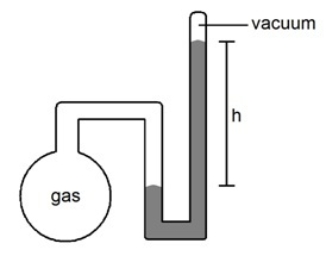
(Multiple Choice)
4.8/5 (70)
(70) A sample of pure nitrogen has a temperature of 15 C. What is the temperature of the nitrogen in units of Kelvin
(Multiple Choice)
4.9/5 (87)
(87) 1.000 atm of oxygen gas, placed in a container having a pinhole opening in its side, leaks from the container 2.14 times faster than does 1.000 atm of an unknown gas placed in this same apparatus. Which of these species could be the unknown gas
(Multiple Choice)
4.8/5 (80)
(80) Packaged cake mixes usually contain baking powder, a mixture of sodium hydrogen carbonate and calcium hydrogen phosphate that react to produce carbon dioxide gas when they are heated in water. The CO2(g) formed allows the cake to "rise." When such cake mixes are used at high altitudes, often the cake will rise too much and collapse, unless special instructions are followed. Why does this happen
(Multiple Choice)
4.9/5 (78)
(78) A sample of hydrogen gas was collected over water at 21 C and 685 mmHg. The volume of the container was 7.80 L. Calculate the mass of H2(g) collected. (Vapor pressure of water = 18.6 mmHg at 21 C.)
(Multiple Choice)
4.9/5 (76)
(76) How many atoms of Ar gas are present in a 340 mL container at 55 C and 720 mmHg
(Multiple Choice)
4.8/5 (77)
(77) 2.0 L of gas A at 1.0 atm and 1.0 L of gas B at 1.0 atm are combined in a 3.0 L flask. The flask is sealed and over time they react completely to give gas C according to the following chemical equation: 2A(g) + B(g) C(g)
Assuming the temperature stays constant, what will be the pressure after the reaction goes to completion
(Multiple Choice)
4.8/5 (81)
(81) At constant temperature, the volume of the container that a sample of nitrogen gas is in is doubled. As a result the pressure of the nitrogen gas is halved. The amount of nitrogen gas is unchanged in this process. This is an example of:
(Multiple Choice)
4.8/5 (88)
(88) Calculate the volume occupied by 56.5 g of argon gas at STP.
(Multiple Choice)
5.0/5 (87)
(87) The following data describes an initial and final state for an ideal gas. Given that the amount of gas does not change in the process, what is the final pressure (atm) of the gas P V T initial: 1.35 458 2 final: ? 556 2
(Multiple Choice)
4.9/5 (83)
(83) Calculate the density, in g/L, of SF6 gas at 27 C and 0.500 atm pressure.
(Multiple Choice)
4.7/5 (69)
(69) Dalton's Law states that the total pressure of a mixture of gases is just the sum of the pressures that each gas would exert if it were present alone.
(True/False)
4.9/5 (92)
(92) Calculate the volume occupied by 35.2 g of methane gas (CH4) at 25 C and 1.0 atm. R = 0.08206 L.atm/K.mol.
(Multiple Choice)
4.8/5 (74)
(74) The mole fraction of oxygen molecules in dry air is 0.2095. What volume of dry air at 1.00 atm and 25 C is required for burning 1.00 L of hexane (C6H14, density = 0.660 g/mL) completely, yielding carbon dioxide and water
(Multiple Choice)
4.7/5 (77)
(77) In an effort to address concerns about global warming, a power plant in Portland, Oregon is designed to take all of its exhaust gases from its boilers and recycle the CO2 using the Solvay process to make sodium hydrogen carbonate. The reaction is shown below.NH3(g) + H2O(l) + CO2(g) + NaCl(aq) NaHCO3(aq) + NH4Cl(aq) How many liters each of NH3 and CO2 (both at STP) would be consumed to produce 3.00 kg of sodium bicarbonate
(Multiple Choice)
4.9/5 (90)
(90) Calculate the density, in g/L, of N2 gas at 35 C and 0.98 atm pressure.
(Multiple Choice)
4.8/5 (81)
(81) What volume of O2(g) at 810. mmHg pressure is required to react completely with a 4.50g sample of C(s) at 48 C
2 C(s) + O2(g) 2 CO(g)
(Multiple Choice)
4.9/5 (70)
(70) The molecules of different samples of an ideal gas have the same average kinetic energies, at the same
(Multiple Choice)
4.9/5 (94)
(94) Which of the following statements is consistent with Boyle's Law concerning an ideal gas
(Multiple Choice)
4.9/5 (77)
(77) 
Filters
- Essay(0)
- Multiple Choice(0)
- Short Answer(0)
- True False(0)
- Matching(0)