



 Chat with AI
Exam 5: Gases

Exam 1: Chemistry: The Study of Change175 Questions
Exam 2: Atoms Molecules and Ions156 Questions
Exam 3: Mass Relationships in Chemical Reactions194 Questions
Exam 4: Reactions in Aqueous Solutions192 Questions
Exam 5: Gases130 Questions
Exam 6: Thermochemistry119 Questions
Exam 7: Quantum Theory and the Electronic Structure of Atoms135 Questions
Exam 8: Periodic Relationships Among the Elements144 Questions
Exam 9: Chemical Bonding I: Basic Concepts136 Questions
Exam 10: Chemical Bonding II: Molecular Geometry and Hybridization of Atomic146 Questions
Exam 11: Intermolecular Forces and Liquids and Solids149 Questions
Exam 12: Physical Properties of Solutions122 Questions
Exam 13: Chemical Kinetics131 Questions
Exam 14: Chemical Equilibrium119 Questions
Exam 15: Acids and Bases178 Questions
Exam 16: Acid-Base Equilibria and Solubility Equilibria145 Questions
Exam 17: Entropy Free Energy and Equilibrium128 Questions
Exam 18: Electrochemistry154 Questions
Exam 19: Nuclear Chemistry128 Questions
Exam 20: Chemistry in the Atmosphere50 Questions
Exam 21: Metallurgy and the Chemistry of Metals63 Questions
Exam 22: Nonmetallic Elements and Their Compounds52 Questions
Exam 23: Transition Metals Chemistry and Coordination Compounds92 Questions
Exam 24: Organic Chemistry66 Questions
Exam 25: Synthetic and Natural Organic Polymers46 Questions
Select questions type


A sample of carbon monoxide gas was collected in a 2.0 L flask by displacing water at 28 C and 810 mmHg. Calculate the number of CO molecules in the flask. The vapor pressure of water at 28 C is 28.3 mmHg.
(Multiple Choice)
4.8/5  (76)
(76) Boyle's Law states that the volume of a fixed amount of gas maintained at constant temperature is directly proportional to the gas pressure
(True/False)
4.7/5 (81)
(81) Which of the following is not an example of a compound that exists as a gas at room temperature and pressure.
(Multiple Choice)
4.8/5 (78)
(78) Calculate the density of Br2(g) at 59.0 C and 1.00 atm pressure.
(Multiple Choice)
4.7/5 (80)
(80) The gas pressure in an aerosol can is 1.8 atm at 25 C. If the gas is an ideal gas, what pressure would develop in the can if it were heated to 475 C
(Multiple Choice)
4.9/5 (73)
(73) Gasoline (which can be considered to be octane, C8H18) burns in oxygen to produce carbon dioxide and water. What volume (L) of oxygen at STP is necessary to react with 1.0 gal of gasoline
(The density of gasoline is 0.81 g/mL. 1 gal = 3.78 L)
(Multiple Choice)
4.8/5 (92)
(92) How many liters of chlorine gas at 25 C and 0.950 atm can be produced by the reaction of 12.0 g of MnO2 with excess HCl(aq) according to the following chemical equation
MnO2(s) + 4HCl(aq) MnCl2(aq) + 2H2O(l) + Cl2(g)
(Multiple Choice)
4.9/5 (79)
(79) What will happen to the height (h) of the mercury column in the manometer shown below if the stopcock is opened, given that the atmospheric pressure is 755 mmHg 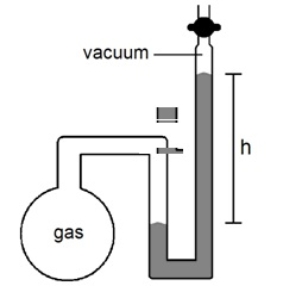
(Multiple Choice)
4.8/5 (77)
(77) A convenient way to produce very high purity oxygen in the laboratory is to decompose KMnO4(s) at high temperature according to the following chemical equation: 2KMnO4(s) K2MnO4(s) + MnO2(s) + O2(g)
If 2.50 L of O2(g) is needed at 1.00 atm and 20. C, what mass (in grams) of KMnO4(s) should be decomposed
Assume the decomposition of KMnO4(s) goes to completion.
(Multiple Choice)
4.8/5 (81)
(81) A sample of mercury(II) oxide is placed in a 5.00 L evacuated container and heated until it decomposes entirely to mercury metal and oxygen gas. The container is then cooled to 25 C. One now finds that the gas pressure inside the container is 1.73 atm. What mass of mercury(II) oxide was originally placed into the container
(Multiple Choice)
4.7/5 (88)
(88) Calculate the grams of SO2 gas present at STP in a 5.9 L container.
(Multiple Choice)
4.9/5 (77)
(77) 1.018 g of Freon-113 gas is trapped in a 145 mL container at 760. mmHg and 50.0 C. What is the molar mass of Freon-113
(Multiple Choice)
4.9/5 (73)
(73) 0.820 mole of hydrogen gas has a volume of 2.00 L at a certain temperature and pressure. What is the volume of 0.125 mol of this gas at the same temperature and pressure
(Multiple Choice)
4.9/5 (77)
(77) Which of these properties is/are characteristic(s) of gases
(Multiple Choice)
4.9/5 (73)
(73) Calculate the density of CO2(g) at 120 C and 790 mmHg pressure.
(Multiple Choice)
4.8/5 (88)
(88) Calculate the volume of H2(g) at 273 K and 2.00 atm that will be formed when 275 mL of 0.725 M HCl solution reacts with excess Mg to give hydrogen gas and aqueous magnesium chloride.
(Multiple Choice)
4.9/5 (71)
(71) A small bubble rises from the bottom of a lake, where the temperature and pressure are 4 C and 3.0 atm, to the water's surface, where the temperature is 25 C and the pressure is 0.95 atm. Calculate the final volume of the bubble if its initial volume was 2.1 mL.
(Multiple Choice)
4.9/5 (84)
(84) 10.0 g of gaseous ammonia and 6.50 g of oxygen gas are introduced into a previously evacuated 5.50 L vessel. If the ammonia and oxygen then react to yield NO gas and water vapor, what is the final gas pressure inside the vessel at 23ºC
(Multiple Choice)
5.0/5 (69)
(69) A method of removing CO2 from a spacecraft is to allow the CO2 to react with sodium hydroxide. (The products of the reaction are sodium carbonate and water.) What volume of carbon dioxide at 25 C and 749 mmHg can be removed per kilogram of sodium hydroxide that reacts
(Multiple Choice)
4.9/5 (66)
(66) 
Filters
- Essay(0)
- Multiple Choice(0)
- Short Answer(0)
- True False(0)
- Matching(0)