



 Chat with AI
Exam 5: Membrane Dynamics

Exam 1: Introduction to Physiology63 Questions
Exam 2: Molecular Interactions149 Questions
Exam 3: Compartmentation: Cells and Tissues159 Questions
Exam 4: Energy and Cellular Metabolism144 Questions
Exam 5: Membrane Dynamics136 Questions
Exam 6: Communication, Integration, and Homeostasis79 Questions
Exam 7: Introduction to the Endocrine System76 Questions
Exam 8: Neurons: Cellular and Network Properties223 Questions
Exam 9: The Central Nervous System107 Questions
Exam 10: Sensory Physiology173 Questions
Exam 11: Efferent Division: Autonomic and Somatic Motor Control75 Questions
Exam 12: Muscles100 Questions
Exam 13: Integrative Physiology I: Control of Body Movement69 Questions
Exam 14: Cardiovascular Physiology184 Questions
Exam 15: Blood Flow and the Control of Blood Pressure121 Questions
Exam 16: Blood107 Questions
Exam 17: Mechanics of Breathing117 Questions
Exam 18: Gas Exchange and Transport84 Questions
Exam 19: The Kidneys75 Questions
Exam 20: Integrative Physiology II: Fluid and Electrolyte Balance80 Questions
Exam 21: The Digestive System131 Questions
Exam 22: Metabolism and Energy Balance132 Questions
Exam 23: Endocrine Control of Growth and Metabolism97 Questions
Exam 24: The Immune System116 Questions
Exam 25: Integrative Physiology III: Exercise62 Questions
Exam 26: Reproduction and Development122 Questions
Select questions type


Bulk flow is fluid flow as a result of a(n)________ gradient.
(Multiple Choice)
4.8/5  (82)
(82) Match the transport process to its description.
-the movement of molecules against the concentration gradient
(Multiple Choice)
4.9/5 (77)
(77) Compare and contrast penetrating solutes and non-penetrating solutes.
(Essay)
4.8/5 (67)
(67) The term cellular (metabolic)energy indicates any biological process requiring
(Multiple Choice)
4.8/5 (78)
(78) If a 10% sucrose solution is separated from a 20% sucrose solution by a membrane impermeable to sucrose,in which direction will net movement of water occur?
(Multiple Choice)
4.9/5 (75)
(75) Match the type of transport with its description.
-between adjacent cells
(Multiple Choice)
4.9/5 (77)
(77) Water is a polar molecule,yet it easily moves through the nonpolar portions of cell membranes.Which transport process is responsible?
(Multiple Choice)
4.9/5 (92)
(92) Distinguish between the following terms: cotransport; antiport; symport.
(Essay)
4.8/5 (75)
(75) Match the transport process to its description.
-the movement of molecules from an area of high concentration to an area of low concentration
(Multiple Choice)
4.8/5 (77)
(77) A dehydrated patient needs a saline solution IV in order to be rehydrated.Unfortunately the hospital is poorly stocked with saline solutions.The nurse was asked by the doctor to mix up 1 L of a 0.45% saline solution using NaCl and distilled water.How would she do this? What is the osmolarity of this solution?
(Essay)
4.8/5 (95)
(95) The ion that plays a key role in initiating electrical signals in neurons is
(Multiple Choice)
4.8/5 (78)
(78) What property of some cell membranes is associated with impermeability to water molecules?
(Essay)
4.8/5 (74)
(74) The resting membrane potential in a typical nerve cell is approximately
(Multiple Choice)
4.8/5 (70)
(70) Membrane protein pores that are essentially always open are called ________ or ________ channels.
(Short Answer)
4.9/5 (85)
(85) Water will always move from ________ areas to ________ areas,if there are no impermeable barriers.
(Multiple Choice)
4.8/5 (85)
(85) All of the following are types of mediated transport except one.Identify the exception.
(Multiple Choice)
4.9/5 (72)
(72) Based on what you know about the characteristics of membrane transport,explain the results shown on the graph.Each mixture consists of equal parts of glucose and fructose at the indicated concentration. 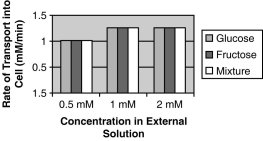
(Essay)
4.9/5 (75)
(75) 
Filters
- Essay(0)
- Multiple Choice(0)
- Short Answer(0)
- True False(0)
- Matching(0)