



 Chat with AI
Exam 5: Membrane Dynamics

Exam 1: Introduction to Physiology63 Questions
Exam 2: Molecular Interactions149 Questions
Exam 3: Compartmentation: Cells and Tissues159 Questions
Exam 4: Energy and Cellular Metabolism144 Questions
Exam 5: Membrane Dynamics136 Questions
Exam 6: Communication, Integration, and Homeostasis79 Questions
Exam 7: Introduction to the Endocrine System76 Questions
Exam 8: Neurons: Cellular and Network Properties223 Questions
Exam 9: The Central Nervous System107 Questions
Exam 10: Sensory Physiology173 Questions
Exam 11: Efferent Division: Autonomic and Somatic Motor Control75 Questions
Exam 12: Muscles100 Questions
Exam 13: Integrative Physiology I: Control of Body Movement69 Questions
Exam 14: Cardiovascular Physiology184 Questions
Exam 15: Blood Flow and the Control of Blood Pressure121 Questions
Exam 16: Blood107 Questions
Exam 17: Mechanics of Breathing117 Questions
Exam 18: Gas Exchange and Transport84 Questions
Exam 19: The Kidneys75 Questions
Exam 20: Integrative Physiology II: Fluid and Electrolyte Balance80 Questions
Exam 21: The Digestive System131 Questions
Exam 22: Metabolism and Energy Balance132 Questions
Exam 23: Endocrine Control of Growth and Metabolism97 Questions
Exam 24: The Immune System116 Questions
Exam 25: Integrative Physiology III: Exercise62 Questions
Exam 26: Reproduction and Development122 Questions
Select questions type


The two extracellular compartments in the body are ________ and ________.
(Short Answer)
4.7/5  (75)
(75) Carrier proteins operating at their maximum rate are said to be ________.
(Short Answer)
5.0/5 (82)
(82) The walls of the ________ separate the two extracellular fluid compartments.
(Short Answer)
4.7/5 (91)
(91) Which of the following is NOT involved in creating the resting potential of a neuron?
(Multiple Choice)
4.9/5 (83)
(83) The membrane proteins that catalyze reactions that take place on the external or internal surface of the cell are ________.
(Short Answer)
4.8/5 (81)
(81) Explain how the body can be in a state of osmotic equilibrium and chemical disequilibrium.
(Essay)
5.0/5 (80)
(80) Explain the process of secondary active transport and how it uses ATP.
(Essay)
4.8/5 (71)
(71) If a 10% sucrose solution is separated from a 20% sucrose solution by a membrane permeable to sucrose,in which direction will net diffusion of sucrose take place?
(Multiple Choice)
4.9/5 (83)
(83) Match the terms to changes presented,assuming a resting membrane potential of -70 mV.Answers may be used once,more than once,or not at all.
-to -90 mV from resting potential
(Multiple Choice)
4.9/5 (65)
(65) Match the transport process to its description.
-the movement of molecules from an area of high concentration to an area of low concentration
(Multiple Choice)
4.9/5 (77)
(77) Voltage-gated (voltage-dependent)channels and antiport carriers are both types of
(Multiple Choice)
4.9/5 (91)
(91) Match the transport process to its description.
-conform(s)to the properties of specificity,competition,and saturation
(Multiple Choice)
4.9/5 (78)
(78) Match the terms to changes presented,assuming a resting membrane potential of -70 mV.Answers may be used once,more than once,or not at all.
-any value other than 0 mV,regardless of relationship to resting potential
(Multiple Choice)
4.8/5 (73)
(73) You are walking to school one day when you notice an alien spaceship that has crashed in a nearby field.You and some other physiology students collect samples from the beings inside of the spaceship.First,you collect a liquid sample of what appears to be alien blood so that you can test for the concentration of solutes inside the alien blood cells.You then extract some of these cells,place them in various concentrations of glucose in water,then look at them under the microscope.Below is what happens to the cells when they are placed in various concentrations of glucose:
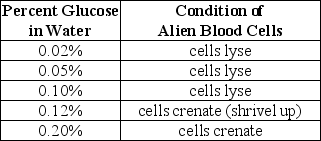 Table 5.1
-Refer to Table 5.1.From cells located in another part of the alien's body,you find that the protein-to-lipid ratio of the cell membrane is about 20% protein,78% lipid,and 2% carbohydrate.Assuming the aliens use their cells as Earthlings do,and have the same terrestrial physiology,what is the most likely function of these cells?
Table 5.1
-Refer to Table 5.1.From cells located in another part of the alien's body,you find that the protein-to-lipid ratio of the cell membrane is about 20% protein,78% lipid,and 2% carbohydrate.Assuming the aliens use their cells as Earthlings do,and have the same terrestrial physiology,what is the most likely function of these cells? (Essay)
4.8/5 (76)
(76) Compare and contrast primary active transport and secondary active transport,noting any special differences.
(Essay)
4.8/5 (94)
(94) Match the potential or potential change with the causative circumstances.Assume ion movements are net movements.Answers may be used more than once or not at all.
-Cl- enters the cell
(Multiple Choice)
5.0/5 (91)
(91) There are two solutions separated by a semipermeable membrane.Solution a is 0.2 M NaCl and solution b is 0.1 M CaCl2.Will there be a net flow of water across the membrane? Why or why not?
(Essay)
4.9/5 (79)
(79) Which property of diffusion best helps explain the necessity of the circulatory system in multicellular organisms?
(Multiple Choice)
4.9/5 (90)
(90) Sodium ions are more concentrated in the extracellular fluid than in the intracellular fluid.This is an example of
(Multiple Choice)
4.8/5 (75)
(75) 
Filters
- Essay(0)
- Multiple Choice(0)
- Short Answer(0)
- True False(0)
- Matching(0)