



 Chat with AI
Exam 5: Membrane Dynamics

Exam 1: Introduction to Physiology63 Questions
Exam 2: Molecular Interactions149 Questions
Exam 3: Compartmentation: Cells and Tissues159 Questions
Exam 4: Energy and Cellular Metabolism144 Questions
Exam 5: Membrane Dynamics136 Questions
Exam 6: Communication, Integration, and Homeostasis79 Questions
Exam 7: Introduction to the Endocrine System76 Questions
Exam 8: Neurons: Cellular and Network Properties223 Questions
Exam 9: The Central Nervous System107 Questions
Exam 10: Sensory Physiology173 Questions
Exam 11: Efferent Division: Autonomic and Somatic Motor Control75 Questions
Exam 12: Muscles100 Questions
Exam 13: Integrative Physiology I: Control of Body Movement69 Questions
Exam 14: Cardiovascular Physiology184 Questions
Exam 15: Blood Flow and the Control of Blood Pressure121 Questions
Exam 16: Blood107 Questions
Exam 17: Mechanics of Breathing117 Questions
Exam 18: Gas Exchange and Transport84 Questions
Exam 19: The Kidneys75 Questions
Exam 20: Integrative Physiology II: Fluid and Electrolyte Balance80 Questions
Exam 21: The Digestive System131 Questions
Exam 22: Metabolism and Energy Balance132 Questions
Exam 23: Endocrine Control of Growth and Metabolism97 Questions
Exam 24: The Immune System116 Questions
Exam 25: Integrative Physiology III: Exercise62 Questions
Exam 26: Reproduction and Development122 Questions
Select questions type


Define the term transport maximum and describe a way cells can increase their transport capacity.
(Essay)
5.0/5  (87)
(87) This type of membrane protein extends all the way through the cell membrane into both the extra- and intracellular fluids: ________.
(Short Answer)
4.7/5 (59)
(59) Explain the differences between channel proteins and carrier proteins and why cells need both.
(Essay)
4.8/5 (75)
(75) Which of the following is a way for solutes in an aqueous solution to move from an area of high solute concentration to an area of low solute concentration?
(Multiple Choice)
4.9/5 (80)
(80) Explain the difference between Fick's law of diffusion and the flux of a molecule.
(Essay)
5.0/5 (79)
(79) The inside of a resting cell is slightly negative relative to the outside.This is an example of
(Multiple Choice)
4.7/5 (98)
(98) Match the terms to changes presented,assuming a resting membrane potential of -70 mV.Answers may be used once,more than once,or not at all.
-to +30 mV from resting potential
(Multiple Choice)
4.8/5 (79)
(79) The means by which a cell transports large molecules out of the cell is called
(Multiple Choice)
4.9/5 (80)
(80) Match the terms to changes presented,assuming a resting membrane potential of -70 mV.Answers may be used once,more than once,or not at all.
-to -70 mV from -90 mV
(Multiple Choice)
4.8/5 (88)
(88) Diuretics cause the kidneys to produce large amounts of urine.Unfortunately,they can also cause the loss of large quantities of K+ in the urine.What effect might prolonged use of diuretics have on nerve or muscle cells?
(Essay)
4.9/5 (80)
(80) Match the transport process to its description.
-the use of ATP to move molecules
(Multiple Choice)
4.8/5 (79)
(79) Explain why transporting epithelial cells are said to be polarized.What does it mean when a nerve cell is said to be polarized?
(Essay)
4.8/5 (77)
(77) A cell that is permeable to Solute X is placed into solution containing a higher concentration of X.Diffusion occurs until equilibrium is attained.At this time,
(Multiple Choice)
4.8/5 (75)
(75) Membrane protein pores that can be opened and closed are called ________ channels.
(Short Answer)
4.9/5 (84)
(84) You are walking to school one day when you notice an alien spaceship that has crashed in a nearby field.You and some other physiology students collect samples from the beings inside of the spaceship.First,you collect a liquid sample of what appears to be alien blood so that you can test for the concentration of solutes inside the alien blood cells.You then extract some of these cells,place them in various concentrations of glucose in water,then look at them under the microscope.Below is what happens to the cells when they are placed in various concentrations of glucose:
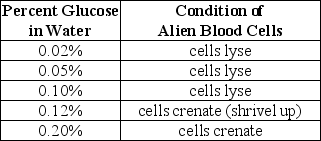 Table 5.1
-Refer to Table 5.1.How can you determine the osmolarity and tonicity of the alien blood and alien cells?
Table 5.1
-Refer to Table 5.1.How can you determine the osmolarity and tonicity of the alien blood and alien cells? (Essay)
4.9/5 (84)
(84) 
Filters
- Essay(0)
- Multiple Choice(0)
- Short Answer(0)
- True False(0)
- Matching(0)