



 Chat with AI
Exam 17: Oligopoly

Exam 1: Ten Principles of Economics281 Questions
Exam 2: Thinking Like an Economist451 Questions
Exam 3: Interdependence and the Gains From Trade353 Questions
Exam 4: The Market Forces of Supply and Demand467 Questions
Exam 5: Elasticity and Its Application409 Questions
Exam 6: Supply, Demand, and Government Policies459 Questions
Exam 7: Consumers, Producers, and the Efficiency of Markets363 Questions
Exam 8: Application: The Costs of Taxation353 Questions
Exam 9: Application: International Trade333 Questions
Exam 10: Externalities352 Questions
Exam 11: Public Goods and Common Resources270 Questions
Exam 12: The Design of the Tax System397 Questions
Exam 13: The Costs of Production434 Questions
Exam 14: Firms in Competitive Markets381 Questions
Exam 15: Monopoly427 Questions
Exam 16: Monopolistic Competition416 Questions
Exam 17: Oligopoly325 Questions
Exam 18: The Markets for the Factors of Production361 Questions
Exam 19: Earnings and Discrimination335 Questions
Exam 20: Income Inequality and Poverty312 Questions
Exam 21: The Theory of Consumer Choice354 Questions
Exam 22: Frontiers of Microeconomics262 Questions
Exam 23: Measuring a Nations Income343 Questions
Exam 24: Measuring the Cost of Living358 Questions
Exam 25: Production and Growth335 Questions
Exam 26: Saving, investment, and the Financial System381 Questions
Exam 27: The Basic Tools of Finance336 Questions
Exam 28: Unemployment533 Questions
Exam 29: The Monetary System366 Questions
Exam 30: Money Growth and Inflation312 Questions
Exam 31: Open-Economy Macroeconomics: Basic Concepts346 Questions
Exam 32: A Macroeconomic Theory of the Open Economy300 Questions
Exam 33: Aggregate Demand and Aggregate Supply386 Questions
Exam 34: The Influence of Monetary and Fiscal Policy on Aggregate Demand334 Questions
Exam 35: The Short-Run Trade-Off Between Inflation and Unemployment306 Questions
Exam 36: Five Debates Over Macroeconomic Policy179 Questions
Select questions type


Table 17-1
Imagine a small town in which only two residents,Lisa and Mark,own wells that produce safe drinking water.Each week Lisa and Mark work together to decide how many gallons of water to pump.They bring the water to town and sell it at whatever price the market will bear.To keep things simple,suppose that Lisa and Mark can pump as much water as they want without cost so that the marginal cost of water equals zero.The weekly town demand schedule and total revenue schedule for water is shown in the table below:
 -Refer to Table 17-1.If Lisa and Mark operate as a profit-maximizing monopoly in the market for water,how many gallons of water will be produced and sold?
 (Multiple Choice)
5.0/5  (92)
(92) Ford and General Motors are considering expanding into the Vietnamese automobile market.Devise a simple prisoners' dilemma game to demonstrate the strategic considerations that are relevant to this decision.
(Essay)
4.9/5 (81)
(81) Table 17-15.This table shows a game played between two firms,Firm A and Firm B.In this game each firm must decide how much output (Q)to produce: 2 units or 3 units.The profit for each firm is given in the table as (Profit for Firm A,Profit for Firm B).
 -Refer to Table 17-15.In this game,
 (Multiple Choice)
4.8/5 (70)
(70) Scenario 17-1.Assume that the countries of Irun and Urun are the only two producers of crude oil.Further assume that both countries have entered into an agreement to maintain certain production levels in order to maximize profits.In the world market for oil,the demand curve is downward sloping.
-Refer to Scenario 17-1.As long as the combined level of output is less than the Nash equilibrium level,both Irun and Urun have the individual incentive to
(Multiple Choice)
4.8/5 (84)
(84) Table 17-13.This table shows a game played between two players,A and B.The payoffs in the table are shown as (Payoff to A,Payoff to B).
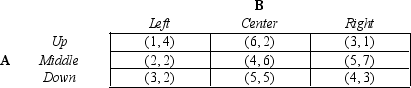 -Refer to Table 17-13.Which of the following outcomes represents a Nash equilibrium in the game?
 (Multiple Choice)
4.8/5 (67)
(67) Table 17-5.Imagine a small town in which only two residents,Bill and Ben,own wells that produce safe drinking water.Each week Bill and Ben work together to decide how many gallons of water to pump,to bring the water to town,and to sell it at whatever price the market will bear.Assume Bill and Ben can pump as much water as they want without cost so that the marginal cost of water equals zero.
The weekly town demand schedule and total revenue schedule for water are shown in the table below.
 -Refer to Table 17-5.As long as Bill and Ben operate as a profit-maximizing monopoly,what will their combined weekly revenue amount to?
 (Multiple Choice)
4.8/5 (85)
(85) To move the allocation of resources closer to the social optimum,policymakers should typically try to induce firms in an oligopoly to
(Multiple Choice)
4.8/5 (75)
(75) In the prisoners' dilemma game,confessing is a dominant strategy for each of the two prisoners.
(True/False)
4.9/5 (76)
(76) Table 17-5.Imagine a small town in which only two residents,Bill and Ben,own wells that produce safe drinking water.Each week Bill and Ben work together to decide how many gallons of water to pump,to bring the water to town,and to sell it at whatever price the market will bear.Assume Bill and Ben can pump as much water as they want without cost so that the marginal cost of water equals zero.
The weekly town demand schedule and total revenue schedule for water are shown in the table below.
-Refer to Table 17-5.Since Bill and Ben operate as a profit-maximizing monopoly in the market for water,what price will they charge for water?
-Refer to Table 17-5.Since Bill and Ben operate as a profit-maximizing monopoly in the market for water,what price will they charge for water? (Multiple Choice)
4.9/5 (74)
(74) Table 17-1
Imagine a small town in which only two residents,Lisa and Mark,own wells that produce safe drinking water.Each week Lisa and Mark work together to decide how many gallons of water to pump.They bring the water to town and sell it at whatever price the market will bear.To keep things simple,suppose that Lisa and Mark can pump as much water as they want without cost so that the marginal cost of water equals zero.The weekly town demand schedule and total revenue schedule for water is shown in the table below:
-Refer to Table 17-1.If Lisa and Mark operate as a profit-maximizing monopoly in the market for water,how much profit will each of them earn?
-Refer to Table 17-1.If Lisa and Mark operate as a profit-maximizing monopoly in the market for water,how much profit will each of them earn? (Multiple Choice)
4.8/5 (82)
(82) Table 17-17.Consider a small town that has two grocery stores from which residents can choose to buy a gallon of milk.The store owners each must make a decision to set a high milk price or a low milk price.The payoff table,showing profit per week,is provided below.The profit in each cell is shown as (Store 1,Store 2).
 -Refer to Table 17-17.What is grocery store 1's dominant strategy?
 (Multiple Choice)
4.8/5 (68)
(68) Very often,the reason that players can solve the prisoners' dilemma and reach the most profitable outcome is that
(Multiple Choice)
4.8/5 (85)
(85) A particular cable TV company requires a household to subscribe to its high-speed Internet service if it subscribes to cable TV,and vice versa.This practice
(Multiple Choice)
4.8/5 (94)
(94) Table 17-12.This table shows a game played between two players,A and B.The payoffs in the table are shown as (Payoff to A,Payoff to B).
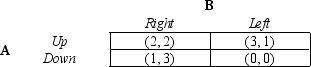 -Refer to Table 17-12.Which of the following statements about this game is true?
 (Multiple Choice)
4.9/5 (68)
(68) Laurel and Janet are competitors in a local market and each is trying to decide if it is worthwhile to advertise.If both of them advertise,each will earn a profit of $5,000.If neither of them advertise,each will earn a profit of $10,000.If one advertises and the other doesn't,then the one who advertises will earn a profit of $12,000 and the other will earn $2,000.In this version of the prisoners' dilemma,if the game is played only once,Laurel should
(Multiple Choice)
4.9/5 (82)
(82) 
Filters
- Essay(0)
- Multiple Choice(0)
- Short Answer(0)
- True False(0)
- Matching(0)