



 Chat with AI
Exam 17: Oligopoly

Exam 1: Ten Principles of Economics281 Questions
Exam 2: Thinking Like an Economist451 Questions
Exam 3: Interdependence and the Gains From Trade353 Questions
Exam 4: The Market Forces of Supply and Demand467 Questions
Exam 5: Elasticity and Its Application409 Questions
Exam 6: Supply, Demand, and Government Policies459 Questions
Exam 7: Consumers, Producers, and the Efficiency of Markets363 Questions
Exam 8: Application: The Costs of Taxation353 Questions
Exam 9: Application: International Trade333 Questions
Exam 10: Externalities352 Questions
Exam 11: Public Goods and Common Resources270 Questions
Exam 12: The Design of the Tax System397 Questions
Exam 13: The Costs of Production434 Questions
Exam 14: Firms in Competitive Markets381 Questions
Exam 15: Monopoly427 Questions
Exam 16: Monopolistic Competition416 Questions
Exam 17: Oligopoly325 Questions
Exam 18: The Markets for the Factors of Production361 Questions
Exam 19: Earnings and Discrimination335 Questions
Exam 20: Income Inequality and Poverty312 Questions
Exam 21: The Theory of Consumer Choice354 Questions
Exam 22: Frontiers of Microeconomics262 Questions
Exam 23: Measuring a Nations Income343 Questions
Exam 24: Measuring the Cost of Living358 Questions
Exam 25: Production and Growth335 Questions
Exam 26: Saving, investment, and the Financial System381 Questions
Exam 27: The Basic Tools of Finance336 Questions
Exam 28: Unemployment533 Questions
Exam 29: The Monetary System366 Questions
Exam 30: Money Growth and Inflation312 Questions
Exam 31: Open-Economy Macroeconomics: Basic Concepts346 Questions
Exam 32: A Macroeconomic Theory of the Open Economy300 Questions
Exam 33: Aggregate Demand and Aggregate Supply386 Questions
Exam 34: The Influence of Monetary and Fiscal Policy on Aggregate Demand334 Questions
Exam 35: The Short-Run Trade-Off Between Inflation and Unemployment306 Questions
Exam 36: Five Debates Over Macroeconomic Policy179 Questions
Select questions type


An agreement between two duopolists to function as a monopolist usually breaks down because
(Multiple Choice)
4.9/5  (75)
(75) Figure 17-3.Katie and Taylor are roommates.On a particular day,their lawn needs to be mowed.Each person has to decide whether to take part in mowing the lawn.At the end of the day,either the lawn will be mowed (if one or both roommates take part in mowing),or it will remain unmowed (if neither roommate mows).With happiness measured on a scale of 1 (very unhappy)to 10 (very happy),the possible outcomes are as follows:  -Refer to Figure 17-3.The dominant strategy for Taylor is to
 (Multiple Choice)
4.9/5 (78)
(78) Game theory is just as necessary for understanding competitive or monopoly markets as it is for understanding oligopolistic markets.
(True/False)
4.8/5 (69)
(69) The likely outcome of the standard prisoners' dilemma game is that
(Multiple Choice)
4.8/5 (70)
(70) Table 17-10
Each year the United States considers renewal of Most Favored Nation (MFN)trading status with Farland (a mythical nation).Historically,legislators have made threats of not renewing MFN status because of human rights abuses in Farland.The non-renewal of MFN trading status is likely to involve some retaliatory measures by Farland.The payoff table below shows the potential economic gains associated with a game in which Farland may impose trade sanctions against U.S.firms and the United States may not renew MFN status with Farland.The table contains the dollar value of all trade-flow benefits to the United States and Farland.
 -Refer to Table 17-10.Pursuing its own best interests,Farland will impose trade sanctions against U.S.firms
 (Multiple Choice)
4.8/5 (90)
(90) Table 17-5.Imagine a small town in which only two residents,Bill and Ben,own wells that produce safe drinking water.Each week Bill and Ben work together to decide how many gallons of water to pump,to bring the water to town,and to sell it at whatever price the market will bear.Assume Bill and Ben can pump as much water as they want without cost so that the marginal cost of water equals zero.
The weekly town demand schedule and total revenue schedule for water are shown in the table below.
 -Refer to Table 17-5.If the market for water were perfectly competitive instead of monopolistic,how many gallons of water would be produced and sold?
 (Multiple Choice)
5.0/5 (70)
(70) Suppose that two poker players believe that they are superior players to the rest of the people at their table.Further suppose that the two players make an agreement to concede hands to each other in order to drive the other players from the game first.Economists would model such behavior as
(Multiple Choice)
4.9/5 (96)
(96) Scenario 17-2.Imagine that two oil companies,Lexxon and PB,own adjacent oil fields.Under the fields is a common pool of oil worth $48 million.Drilling a well to recover oil costs $4 million per well.If each company drills one well,each will get half of the oil and earn a $20 million profit ($24 million in revenue - $4 million in costs).Assume that having X percent of the total wells means that a company will collect X percent of the total revenue.
-Refer to Scenario 17-2.If Lexxon were to drill a second well and PB also drilled a second well,what would Lexxon's profit be?
(Multiple Choice)
4.8/5 (78)
(78) Table 17-1
Imagine a small town in which only two residents,Lisa and Mark,own wells that produce safe drinking water.Each week Lisa and Mark work together to decide how many gallons of water to pump.They bring the water to town and sell it at whatever price the market will bear.To keep things simple,suppose that Lisa and Mark can pump as much water as they want without cost so that the marginal cost of water equals zero.The weekly town demand schedule and total revenue schedule for water is shown in the table below:
 -Refer to Table 17-1.Suppose the town enacts new antitrust laws that prohibit Lisa and Mark from operating as a monopoly.How many gallons of water will be produced and sold once Lisa and Mark reach a Nash equilibrium?
 (Multiple Choice)
4.9/5 (84)
(84) As the number of firms in an oligopoly increases,the price approaches
(Multiple Choice)
4.8/5 (78)
(78) Table 17-9
Two cigarette manufacturers (Firm A and Firm B)are faced with lawsuits from states to recover the healthcare related expenses associated with cigarette smoking.Both cigarette firms have evidence that indicates that cigarette smoke causes lung cancer (and other related illnesses).State prosecutors do not have access to the same data used by cigarette manufacturers and thus will have difficulty recovering full costs without the help of at least one cigarette firm study.Each firm has been presented with an opportunity to lower its liability in the suit if it cooperates with attorneys representing the states.
 -Refer to Table 17-9.Pursuing its own best interests,Firm A will concede that cigarette smoke causes lung cancer
 (Multiple Choice)
4.8/5 (70)
(70) In a particular town,Metrovision and Cableview are the only two providers of cable TV service.Metrovision and Cableview constitute a
(Multiple Choice)
4.9/5 (71)
(71) Table 17-6.The table shows the demand schedule for a particular product.
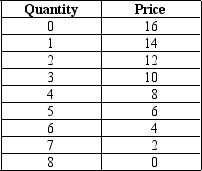 -Refer to Table 17-6.Suppose the market for this product is served by two firms that have formed a cartel.What price will the cartel charge in this market if the marginal cost of production is $0?
 (Multiple Choice)
4.8/5 (86)
(86) A key issue in the Microsoft case involved whether or not the bundling of the Windows operating system with an Internet browser was an example of
(Multiple Choice)
4.9/5 (74)
(74) Table 17-18.Amy and Heather are two college roommates who both prefer a clean common space in their dorm room,but neither enjoys cleaning.The roommates must each make a decision to either clean or not clean the dorm room's common space.The payoff table for this situation is provided below,where the higher a player's payoff number,the better off that player is.The payoffs in each cell are shown as (payoff for Amy,payoff for Heather).
 -Refer to Table 17-18.What is Heather's dominant strategy?
 (Multiple Choice)
4.8/5 (88)
(88) Table 17-16.This table shows a game played between two firms,Firm A and Firm B.In this game each firm must decide how much output (Q)to produce: 5 units or 6 units.The profit for each firm is given in the table as (Profit for Firm A,Profit for Firm B).
 -Refer to Table 17-16.The dominant strategy For Firm A is to produce
 (Multiple Choice)
4.8/5 (90)
(90) When the prisoners' dilemma game is generalized to describe situations other than those that literally involve two prisoners,we see that cooperation between the players of the game
(Multiple Choice)
4.9/5 (84)
(84) Table 17-18.Amy and Heather are two college roommates who both prefer a clean common space in their dorm room,but neither enjoys cleaning.The roommates must each make a decision to either clean or not clean the dorm room's common space.The payoff table for this situation is provided below,where the higher a player's payoff number,the better off that player is.The payoffs in each cell are shown as (payoff for Amy,payoff for Heather).
-Refer to Table 17-18.What is the Nash Equilibrium in this dorm room cleaning game?
-Refer to Table 17-18.What is the Nash Equilibrium in this dorm room cleaning game? (Multiple Choice)
4.9/5 (83)
(83) Figure 17-1.Two companies,ABC and XYZ,each decide whether to produce a high level of output or a low level of output.In the figure,the dollar amounts are payoffs and they represent annual profits for the two companies.  -Refer to Figure 17-1.The dominant strategy for ABC is to
 (Multiple Choice)
4.9/5 (72)
(72) If nations such as Germany,Japan,and the United States prohibited international trade in automobiles,a likely effect would be that
(Multiple Choice)
4.8/5 (86)
(86) 
Filters
- Essay(0)
- Multiple Choice(0)
- Short Answer(0)
- True False(0)
- Matching(0)