



 Chat with AI
Exam 17: Oligopoly

Exam 1: Ten Principles of Economics281 Questions
Exam 2: Thinking Like an Economist451 Questions
Exam 3: Interdependence and the Gains From Trade353 Questions
Exam 4: The Market Forces of Supply and Demand467 Questions
Exam 5: Elasticity and Its Application409 Questions
Exam 6: Supply, Demand, and Government Policies459 Questions
Exam 7: Consumers, Producers, and the Efficiency of Markets363 Questions
Exam 8: Application: The Costs of Taxation353 Questions
Exam 9: Application: International Trade333 Questions
Exam 10: Externalities352 Questions
Exam 11: Public Goods and Common Resources270 Questions
Exam 12: The Design of the Tax System397 Questions
Exam 13: The Costs of Production434 Questions
Exam 14: Firms in Competitive Markets381 Questions
Exam 15: Monopoly427 Questions
Exam 16: Monopolistic Competition416 Questions
Exam 17: Oligopoly325 Questions
Exam 18: The Markets for the Factors of Production361 Questions
Exam 19: Earnings and Discrimination335 Questions
Exam 20: Income Inequality and Poverty312 Questions
Exam 21: The Theory of Consumer Choice354 Questions
Exam 22: Frontiers of Microeconomics262 Questions
Exam 23: Measuring a Nations Income343 Questions
Exam 24: Measuring the Cost of Living358 Questions
Exam 25: Production and Growth335 Questions
Exam 26: Saving, investment, and the Financial System381 Questions
Exam 27: The Basic Tools of Finance336 Questions
Exam 28: Unemployment533 Questions
Exam 29: The Monetary System366 Questions
Exam 30: Money Growth and Inflation312 Questions
Exam 31: Open-Economy Macroeconomics: Basic Concepts346 Questions
Exam 32: A Macroeconomic Theory of the Open Economy300 Questions
Exam 33: Aggregate Demand and Aggregate Supply386 Questions
Exam 34: The Influence of Monetary and Fiscal Policy on Aggregate Demand334 Questions
Exam 35: The Short-Run Trade-Off Between Inflation and Unemployment306 Questions
Exam 36: Five Debates Over Macroeconomic Policy179 Questions
Select questions type


Scenario 17-3.Consider two countries,Muria and Zenya,that are engaged in an arms race.Each country must decide whether to build new weapons or to disarm existing weapons.Each country prefers to have more arms than the other because a large arsenal gives it more influence in world affairs.But each country also prefers to live in a world safe from the other country's weapons.The following table shows the possible outcomes for each decision combination.The numbers in each cell represent the country's ranking of the outcome (4 = best outcome,1 = worst outcome).
 -Refer to Scenario 17-3.If Zenya chooses to disarm its existing weapons,then Muria will
 (Multiple Choice)
5.0/5  (86)
(86) Figure 17-1.Two companies,ABC and XYZ,each decide whether to produce a high level of output or a low level of output.In the figure,the dollar amounts are payoffs and they represent annual profits for the two companies.  -Refer to Figure 17-1.If this game is played only once,then the most likely outcome is that
 (Multiple Choice)
4.8/5 (74)
(74) Scenario 17-1.Assume that the countries of Irun and Urun are the only two producers of crude oil.Further assume that both countries have entered into an agreement to maintain certain production levels in order to maximize profits.In the world market for oil,the demand curve is downward sloping.
-Refer to Scenario 17-1.If Irun fails to live up to the production agreement and overproduces,which of the following statements will be true of Urun's condition?
(Multiple Choice)
4.9/5 (85)
(85) Because each oligopolist cares about its own profit rather than the collective profit of all the oligopolists together,
(Multiple Choice)
4.8/5 (69)
(69) Scenario 17-3.Consider two countries,Muria and Zenya,that are engaged in an arms race.Each country must decide whether to build new weapons or to disarm existing weapons.Each country prefers to have more arms than the other because a large arsenal gives it more influence in world affairs.But each country also prefers to live in a world safe from the other country's weapons.The following table shows the possible outcomes for each decision combination.The numbers in each cell represent the country's ranking of the outcome (4 = best outcome,1 = worst outcome).
-Refer to Scenario 17-3.Building new weapons is a dominant strategy for
-Refer to Scenario 17-3.Building new weapons is a dominant strategy for (Multiple Choice)
4.9/5 (81)
(81) If all of the firms in an oligopoly successfully collude and form a cartel,then total profit for the cartel is equal to what it would be if the market were a monopoly.
(True/False)
4.8/5 (77)
(77) Scenario 17-5
Assume that a local bank sells two services,checking accounts and ATM card services.The bank's only two customers are Mr.Donethat and Ms.Beenthere.Mr.Donethat is willing to pay $8 a month for the bank to service his checking account and $2 a month for unlimited use of his ATM card.Ms.Beenthere is willing to pay only $5 for a checking account,but is willing to pay $9 for unlimited use of her ATM card.Assume that the bank can provide each of these services at zero marginal cost.
-Refer to Scenario 17-5.If the bank is able to use tying to price checking account and ATM services,what is the profit-maximizing price to charge for the "tied" good?
(Multiple Choice)
4.8/5 (86)
(86) After initial success,the OPEC cartel saw the price of oil and the revenues of its members decline due,in part,to
(Multiple Choice)
4.8/5 (73)
(73) Assume that demand for a product that is produced at zero marginal cost is reflected in the table below.
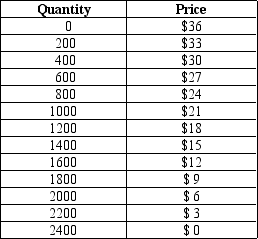 a.What is the profit-maximizing level of production for a group of oligopolistic firms that operate as a cartel?
b.Assume that this market is characterized by a duopoly in which collusive agreements are illegal.What market price and quantity will be associated with a Nash equilibrium?
a.What is the profit-maximizing level of production for a group of oligopolistic firms that operate as a cartel?
b.Assume that this market is characterized by a duopoly in which collusive agreements are illegal.What market price and quantity will be associated with a Nash equilibrium? (Essay)
4.7/5 (84)
(84) If an oligopolist is part of a cartel that is collectively producing the monopoly level of output,then that oligopolist has the incentive to lower production with the aim of
(Multiple Choice)
4.9/5 (88)
(88) Some business practices that appear to reduce competition,such as resale price maintenance,may have legitimate economic purposes.
(True/False)
4.8/5 (73)
(73) During the 1990s,the members of OPEC operated independently from one another,causing the world market for crude oil to become close to
(Multiple Choice)
4.7/5 (82)
(82) When firms are faced with making strategic choices in order to maximize profit,economists typically use
(Multiple Choice)
5.0/5 (68)
(68) Table 17-7.The table shows the demand schedule for a particular product.
 -Refer to Table 17-7.Suppose the market for this product is served by two duopolists who have formed a cartel and are colluding to set the price and quantity in this market.If the marginal cost to produce this product is constant at $2 per unit,then what price will the cartel set in this market?
 (Multiple Choice)
4.9/5 (84)
(84) Table 17-2.The table shows the town of Pittsville's demand schedule for gasoline.For simplicity,assume the town's gasoline seller(s)incur no costs in selling gasoline.
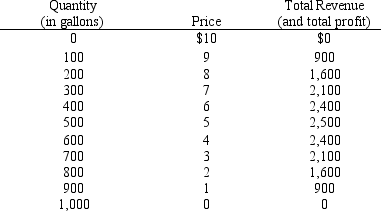 -Refer to Table 17-2.If the market for gasoline in Pittsville is perfectly competitive,then the equilibrium price of gasoline is
 (Multiple Choice)
4.9/5 (83)
(83) Scenario 17-5
Assume that a local bank sells two services,checking accounts and ATM card services.The bank's only two customers are Mr.Donethat and Ms.Beenthere.Mr.Donethat is willing to pay $8 a month for the bank to service his checking account and $2 a month for unlimited use of his ATM card.Ms.Beenthere is willing to pay only $5 for a checking account,but is willing to pay $9 for unlimited use of her ATM card.Assume that the bank can provide each of these services at zero marginal cost.
-Refer to Scenario 17-5.How much additional profit can the bank earn by switching to the use of a tying strategy to price checking accounts and ATM service rather than pricing these services separately?
(Multiple Choice)
4.7/5 (67)
(67) 
Filters
- Essay(0)
- Multiple Choice(0)
- Short Answer(0)
- True False(0)
- Matching(0)