



 Chat with AI
Exam 4: The Market Forces of Supply and Demand

Exam 1: Ten Principles of Economics281 Questions
Exam 2: Thinking Like an Economist451 Questions
Exam 3: Interdependence and the Gains From Trade353 Questions
Exam 4: The Market Forces of Supply and Demand467 Questions
Exam 5: Elasticity and Its Application409 Questions
Exam 6: Supply, Demand, and Government Policies459 Questions
Exam 7: Consumers, Producers, and the Efficiency of Markets363 Questions
Exam 8: Application: The Costs of Taxation353 Questions
Exam 9: Application: International Trade333 Questions
Exam 10: Externalities352 Questions
Exam 11: Public Goods and Common Resources270 Questions
Exam 12: The Design of the Tax System397 Questions
Exam 13: The Costs of Production434 Questions
Exam 14: Firms in Competitive Markets381 Questions
Exam 15: Monopoly427 Questions
Exam 16: Monopolistic Competition416 Questions
Exam 17: Oligopoly325 Questions
Exam 18: The Markets for the Factors of Production361 Questions
Exam 19: Earnings and Discrimination335 Questions
Exam 20: Income Inequality and Poverty312 Questions
Exam 21: The Theory of Consumer Choice354 Questions
Exam 22: Frontiers of Microeconomics262 Questions
Exam 23: Measuring a Nations Income343 Questions
Exam 24: Measuring the Cost of Living358 Questions
Exam 25: Production and Growth335 Questions
Exam 26: Saving, investment, and the Financial System381 Questions
Exam 27: The Basic Tools of Finance336 Questions
Exam 28: Unemployment533 Questions
Exam 29: The Monetary System366 Questions
Exam 30: Money Growth and Inflation312 Questions
Exam 31: Open-Economy Macroeconomics: Basic Concepts346 Questions
Exam 32: A Macroeconomic Theory of the Open Economy300 Questions
Exam 33: Aggregate Demand and Aggregate Supply386 Questions
Exam 34: The Influence of Monetary and Fiscal Policy on Aggregate Demand334 Questions
Exam 35: The Short-Run Trade-Off Between Inflation and Unemployment306 Questions
Exam 36: Five Debates Over Macroeconomic Policy179 Questions
Select questions type


Suppose the number of buyers in a market increases and a technological advancement occurs also.What would we expect to happen in the market?

Free
(Multiple Choice)
4.8/5  (94)
(94) Correct Answer: Verified
D
The law of supply states that,other things equal,
Free
(Multiple Choice)
4.8/5 (76)
(76) Correct Answer:Verified
VerifiedA
Cocoa and marshmallows are complements,so a decrease in the price of cocoa will cause an increase in the demand for marshmallows.
Free
(True/False)
4.8/5 (95)
(95) Correct Answer:Verified
VerifiedTrue
The market for diamond rings is closely linked to the market for high-quality diamonds.If a large quantity of high-quality diamonds enters the market,then
(Multiple Choice)
4.8/5 (82)
(82) The difference between a supply schedule and a supply curve is that
(Multiple Choice)
4.8/5 (84)
(84) Figure 4-9  -Refer to Figure 4-9.If price in this market is currently $14,then there would be a(n)
 (Multiple Choice)
4.9/5 (73)
(73) The law of supply states that,other things equal,when the price of a good rises,the quantity supplied of the good falls.
(True/False)
4.9/5 (79)
(79) Most studies have found that tobacco and marijuana are complements rather than substitutes.
(True/False)
4.9/5 (83)
(83) When the price of a good is high,selling the good is profitable,and so the quantity supplied is large.
(True/False)
4.8/5 (71)
(71) Figure 4-13
The diagram below pertains to the supply of paper in university markets.  -Refer to Figure 4-13.All else equal,an increase in the price of the pulp used in the paper production process would cause a move
 (Multiple Choice)
4.8/5 (72)
(72) The current price of neckties is $30,but the equilibrium price of neckties is $25.As a result,
(Multiple Choice)
5.0/5 (72)
(72) When quantity supplied exceeds quantity demanded at the current market price,the market has a surplus and market price will likely rise in the future to eliminate the surplus.
(True/False)
4.9/5 (69)
(69) Individual demand curves are summed horizontally to obtain the market demand curve.
(True/False)
4.9/5 (78)
(78) Assume the market for tennis balls is perfectly competitive.When one tennis ball producer exits the market,
(Multiple Choice)
4.7/5 (72)
(72) Figure 4-2 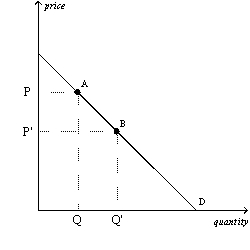 -Refer to Figure 4-2.It is apparent from the figure that
 (Multiple Choice)
4.8/5 (92)
(92) A movement upward and to the left along a given demand curve is called a decrease in demand..
(True/False)
4.9/5 (78)
(78) In a competitive market,each seller has limited control over the price of his product because
(Multiple Choice)
5.0/5 (92)
(92) 
Filters
- Essay(0)
- Multiple Choice(0)
- Short Answer(0)
- True False(0)
- Matching(0)