



 Chat with AI
Exam 4: The Market Forces of Supply and Demand

Exam 1: Ten Principles of Economics281 Questions
Exam 2: Thinking Like an Economist451 Questions
Exam 3: Interdependence and the Gains From Trade353 Questions
Exam 4: The Market Forces of Supply and Demand467 Questions
Exam 5: Elasticity and Its Application409 Questions
Exam 6: Supply, Demand, and Government Policies459 Questions
Exam 7: Consumers, Producers, and the Efficiency of Markets363 Questions
Exam 8: Application: The Costs of Taxation353 Questions
Exam 9: Application: International Trade333 Questions
Exam 10: Externalities352 Questions
Exam 11: Public Goods and Common Resources270 Questions
Exam 12: The Design of the Tax System397 Questions
Exam 13: The Costs of Production434 Questions
Exam 14: Firms in Competitive Markets381 Questions
Exam 15: Monopoly427 Questions
Exam 16: Monopolistic Competition416 Questions
Exam 17: Oligopoly325 Questions
Exam 18: The Markets for the Factors of Production361 Questions
Exam 19: Earnings and Discrimination335 Questions
Exam 20: Income Inequality and Poverty312 Questions
Exam 21: The Theory of Consumer Choice354 Questions
Exam 22: Frontiers of Microeconomics262 Questions
Exam 23: Measuring a Nations Income343 Questions
Exam 24: Measuring the Cost of Living358 Questions
Exam 25: Production and Growth335 Questions
Exam 26: Saving, investment, and the Financial System381 Questions
Exam 27: The Basic Tools of Finance336 Questions
Exam 28: Unemployment533 Questions
Exam 29: The Monetary System366 Questions
Exam 30: Money Growth and Inflation312 Questions
Exam 31: Open-Economy Macroeconomics: Basic Concepts346 Questions
Exam 32: A Macroeconomic Theory of the Open Economy300 Questions
Exam 33: Aggregate Demand and Aggregate Supply386 Questions
Exam 34: The Influence of Monetary and Fiscal Policy on Aggregate Demand334 Questions
Exam 35: The Short-Run Trade-Off Between Inflation and Unemployment306 Questions
Exam 36: Five Debates Over Macroeconomic Policy179 Questions
Select questions type


Figure 4-14
Panel (a)Panel (b) 
 Panel (c)Panel (d)

 -Refer to Figure 4-14.Panel (c)shows which of the following?
Panel (c)Panel (d)
-Refer to Figure 4-14.Panel (c)shows which of the following? (Multiple Choice)
4.7/5  (70)
(70) Figure 4-11  -Refer to Figure 4-11.What is the equilibrium quantity in this market?
 (Multiple Choice)
4.8/5 (73)
(73) In a market economy,who or what determines who produces each good and how much is produced?
(Multiple Choice)
4.9/5 (79)
(79) Sellers as a group determine the demand for a product,and buyers as a group determine the supply of a product.
(True/False)
4.7/5 (79)
(79) Table 4-6
A country club usually only allows members to purchase tickets for its celebrity golf tournament,but the club is considering allowing non-members to purchase tickets this year.The demand and supply schedules are as follows:
 -Refer to Table 4-6.If both members and non-members are allowed to purchase tickets to this year's celebrity golf tournament and the country club sets the ticket price at $20,then there will be
 (Multiple Choice)
4.9/5 (79)
(79) Suppose we are analyzing the market for hot chocolate.Graphically illustrate the impact each of the following would have on demand or supply.Also show how equilibrium price and equilibrium quantity would change.
5.Suppose we are analyzing the market for hot chocolate.Graphically illustrate the impact each of the following would have on demand or supply.Also show how equilibrium price and equilibrium quantity would change.
a.Winter starts and the weather turns sharply colder.
b.The price of tea,a substitute for hot chocolate,falls.
c.The price of cocoa beans decreases.
d.The price of whipped cream falls.
e.A better method of harvesting cocoa beans is introduced.
f.The Surgeon General of the U.S.announces that hot chocolate cures acne.
g.Protesting farmers dump millions of gallons of milk,causing the price of milk to rise.
h.Consumer income falls because of a recession,and hot chocolate is considered a normal good.
i.Producers expect the price of hot chocolate to increase next month.
j.Currently,the price of hot chocolate is $0.50 per cup above equilibrium.
(Essay)
4.9/5 (89)
(89) Figure 4-13
The diagram below pertains to the supply of paper in university markets.  -Refer to Figure 4-13.All else equal,buyers expecting paper to be more expensive in the future would cause a current move
 (Multiple Choice)
4.9/5 (83)
(83) Table 4-2
 -Refer to Table 4-2.If these are the only four buyers in the market,then the market quantity demanded at a price of $8 is
 (Multiple Choice)
4.7/5 (85)
(85) Music compact discs are normal goods.What will happen to the equilibrium price and quantity of music compact discs if musicians accept lower royalties,compact disc players become cheaper,more firms start producing music compact discs,and music lovers experience an increase in income?
(Multiple Choice)
4.8/5 (73)
(73) A movement along the supply curve might be caused by a change in
(Multiple Choice)
4.7/5 (84)
(84) Figure 4-2 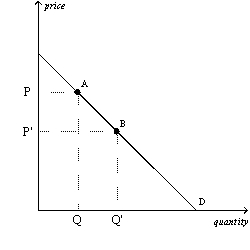 -Refer to Figure 4-2.The movement from point A to point B on the graph is caused by
 (Multiple Choice)
4.9/5 (88)
(88) The actions of buyers and sellers naturally move markets toward equilibrium.
(True/False)
4.9/5 (96)
(96) Figure 4-12
The diagram below pertains to the demand for turkey in the United States.  -Refer to Figure 4-12.All else equal,the destruction of thousands of turkeys would cause a move
 (Multiple Choice)
4.7/5 (73)
(73) An increase in demand will cause an increase in price,which will cause an increase in quantity supplied.
(True/False)
4.8/5 (72)
(72) 
Filters
- Essay(0)
- Multiple Choice(0)
- Short Answer(0)
- True False(0)
- Matching(0)