



 Chat with AI
Exam 18: The Markets for the Factors of Production

Exam 1: Ten Principles of Economics281 Questions
Exam 2: Thinking Like an Economist451 Questions
Exam 3: Interdependence and the Gains From Trade353 Questions
Exam 4: The Market Forces of Supply and Demand467 Questions
Exam 5: Elasticity and Its Application409 Questions
Exam 6: Supply, Demand, and Government Policies459 Questions
Exam 7: Consumers, Producers, and the Efficiency of Markets363 Questions
Exam 8: Application: The Costs of Taxation353 Questions
Exam 9: Application: International Trade333 Questions
Exam 10: Externalities352 Questions
Exam 11: Public Goods and Common Resources270 Questions
Exam 12: The Design of the Tax System397 Questions
Exam 13: The Costs of Production434 Questions
Exam 14: Firms in Competitive Markets381 Questions
Exam 15: Monopoly427 Questions
Exam 16: Monopolistic Competition416 Questions
Exam 17: Oligopoly325 Questions
Exam 18: The Markets for the Factors of Production361 Questions
Exam 19: Earnings and Discrimination335 Questions
Exam 20: Income Inequality and Poverty312 Questions
Exam 21: The Theory of Consumer Choice354 Questions
Exam 22: Frontiers of Microeconomics262 Questions
Exam 23: Measuring a Nations Income343 Questions
Exam 24: Measuring the Cost of Living358 Questions
Exam 25: Production and Growth335 Questions
Exam 26: Saving, investment, and the Financial System381 Questions
Exam 27: The Basic Tools of Finance336 Questions
Exam 28: Unemployment533 Questions
Exam 29: The Monetary System366 Questions
Exam 30: Money Growth and Inflation312 Questions
Exam 31: Open-Economy Macroeconomics: Basic Concepts346 Questions
Exam 32: A Macroeconomic Theory of the Open Economy300 Questions
Exam 33: Aggregate Demand and Aggregate Supply386 Questions
Exam 34: The Influence of Monetary and Fiscal Policy on Aggregate Demand334 Questions
Exam 35: The Short-Run Trade-Off Between Inflation and Unemployment306 Questions
Exam 36: Five Debates Over Macroeconomic Policy179 Questions
Select questions type


Which of the following would shift a market labor supply curve to the left?

Free
(Multiple Choice)
4.9/5  (90)
(90) Correct Answer: Verified
A
In the United States,technological advances help explain persistently rising employment in the face of rising wages.
Free
(True/False)
4.9/5 (72)
(72) Correct Answer:Verified
VerifiedTrue
Suppose that the market for labor is initially in equilibrium.If the firm employs labor-saving technology,
Free
(Multiple Choice)
4.8/5 (77)
(77) Correct Answer:Verified
VerifiedB
Table 18-3
 -When labor is the only input a firm uses,the marginal cost of a unit of output can be defined as
 (Multiple Choice)
4.8/5 (85)
(85) Figure 18-6  -Refer to Figure 18-6.The shift of the labor demand curve from D1 to D2 could possibly be explained by
 (Multiple Choice)
4.8/5 (91)
(91) Figure 18-1.On the graph,L represents the quantity of labor and Q represents the quantity of output per week. 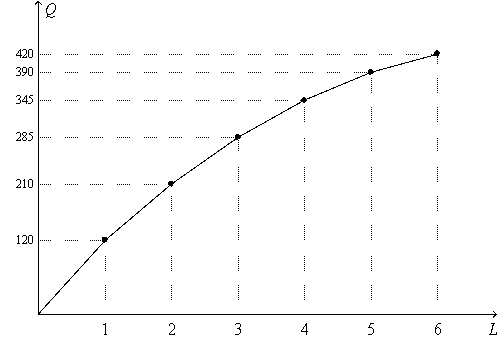 -Refer to Figure 18-1.The shape of the curve suggests the presence of
 (Multiple Choice)
4.9/5 (102)
(102) A profit-maximizing competitive firm will hire workers up to the point at which the wage equals the marginal product of labor.
(True/False)
4.8/5 (80)
(80) Table 18-4
Consider the following daily production data for Wills Golf Balls.Wills sells golf balls for $2.50 cents each and pays the workers a wage of $325 per day.
 -Refer to Table 18-4.Assume that Wills is a competitive,profit-maximizing firm.If the market price of golf balls decreases from $2.50 to $2.00,how many workers would the firm then hire?
 (Multiple Choice)
4.8/5 (84)
(84) Figure 18-4
This figure below shows the labor market for automobile workers.The curve labeled S is the labor supply curve,and the curves labeled D1 and D2 are the labor demand curves.On the horizontal axis,L represents the quantity of labor in the market.  -Refer to Figure 18-4.Which of the following is a possible explanation of the shift of the labor-demand curve from D1 to D2?
 (Multiple Choice)
4.7/5 (76)
(76) The labor supply curve is fundamentally a representation of the trade-off people face between which of the following?
(Multiple Choice)
4.9/5 (82)
(82) Consider the market for capital equipment.Suppose the market price of firms' output decreases.Holding all else constant,what will happen to the equilibrium quantity of capital equipment?
(Multiple Choice)
4.9/5 (90)
(90) Technological advances can cause the labor demand curve to shift.
(True/False)
4.8/5 (80)
(80) Consider the market for university economics professors.Suppose the opportunity cost of going to graduate school to get a Ph.D.in economics decreases for many individuals.Since it generally takes about five years to get a Ph.D.in economics,holding all else constant,what will happen to the equilibrium wage for university economics professors in five years?
(Multiple Choice)
4.9/5 (87)
(87) Suppose that the market for labor is initially in equilibrium.An increase in immigration will cause
(Multiple Choice)
4.8/5 (67)
(67) Suppose that a large lake in the middle of Minnesota evaporates,leaving more fertile farm land for growing corn available.Assuming that land and labor are complements in a farming production function,what would happen to the wages earned by workers and rents earned by landowners?
(Multiple Choice)
4.8/5 (81)
(81) Consider the labor market for computer programmers.During the late 1990s,the value of the marginal product of all computer programmers increased dramatically.Holding all else equal,what effect did this process have on the labor market for computer programmers?
(Multiple Choice)
4.9/5 (75)
(75) Suppose that in January a profit-maximizing firm has 25 employees.By February,the firm has decreased employment.One can infer that,when 25 employees are hired,the
(Multiple Choice)
4.8/5 (64)
(64) 
Filters
- Essay(0)
- Multiple Choice(0)
- Short Answer(0)
- True False(0)
- Matching(0)