



 Chat with AI
Exam 17: Oligopoly

Exam 1: Ten Principles of Economics281 Questions
Exam 2: Thinking Like an Economist451 Questions
Exam 3: Interdependence and the Gains From Trade353 Questions
Exam 4: The Market Forces of Supply and Demand467 Questions
Exam 5: Elasticity and Its Application409 Questions
Exam 6: Supply, Demand, and Government Policies459 Questions
Exam 7: Consumers, Producers, and the Efficiency of Markets363 Questions
Exam 8: Application: The Costs of Taxation353 Questions
Exam 9: Application: International Trade333 Questions
Exam 10: Externalities352 Questions
Exam 11: Public Goods and Common Resources270 Questions
Exam 12: The Design of the Tax System397 Questions
Exam 13: The Costs of Production434 Questions
Exam 14: Firms in Competitive Markets381 Questions
Exam 15: Monopoly427 Questions
Exam 16: Monopolistic Competition416 Questions
Exam 17: Oligopoly325 Questions
Exam 18: The Markets for the Factors of Production361 Questions
Exam 19: Earnings and Discrimination335 Questions
Exam 20: Income Inequality and Poverty312 Questions
Exam 21: The Theory of Consumer Choice354 Questions
Exam 22: Frontiers of Microeconomics262 Questions
Exam 23: Measuring a Nations Income343 Questions
Exam 24: Measuring the Cost of Living358 Questions
Exam 25: Production and Growth335 Questions
Exam 26: Saving, investment, and the Financial System381 Questions
Exam 27: The Basic Tools of Finance336 Questions
Exam 28: Unemployment533 Questions
Exam 29: The Monetary System366 Questions
Exam 30: Money Growth and Inflation312 Questions
Exam 31: Open-Economy Macroeconomics: Basic Concepts346 Questions
Exam 32: A Macroeconomic Theory of the Open Economy300 Questions
Exam 33: Aggregate Demand and Aggregate Supply386 Questions
Exam 34: The Influence of Monetary and Fiscal Policy on Aggregate Demand334 Questions
Exam 35: The Short-Run Trade-Off Between Inflation and Unemployment306 Questions
Exam 36: Five Debates Over Macroeconomic Policy179 Questions
Select questions type


Table 17-8.For a certain small town,the table shows the demand schedule for water.Assume the marginal cost of supplying water is constant at $4 per bottle.
 -Refer to Table 17-8.If there were many suppliers of bottled water,what would be the price and quantity?
Free
(Multiple Choice)
4.8/5  (70)
(70) Correct Answer: Verified
C
Tying can be thought of as a form of price discrimination.
Free
(True/False)
4.9/5 (74)
(74) Correct Answer:Verified
VerifiedTrue
Whether an oligopoly consists of 3 firms or 10 firms,the level of output likely will be the same.
Free
(True/False)
5.0/5 (70)
(70) Correct Answer:Verified
VerifiedFalse
Consider the diagram below,which shows the market demand curve for a particular product.Suppose this market is served by two duopolists who each face the marginal cost curve shown in the diagram.The marginal revenue curve that a monopolist would face in this market is also shown.Which of the following statements is true? 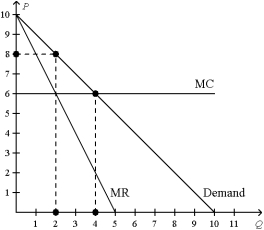
(Multiple Choice)
4.9/5 (83)
(83) Table 17-19.The Chicken Game is named for a contest in which drivers test their courage by driving straight at each other.John and Paul have a common interest to avoid crashing into each other,but they also have a personal,competing interest to not turn first to demonstrate their courage to those observing the contest.The payoff table for this situation is provided below.The payoffs are shown as (John,Paul).
 -Refer to Table 17-19.What is John's dominant strategy?
 (Multiple Choice)
4.9/5 (68)
(68) Table 17-1
Imagine a small town in which only two residents,Lisa and Mark,own wells that produce safe drinking water.Each week Lisa and Mark work together to decide how many gallons of water to pump.They bring the water to town and sell it at whatever price the market will bear.To keep things simple,suppose that Lisa and Mark can pump as much water as they want without cost so that the marginal cost of water equals zero.The weekly town demand schedule and total revenue schedule for water is shown in the table below:
 -Refer to Table 17-1.If Lisa and Mark operate as a profit-maximizing monopoly in the market for water,what price will they charge?
 (Multiple Choice)
4.9/5 (75)
(75) Suppose a market is initially perfectly competitive with many firms selling an identical product.Over time,however,suppose the merging of firms results in the market being served by only three or four firms selling this same product.As a result,we would expect
(Multiple Choice)
4.8/5 (88)
(88) In the game in which two oil companies own adjacent oil fields,the companies will not use the oil efficiently because
(Multiple Choice)
4.7/5 (63)
(63) Even when allowed to collude,firms in an oligopoly may choose to cheat on their agreements with the rest of the cartel.Why?
(Essay)
4.8/5 (80)
(80) Table 17-1
Imagine a small town in which only two residents,Lisa and Mark,own wells that produce safe drinking water.Each week Lisa and Mark work together to decide how many gallons of water to pump.They bring the water to town and sell it at whatever price the market will bear.To keep things simple,suppose that Lisa and Mark can pump as much water as they want without cost so that the marginal cost of water equals zero.The weekly town demand schedule and total revenue schedule for water is shown in the table below:
-Refer to Table 17-1.If this market for water were perfectly competitive instead of monopolistic,what price would be charged?
-Refer to Table 17-1.If this market for water were perfectly competitive instead of monopolistic,what price would be charged? (Multiple Choice)
4.9/5 (80)
(80) Figure 17-3.Katie and Taylor are roommates.On a particular day,their lawn needs to be mowed.Each person has to decide whether to take part in mowing the lawn.At the end of the day,either the lawn will be mowed (if one or both roommates take part in mowing),or it will remain unmowed (if neither roommate mows).With happiness measured on a scale of 1 (very unhappy)to 10 (very happy),the possible outcomes are as follows:  -Refer to Figure 17-3.In pursuing her own self-interest,Taylor will
 (Multiple Choice)
4.8/5 (68)
(68) Which of the following would be most likely to contribute to the breakdown of a cartel in a natural resource (e.g. ,bauxite)market?
(Multiple Choice)
4.9/5 (73)
(73) Consider a game of the "Jack and Jill" type in which a market is a duopoly and each firm decides to produce either a "high" quantity of output or a "low" quantity of output.If the two firms successfully reach and maintain the cooperative outcome of the game,then
(Multiple Choice)
4.7/5 (78)
(78) Table 17-2.The table shows the town of Pittsville's demand schedule for gasoline.For simplicity,assume the town's gasoline seller(s)incur no costs in selling gasoline.
 -Refer to Table 17-2.If the market for gasoline in Pittsville is a monopoly,then the profit-maximizing monopolist will charge a price of
 (Multiple Choice)
4.8/5 (82)
(82) As the number of firms in an oligopoly increases,the magnitude of the price effect increases.
(True/False)
5.0/5 (73)
(73) Table 17-12.This table shows a game played between two players,A and B.The payoffs in the table are shown as (Payoff to A,Payoff to B).
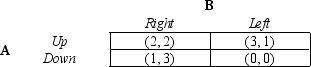 -Refer to Table 17-12.Which outcome is the Nash equilibrium in this game?
 (Multiple Choice)
4.9/5 (79)
(79) 
Filters
- Essay(0)
- Multiple Choice(0)
- Short Answer(0)
- True False(0)
- Matching(0)