



 Chat with AI
Exam 17: Oligopoly

Exam 1: Ten Principles of Economics281 Questions
Exam 2: Thinking Like an Economist451 Questions
Exam 3: Interdependence and the Gains From Trade353 Questions
Exam 4: The Market Forces of Supply and Demand467 Questions
Exam 5: Elasticity and Its Application409 Questions
Exam 6: Supply, Demand, and Government Policies459 Questions
Exam 7: Consumers, Producers, and the Efficiency of Markets363 Questions
Exam 8: Application: The Costs of Taxation353 Questions
Exam 9: Application: International Trade333 Questions
Exam 10: Externalities352 Questions
Exam 11: Public Goods and Common Resources270 Questions
Exam 12: The Design of the Tax System397 Questions
Exam 13: The Costs of Production434 Questions
Exam 14: Firms in Competitive Markets381 Questions
Exam 15: Monopoly427 Questions
Exam 16: Monopolistic Competition416 Questions
Exam 17: Oligopoly325 Questions
Exam 18: The Markets for the Factors of Production361 Questions
Exam 19: Earnings and Discrimination335 Questions
Exam 20: Income Inequality and Poverty312 Questions
Exam 21: The Theory of Consumer Choice354 Questions
Exam 22: Frontiers of Microeconomics262 Questions
Exam 23: Measuring a Nations Income343 Questions
Exam 24: Measuring the Cost of Living358 Questions
Exam 25: Production and Growth335 Questions
Exam 26: Saving, investment, and the Financial System381 Questions
Exam 27: The Basic Tools of Finance336 Questions
Exam 28: Unemployment533 Questions
Exam 29: The Monetary System366 Questions
Exam 30: Money Growth and Inflation312 Questions
Exam 31: Open-Economy Macroeconomics: Basic Concepts346 Questions
Exam 32: A Macroeconomic Theory of the Open Economy300 Questions
Exam 33: Aggregate Demand and Aggregate Supply386 Questions
Exam 34: The Influence of Monetary and Fiscal Policy on Aggregate Demand334 Questions
Exam 35: The Short-Run Trade-Off Between Inflation and Unemployment306 Questions
Exam 36: Five Debates Over Macroeconomic Policy179 Questions
Select questions type


In a typical cartel agreement,the cartel maximizes profit when it
(Multiple Choice)
4.9/5  (68)
(68) Much of the research on game theory in recent decades was driven by attempts to analyze actions of players during
(Multiple Choice)
4.8/5 (80)
(80) Figure 17-1.Two companies,ABC and XYZ,each decide whether to produce a high level of output or a low level of output.In the figure,the dollar amounts are payoffs and they represent annual profits for the two companies.  -Refer to Figure 17-1.Which of the following statements is correct?
 (Multiple Choice)
4.9/5 (85)
(85) Table 17-4.The information in the table below shows the total demand for high-speed Internet subscriptions in a small urban market.Assume that each company that provides these subscriptions incurs an annual fixed cost of $200,000 (per year)and that the marginal cost of providing an additional subscription is always $80.
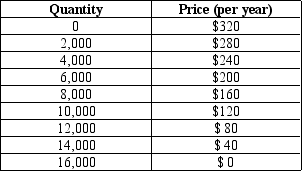 -Refer to Table 17-4.Assume there are two profit-maximizing high-speed Internet service providers operating in this market.Further assume that they are not able to collude on the price and quantity of subscriptions to sell.How many subscriptions will be sold altogether when this market reaches a Nash equilibrium?
 (Multiple Choice)
4.8/5 (71)
(71) The players in a two-person game are choosing between Strategy X and Strategy Y.If the second player chooses Strategy X,the first player's best outcome is to select X.If the second player chooses Strategy Y,the first player's best outcome is to select X.For the first player,Strategy X is called a
(Multiple Choice)
4.8/5 (78)
(78) Which of the following statements is (are)true of the prisoners' dilemma?

(Multiple Choice)
4.9/5 (72)
(72) In 2007 the U.S.Supreme Court ruled that it was not necessary illegal for manufacturers and distributors to agree on minimum retail prices.
(True/False)
4.8/5 (82)
(82) Scenario 17-3.Consider two countries,Muria and Zenya,that are engaged in an arms race.Each country must decide whether to build new weapons or to disarm existing weapons.Each country prefers to have more arms than the other because a large arsenal gives it more influence in world affairs.But each country also prefers to live in a world safe from the other country's weapons.The following table shows the possible outcomes for each decision combination.The numbers in each cell represent the country's ranking of the outcome (4 = best outcome,1 = worst outcome).
 -Refer to Scenario 17-3.If Zenya chooses to build new weapons,then Muria will
 (Multiple Choice)
4.9/5 (85)
(85) The paradoxical nature of oligopoly can be demonstrated by the fact that,even though the monopoly outcome is best for the oligopolists,
(Multiple Choice)
4.9/5 (83)
(83) Suppose that Sonny and Cher are duopolists in the music industry.In January,they agree to work together as a monopolist,charging the monopoly price for their music and producing the monopoly quantity of songs.By February,each singer is considering breaking the agreement.What would you expect to happen next?
(Multiple Choice)
4.8/5 (77)
(77) Table 17-17.Consider a small town that has two grocery stores from which residents can choose to buy a gallon of milk.The store owners each must make a decision to set a high milk price or a low milk price.The payoff table,showing profit per week,is provided below.The profit in each cell is shown as (Store 1,Store 2).
 -Refer to Table 17-17.If grocery store 1 sets a low price,what price should grocery store 2 set? And what will grocery store 2's payoff equal?
 (Multiple Choice)
4.8/5 (81)
(81) A tit-for-tat strategy,in a repeated game,is one in which a player starts by cooperating and then does whatever the other player did last time.
(True/False)
5.0/5 (91)
(91) The game that oligopolists play in trying to reach the oligopoly outcome is similar to the game that the two prisoners play in the prisoners' dilemma.
(True/False)
4.8/5 (88)
(88) Table 17-19.The Chicken Game is named for a contest in which drivers test their courage by driving straight at each other.John and Paul have a common interest to avoid crashing into each other,but they also have a personal,competing interest to not turn first to demonstrate their courage to those observing the contest.The payoff table for this situation is provided below.The payoffs are shown as (John,Paul).
 -Refer to Table 17-19.What is (are)the Nash equilibrium (equilibria)in this Chicken game?
 (Multiple Choice)
4.8/5 (69)
(69) The story of the prisoners' dilemma contains a general lesson that applies to any group trying to maintain cooperation among its members.
(True/False)
4.8/5 (79)
(79) Table 17-1
Imagine a small town in which only two residents,Lisa and Mark,own wells that produce safe drinking water.Each week Lisa and Mark work together to decide how many gallons of water to pump.They bring the water to town and sell it at whatever price the market will bear.To keep things simple,suppose that Lisa and Mark can pump as much water as they want without cost so that the marginal cost of water equals zero.The weekly town demand schedule and total revenue schedule for water is shown in the table below:
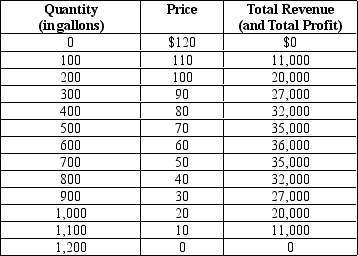 -Refer to Table 17-1.Suppose the town enacts new antitrust laws that prohibit Lisa and Mark from operating as a monopoly.What will be the price of water once Lisa and Mark reach a Nash equilibrium?
 (Multiple Choice)
4.9/5 (82)
(82) 
Filters
- Essay(0)
- Multiple Choice(0)
- Short Answer(0)
- True False(0)
- Matching(0)