



 Chat with AI
Exam 17: Oligopoly

Exam 1: Ten Principles of Economics281 Questions
Exam 2: Thinking Like an Economist451 Questions
Exam 3: Interdependence and the Gains From Trade353 Questions
Exam 4: The Market Forces of Supply and Demand467 Questions
Exam 5: Elasticity and Its Application409 Questions
Exam 6: Supply, Demand, and Government Policies459 Questions
Exam 7: Consumers, Producers, and the Efficiency of Markets363 Questions
Exam 8: Application: The Costs of Taxation353 Questions
Exam 9: Application: International Trade333 Questions
Exam 10: Externalities352 Questions
Exam 11: Public Goods and Common Resources270 Questions
Exam 12: The Design of the Tax System397 Questions
Exam 13: The Costs of Production434 Questions
Exam 14: Firms in Competitive Markets381 Questions
Exam 15: Monopoly427 Questions
Exam 16: Monopolistic Competition416 Questions
Exam 17: Oligopoly325 Questions
Exam 18: The Markets for the Factors of Production361 Questions
Exam 19: Earnings and Discrimination335 Questions
Exam 20: Income Inequality and Poverty312 Questions
Exam 21: The Theory of Consumer Choice354 Questions
Exam 22: Frontiers of Microeconomics262 Questions
Exam 23: Measuring a Nations Income343 Questions
Exam 24: Measuring the Cost of Living358 Questions
Exam 25: Production and Growth335 Questions
Exam 26: Saving, investment, and the Financial System381 Questions
Exam 27: The Basic Tools of Finance336 Questions
Exam 28: Unemployment533 Questions
Exam 29: The Monetary System366 Questions
Exam 30: Money Growth and Inflation312 Questions
Exam 31: Open-Economy Macroeconomics: Basic Concepts346 Questions
Exam 32: A Macroeconomic Theory of the Open Economy300 Questions
Exam 33: Aggregate Demand and Aggregate Supply386 Questions
Exam 34: The Influence of Monetary and Fiscal Policy on Aggregate Demand334 Questions
Exam 35: The Short-Run Trade-Off Between Inflation and Unemployment306 Questions
Exam 36: Five Debates Over Macroeconomic Policy179 Questions
Select questions type


For a firm,strategic interactions with other firms in the market become more important as the number of firms in the market becomes larger.
(True/False)
4.8/5  (79)
(79) Scenario 17-3.Consider two countries,Muria and Zenya,that are engaged in an arms race.Each country must decide whether to build new weapons or to disarm existing weapons.Each country prefers to have more arms than the other because a large arsenal gives it more influence in world affairs.But each country also prefers to live in a world safe from the other country's weapons.The following table shows the possible outcomes for each decision combination.The numbers in each cell represent the country's ranking of the outcome (4 = best outcome,1 = worst outcome).
 -Refer to Scenario 17-3.Suppose the two countries agreed to disarm existing weapons.In reality these two countries may have a hard time keeping this agreement due to which of the following reasons?

-Refer to Scenario 17-3.Suppose the two countries agreed to disarm existing weapons.In reality these two countries may have a hard time keeping this agreement due to which of the following reasons?
(Multiple Choice)
4.9/5 (69)
(69) An equilibrium in which each firm in an oligopoly maximizes profit,given the actions of its rivals,is called
(Multiple Choice)
4.9/5 (67)
(67) The equilibrium quantity in markets characterized by oligopoly is
(Multiple Choice)
4.8/5 (77)
(77) Policymakers should be aggressive in using their powers to place limits on firm behavior,because business practices that appear to reduce competition never have any legitimate purposes.
(True/False)
4.9/5 (81)
(81) Scenario 17-4.Consider two cigarette companies,PM Inc.and Brown Inc.If neither company advertises,the two companies split the market and earn $50 million each.If they both advertise,they again split the market,but profits are lower by $10 million since each company must bear the cost of advertising.Yet if one company advertises while the other does not,the one that advertises attracts customers from the other.In this case,the company that advertises earns $60 million while the company that does not advertise earns only $30 million.
-Refer to Scenario 17-4.In 1971,Congress passed a law that banned cigarette advertising on television.If cigarette companies are profit maximizers,it is likely that
(Multiple Choice)
4.8/5 (79)
(79) Table 17-8.For a certain small town,the table shows the demand schedule for water.Assume the marginal cost of supplying water is constant at $4 per bottle.
 -Refer to Table 17-8.If there are two suppliers of water,Mort and Callie,then what will be their combined level of output when a Nash equilibrium is reached?
 (Multiple Choice)
5.0/5 (73)
(73) Table 17-5.Imagine a small town in which only two residents,Bill and Ben,own wells that produce safe drinking water.Each week Bill and Ben work together to decide how many gallons of water to pump,to bring the water to town,and to sell it at whatever price the market will bear.Assume Bill and Ben can pump as much water as they want without cost so that the marginal cost of water equals zero.
The weekly town demand schedule and total revenue schedule for water are shown in the table below.
 -Refer to Table 17-5.Suppose the town enacts new antitrust laws that prohibit Bill and Ben from operating as a monopolist.What will the new price of water be once the Nash equilibrium is reached?
 (Multiple Choice)
4.8/5 (76)
(76) Table 17-14.This table shows a game played between two players,A and B.The payoffs are given in the table as (Payoff to A,Payoff to B).
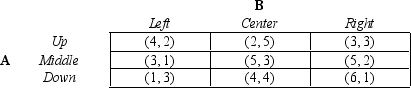 -Refer to Table 17-14.Which of the following statements is true regarding this game?
 (Multiple Choice)
4.7/5 (84)
(84) Oligopolists may well be able to reach their preferred,cooperative outcome if
(Multiple Choice)
4.7/5 (83)
(83) In a duopoly situation,the logic of self-interest results in a total output level that
(Multiple Choice)
4.9/5 (72)
(72) In a competitive market,strategic interactions among the firms are not important.
(True/False)
4.8/5 (75)
(75) A distinguishing feature of an oligopolistic industry is the tension between
(Multiple Choice)
4.8/5 (76)
(76) Suppose two companies own adjacent oil fields.Under the two fields is a common pool of oil worth $30 million.For each well that is drilled,the company that drills the well incurs a cost of $3 million.Each company can drill up to two wells.What is the likely outcome of this game if each company pursues its own self-interest?
(Multiple Choice)
4.7/5 (68)
(68) Table 17-11
Two home-improvement stores (Big Box Deluxe and Homes R Us)in a growing urban area are interested in expanding their market share.Both are interested in expanding the size of their store and parking lot to accommodate potential growth in their customer base.The following game depicts the strategic outcomes that result from the game.Increases in annual profits of the two home-improvement stores are shown in the table below.
 -Refer to Table 17-11.When this game reaches a Nash equilibrium,annual profit will grow by
 (Multiple Choice)
4.7/5 (67)
(67) George and Jerry are competitors in a local market.Each is trying to decide if it is better to advertise on TV,on radio,or not at all.If they both advertise on TV,each will earn a profit of $3,000.If they both advertise on radio,each will earn a profit of $5,000.If neither advertises at all,each will earn a profit of $10,000.If one advertises on TV and the other advertises on radio,then the one advertising on TV will earn $4,000 and the other will earn $2,000.If one advertises on TV and the other does not advertise,then the one advertising on TV will earn $8,000 and the other will earn $5,000.If one advertises on radio and the other does not advertise,then the one advertising on radio will earn $9,000 and the other will earn $6,000.If both follow their dominant strategy,then George will
(Multiple Choice)
5.0/5 (92)
(92) 
Filters
- Essay(0)
- Multiple Choice(0)
- Short Answer(0)
- True False(0)
- Matching(0)