



 Chat with AI
Exam 17: Oligopoly

Exam 1: Ten Principles of Economics281 Questions
Exam 2: Thinking Like an Economist451 Questions
Exam 3: Interdependence and the Gains From Trade353 Questions
Exam 4: The Market Forces of Supply and Demand467 Questions
Exam 5: Elasticity and Its Application409 Questions
Exam 6: Supply, Demand, and Government Policies459 Questions
Exam 7: Consumers, Producers, and the Efficiency of Markets363 Questions
Exam 8: Application: The Costs of Taxation353 Questions
Exam 9: Application: International Trade333 Questions
Exam 10: Externalities352 Questions
Exam 11: Public Goods and Common Resources270 Questions
Exam 12: The Design of the Tax System397 Questions
Exam 13: The Costs of Production434 Questions
Exam 14: Firms in Competitive Markets381 Questions
Exam 15: Monopoly427 Questions
Exam 16: Monopolistic Competition416 Questions
Exam 17: Oligopoly325 Questions
Exam 18: The Markets for the Factors of Production361 Questions
Exam 19: Earnings and Discrimination335 Questions
Exam 20: Income Inequality and Poverty312 Questions
Exam 21: The Theory of Consumer Choice354 Questions
Exam 22: Frontiers of Microeconomics262 Questions
Exam 23: Measuring a Nations Income343 Questions
Exam 24: Measuring the Cost of Living358 Questions
Exam 25: Production and Growth335 Questions
Exam 26: Saving, investment, and the Financial System381 Questions
Exam 27: The Basic Tools of Finance336 Questions
Exam 28: Unemployment533 Questions
Exam 29: The Monetary System366 Questions
Exam 30: Money Growth and Inflation312 Questions
Exam 31: Open-Economy Macroeconomics: Basic Concepts346 Questions
Exam 32: A Macroeconomic Theory of the Open Economy300 Questions
Exam 33: Aggregate Demand and Aggregate Supply386 Questions
Exam 34: The Influence of Monetary and Fiscal Policy on Aggregate Demand334 Questions
Exam 35: The Short-Run Trade-Off Between Inflation and Unemployment306 Questions
Exam 36: Five Debates Over Macroeconomic Policy179 Questions
Select questions type


Table 17-3.The information in the table below shows the total demand for premium-channel digital cable TV subscriptions in a small urban market.Assume that each digital cable TV operator pays a fixed cost of $200,000 (per year)to provide premium digital channels in the market area and that the marginal cost of providing the premium channel service to a household is zero.
 -Refer to Table 17-3.Assume there are two profit-maximizing digital cable TV companies operating in this market.Further assume that they are not able to collude on the price and quantity of premium digital channel subscriptions to sell.How many premium digital channel cable TV subscriptions will be sold altogether when this market reaches a Nash equilibrium?
 (Multiple Choice)
4.8/5  (76)
(76) Table 17-4.The information in the table below shows the total demand for high-speed Internet subscriptions in a small urban market.Assume that each company that provides these subscriptions incurs an annual fixed cost of $200,000 (per year)and that the marginal cost of providing an additional subscription is always $80.
 -Refer to Table 17-4.Assume there are two high-speed Internet service providers operating in this market.Further assume that they are not able to collude on the price and quantity of subscriptions to sell.What price will they charge for a subscription when this market reaches a Nash equilibrium?
 (Multiple Choice)
4.8/5 (77)
(77) Table 17-3.The information in the table below shows the total demand for premium-channel digital cable TV subscriptions in a small urban market.Assume that each digital cable TV operator pays a fixed cost of $200,000 (per year)to provide premium digital channels in the market area and that the marginal cost of providing the premium channel service to a household is zero.
-Refer to Table 17-3.Assume that there are two profit-maximizing digital cable TV companies operating in this market.Further assume that they are not able to collude on the price and quantity of premium digital channel subscriptions to sell.How much profit will each firm earn when this market reaches a Nash equilibrium?
-Refer to Table 17-3.Assume that there are two profit-maximizing digital cable TV companies operating in this market.Further assume that they are not able to collude on the price and quantity of premium digital channel subscriptions to sell.How much profit will each firm earn when this market reaches a Nash equilibrium? (Multiple Choice)
5.0/5 (83)
(83) Table 17-17.Consider a small town that has two grocery stores from which residents can choose to buy a gallon of milk.The store owners each must make a decision to set a high milk price or a low milk price.The payoff table,showing profit per week,is provided below.The profit in each cell is shown as (Store 1,Store 2).
 -Refer to Table 17-17.If grocery store 2 sets a low price,what price should grocery store 1 set? And what will grocery store 1's payoff equal?
 (Multiple Choice)
4.9/5 (71)
(71) Table 17-19.The Chicken Game is named for a contest in which drivers test their courage by driving straight at each other.John and Paul have a common interest to avoid crashing into each other,but they also have a personal,competing interest to not turn first to demonstrate their courage to those observing the contest.The payoff table for this situation is provided below.The payoffs are shown as (John,Paul).
 -Refer to Table 17-19.If Paul chooses Turn,what will John choose to do and what will John's payoff equal?
 (Multiple Choice)
4.8/5 (79)
(79) Suppose three firms form a cartel and agree to charge a specific price for their output.Each individual firm has an incentive to maintain the agreement because the firm's individual profits will be the greatest under the cartel arrangement.
(True/False)
4.7/5 (84)
(84) Table 17-20.Brian and Matt own the only two bicycle repair shops in town.Each must choose between a low price for repair work and a high price.The annual economic profit from each strategy is indicated in the table.The profits are shown as (Matt,Brian)in each cell.
 -Refer to Table 17-20.Which of the following statements is correct if Brian and Matt will play this game only once?
 (Multiple Choice)
5.0/5 (79)
(79) When individuals are damaged by an illegal arrangement to restrain trade,which law allows them to pursue civil action and recover up to three times the damages sustained?
(Multiple Choice)
4.7/5 (70)
(70) Scenario 17-4.Consider two cigarette companies,PM Inc.and Brown Inc.If neither company advertises,the two companies split the market and earn $50 million each.If they both advertise,they again split the market,but profits are lower by $10 million since each company must bear the cost of advertising.Yet if one company advertises while the other does not,the one that advertises attracts customers from the other.In this case,the company that advertises earns $60 million while the company that does not advertise earns only $30 million.
-Refer to Scenario 17-4.PM Inc.'s dominant strategy is to
(Multiple Choice)
4.7/5 (72)
(72) When price is above marginal cost,selling one more unit at the current price will increase profit.This concept is known as the
(Multiple Choice)
4.9/5 (85)
(85) Assuming that oligopolists do not have the opportunity to collude,once they have reached the Nash equilibrium,it
(Multiple Choice)
4.9/5 (97)
(97) In the prisoners' dilemma game with Bonnie and Clyde as the players,the likely outcome is one
(Multiple Choice)
4.9/5 (85)
(85) Table 17-18.Amy and Heather are two college roommates who both prefer a clean common space in their dorm room,but neither enjoys cleaning.The roommates must each make a decision to either clean or not clean the dorm room's common space.The payoff table for this situation is provided below,where the higher a player's payoff number,the better off that player is.The payoffs in each cell are shown as (payoff for Amy,payoff for Heather).
 -Refer to Table 17-18.If Heather chooses not to clean,then Amy will
 (Multiple Choice)
4.8/5 (81)
(81) To increase their individual profits,members of a cartel have an incentive to
(Multiple Choice)
4.9/5 (88)
(88) The Clayton Act of 1914 allows those harmed by illegal arrangements to restrain trade to
(Multiple Choice)
4.8/5 (86)
(86) In an oligopoly,the total output produced in the market is
(Multiple Choice)
4.9/5 (79)
(79) Table 17-13.This table shows a game played between two players,A and B.The payoffs in the table are shown as (Payoff to A,Payoff to B).
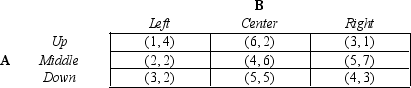 -Refer to Table 17-13.Which of the following statements regarding this game is true?
 (Multiple Choice)
4.8/5 (69)
(69) 
Filters
- Essay(0)
- Multiple Choice(0)
- Short Answer(0)
- True False(0)
- Matching(0)