



 Chat with AI
Exam 16: Monopolistic Competition

Exam 1: Ten Principles of Economics281 Questions
Exam 2: Thinking Like an Economist451 Questions
Exam 3: Interdependence and the Gains From Trade353 Questions
Exam 4: The Market Forces of Supply and Demand467 Questions
Exam 5: Elasticity and Its Application409 Questions
Exam 6: Supply, Demand, and Government Policies459 Questions
Exam 7: Consumers, Producers, and the Efficiency of Markets363 Questions
Exam 8: Application: The Costs of Taxation353 Questions
Exam 9: Application: International Trade333 Questions
Exam 10: Externalities352 Questions
Exam 11: Public Goods and Common Resources270 Questions
Exam 12: The Design of the Tax System397 Questions
Exam 13: The Costs of Production434 Questions
Exam 14: Firms in Competitive Markets381 Questions
Exam 15: Monopoly427 Questions
Exam 16: Monopolistic Competition416 Questions
Exam 17: Oligopoly325 Questions
Exam 18: The Markets for the Factors of Production361 Questions
Exam 19: Earnings and Discrimination335 Questions
Exam 20: Income Inequality and Poverty312 Questions
Exam 21: The Theory of Consumer Choice354 Questions
Exam 22: Frontiers of Microeconomics262 Questions
Exam 23: Measuring a Nations Income343 Questions
Exam 24: Measuring the Cost of Living358 Questions
Exam 25: Production and Growth335 Questions
Exam 26: Saving, investment, and the Financial System381 Questions
Exam 27: The Basic Tools of Finance336 Questions
Exam 28: Unemployment533 Questions
Exam 29: The Monetary System366 Questions
Exam 30: Money Growth and Inflation312 Questions
Exam 31: Open-Economy Macroeconomics: Basic Concepts346 Questions
Exam 32: A Macroeconomic Theory of the Open Economy300 Questions
Exam 33: Aggregate Demand and Aggregate Supply386 Questions
Exam 34: The Influence of Monetary and Fiscal Policy on Aggregate Demand334 Questions
Exam 35: The Short-Run Trade-Off Between Inflation and Unemployment306 Questions
Exam 36: Five Debates Over Macroeconomic Policy179 Questions
Select questions type


When a monopolistically competitive firm raises its price,
(Multiple Choice)
5.0/5  (89)
(89) As developing countries make a transition to market-based economies,one of the first major capital investments is in "Western-quality" hotels.Explain why brand-name hotel accommodations are a critical step in attracting foreign investment.
(Essay)
4.8/5 (88)
(88) Your company has recently requested that you travel to Dhaka,Bangladesh,to work on negotiations for a new factory to be located in one of the port cities.Your travel agent provides a list of several hundred local hotels and a Sheraton.In this case,the Sheraton brand-name is likely to be used as a signal of
(Multiple Choice)
4.9/5 (78)
(78) In which of the following market structures do firms produce the welfare-maximizing level of output?
(Multiple Choice)
4.8/5 (90)
(90) Which of the following correctly lists the products in order from most advertised to least advertised?
(Multiple Choice)
4.8/5 (74)
(74) Which of the following best describes the idea of excess capacity in monopolistic competition?
(Multiple Choice)
4.9/5 (90)
(90) A monopolistically competitive market is like a monopoly in that
(Multiple Choice)
4.8/5 (81)
(81) Because a monopolistically competitive firm has some market power,in the long-run the price of its product exceeds its
(Multiple Choice)
4.9/5 (84)
(84) What is meant by the term "excess capacity" as it relates to monopolistically competitive firms?
(Essay)
4.9/5 (94)
(94) A monopolistically competitive industry is characterized by
(Multiple Choice)
4.9/5 (96)
(96) Table 16-3
This table shows the demand schedule,marginal cost,and average total cost for a monopolistically competitive firm.
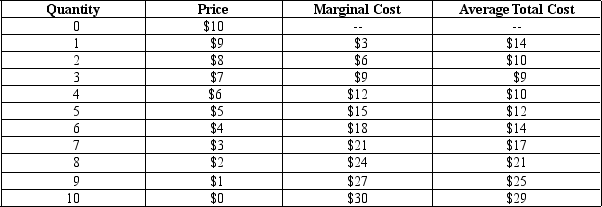 -Refer to Table 16-3.What price will this firm charge to maximize profit?
 (Multiple Choice)
4.9/5 (92)
(92) Figure 16-7
The lines in the figures below illustrate the potential effect of entry and exit in a monopolistically competitive market on either the demand curve or the marginal cost curve of existing firms. 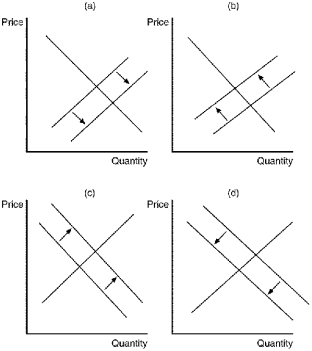 -Refer to Figure 16-7.Panel (d)illustrates the change that would occur if existing firms faced
 (Multiple Choice)
4.7/5 (81)
(81) The Mikati Philippines Hard Rock Cafe has the exact same menu as the Hard Rock Cafe in New York.This is an example of a brand name enhancing market efficiency for U.S.tourists visiting the Philippines.
(True/False)
4.8/5 (77)
(77) Monopolistic competition is considered by some to be inefficient because
(Multiple Choice)
4.9/5 (82)
(82) In the short run,a firm in a monopolistically competitive market operates much like a
(Multiple Choice)
4.9/5 (95)
(95) 
Filters
- Essay(0)
- Multiple Choice(0)
- Short Answer(0)
- True False(0)
- Matching(0)