



 Chat with AI
Exam 16: Monopolistic Competition

Exam 1: Ten Principles of Economics281 Questions
Exam 2: Thinking Like an Economist451 Questions
Exam 3: Interdependence and the Gains From Trade353 Questions
Exam 4: The Market Forces of Supply and Demand467 Questions
Exam 5: Elasticity and Its Application409 Questions
Exam 6: Supply, Demand, and Government Policies459 Questions
Exam 7: Consumers, Producers, and the Efficiency of Markets363 Questions
Exam 8: Application: The Costs of Taxation353 Questions
Exam 9: Application: International Trade333 Questions
Exam 10: Externalities352 Questions
Exam 11: Public Goods and Common Resources270 Questions
Exam 12: The Design of the Tax System397 Questions
Exam 13: The Costs of Production434 Questions
Exam 14: Firms in Competitive Markets381 Questions
Exam 15: Monopoly427 Questions
Exam 16: Monopolistic Competition416 Questions
Exam 17: Oligopoly325 Questions
Exam 18: The Markets for the Factors of Production361 Questions
Exam 19: Earnings and Discrimination335 Questions
Exam 20: Income Inequality and Poverty312 Questions
Exam 21: The Theory of Consumer Choice354 Questions
Exam 22: Frontiers of Microeconomics262 Questions
Exam 23: Measuring a Nations Income343 Questions
Exam 24: Measuring the Cost of Living358 Questions
Exam 25: Production and Growth335 Questions
Exam 26: Saving, investment, and the Financial System381 Questions
Exam 27: The Basic Tools of Finance336 Questions
Exam 28: Unemployment533 Questions
Exam 29: The Monetary System366 Questions
Exam 30: Money Growth and Inflation312 Questions
Exam 31: Open-Economy Macroeconomics: Basic Concepts346 Questions
Exam 32: A Macroeconomic Theory of the Open Economy300 Questions
Exam 33: Aggregate Demand and Aggregate Supply386 Questions
Exam 34: The Influence of Monetary and Fiscal Policy on Aggregate Demand334 Questions
Exam 35: The Short-Run Trade-Off Between Inflation and Unemployment306 Questions
Exam 36: Five Debates Over Macroeconomic Policy179 Questions
Select questions type


On a vacation to Cancun,Mexico,you find yourself eating every meal at the local McDonald's rather than having a hamburger from one of the street vendors.Your traveling companion claims that you are irrational,since you never eat McDonald's hamburgers when you are home,and McDonald's hamburgers cost more than those prepared and sold by Cancun's street vendors.An economist would most likely explain your behavior by suggesting that
(Multiple Choice)
4.9/5  (74)
(74) Figure 16-6  -Refer to Figure 16-6.If a firm in a monopolistically competitive market was producing the level of output depicted as Qd in panel (d),it would
 (Multiple Choice)
4.8/5 (81)
(81) Table 16-3
This table shows the demand schedule,marginal cost,and average total cost for a monopolistically competitive firm.
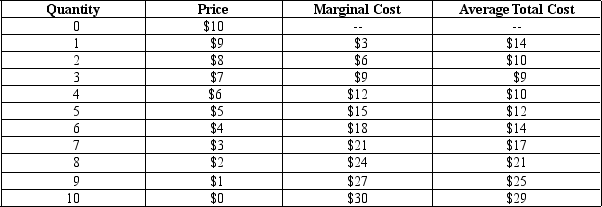 -Refer to Table 16-3.How much profit will this firm earn when it chooses its output to maximize profit?
 (Multiple Choice)
4.9/5 (91)
(91) Advertisements that appear to convey no information at all
(Multiple Choice)
4.7/5 (69)
(69) Figure 16-2
This figure depicts a situation in a monopolistically competitive market.  -Refer to Figure 16-2.How much output will the monopolistically competitive firm produce in this situation?
 (Multiple Choice)
4.7/5 (83)
(83) In monopolistically competitive markets,positive economic profits
(Multiple Choice)
4.9/5 (80)
(80) Figure 16-1.The figure is drawn for a monopolistically competitive firm.  -Refer to Figure 16-1.In order to maximize profit,the firm will charge a price of
 (Multiple Choice)
4.9/5 (71)
(71) The general term for market structures that fall somewhere in-between monopoly and perfect competition is
(Multiple Choice)
4.8/5 (87)
(87) Table 16-5
Traci's Hairstyling is one salon among many in the market for hairstyling.The following table presents cost and revenue data for hair cuts at Traci's Hairstyling.
 -Refer to Table 16-5.If the government forced Traci's to produce at the efficient scale of output,what is the maximum profit Traci's could earn?
 (Multiple Choice)
5.0/5 (92)
(92) A monopolistically competitive market is like a competitive market in that
(Multiple Choice)
4.8/5 (73)
(73) List five goods that are likely sold in a monopolistically competitive market.
(Essay)
4.9/5 (81)
(81) Which of the following is a characteristic of oligopoly or monopolistic competition,but not perfect competition?
(Multiple Choice)
4.8/5 (76)
(76) A firm has the following cost structure:
 If this firm is in a typical perfectly competitive market,in the long run it will likely produce
 (Multiple Choice)
4.9/5 (92)
(92) Since a firm in a monopolistically competitive market faces a
(Multiple Choice)
4.9/5 (76)
(76) Senator Hubris wants to pass a law that would require all monopolistically competitive firms to operate at their efficient scale.If this law were to pass and be enforced,we would expect that monopolistically competitive firms would
(Multiple Choice)
4.9/5 (75)
(75) The "competition" in monopolistically competitive markets is most likely a result of having many sellers in the market.
(True/False)
4.8/5 (80)
(80) When a monopolistically competitive firm is in long-run equilibrium,
(Multiple Choice)
4.9/5 (82)
(82) Kirk consumes Pepsi exclusively.He claims that there is a clear taste difference and that competing brands of cola leave an unsavory taste in his mouth.In a blind taste test,Kirk is found to prefer Pepsi to store-brand cola eight out of ten times.The results of Kirk's taste test would refute claims by critics of brand names that
(Multiple Choice)
4.9/5 (78)
(78) 
Filters
- Essay(0)
- Multiple Choice(0)
- Short Answer(0)
- True False(0)
- Matching(0)