



 Chat with AI
Exam 16: Monopolistic Competition

Exam 1: Ten Principles of Economics281 Questions
Exam 2: Thinking Like an Economist451 Questions
Exam 3: Interdependence and the Gains From Trade353 Questions
Exam 4: The Market Forces of Supply and Demand467 Questions
Exam 5: Elasticity and Its Application409 Questions
Exam 6: Supply, Demand, and Government Policies459 Questions
Exam 7: Consumers, Producers, and the Efficiency of Markets363 Questions
Exam 8: Application: The Costs of Taxation353 Questions
Exam 9: Application: International Trade333 Questions
Exam 10: Externalities352 Questions
Exam 11: Public Goods and Common Resources270 Questions
Exam 12: The Design of the Tax System397 Questions
Exam 13: The Costs of Production434 Questions
Exam 14: Firms in Competitive Markets381 Questions
Exam 15: Monopoly427 Questions
Exam 16: Monopolistic Competition416 Questions
Exam 17: Oligopoly325 Questions
Exam 18: The Markets for the Factors of Production361 Questions
Exam 19: Earnings and Discrimination335 Questions
Exam 20: Income Inequality and Poverty312 Questions
Exam 21: The Theory of Consumer Choice354 Questions
Exam 22: Frontiers of Microeconomics262 Questions
Exam 23: Measuring a Nations Income343 Questions
Exam 24: Measuring the Cost of Living358 Questions
Exam 25: Production and Growth335 Questions
Exam 26: Saving, investment, and the Financial System381 Questions
Exam 27: The Basic Tools of Finance336 Questions
Exam 28: Unemployment533 Questions
Exam 29: The Monetary System366 Questions
Exam 30: Money Growth and Inflation312 Questions
Exam 31: Open-Economy Macroeconomics: Basic Concepts346 Questions
Exam 32: A Macroeconomic Theory of the Open Economy300 Questions
Exam 33: Aggregate Demand and Aggregate Supply386 Questions
Exam 34: The Influence of Monetary and Fiscal Policy on Aggregate Demand334 Questions
Exam 35: The Short-Run Trade-Off Between Inflation and Unemployment306 Questions
Exam 36: Five Debates Over Macroeconomic Policy179 Questions
Select questions type


For the economy as a whole,spending on advertising comprises about what percent of total firm revenue?
(Multiple Choice)
4.9/5  (84)
(84) Which of the following statements regarding brand names in advertising is not correct?
(Multiple Choice)
4.8/5 (80)
(80) Excess capacity characterizes firms in monopolistically competitive markets,even in situations of long-run equilibrium.
(True/False)
4.8/5 (90)
(90) The "monopoly" in monopolistically competitive markets is most likely a result of firms having some pricing power due to product differentiation.
(True/False)
4.8/5 (76)
(76) A monopolistically competitive firm's choice of output level is virtually identical to the choice made by
(Multiple Choice)
4.8/5 (85)
(85) Table 16-1
The following table shows the percentage of output supplied by the top eight firms in four different industries.
 -Refer to Table 16-1.Which industry has the lowest concentration ratio?
 (Multiple Choice)
4.8/5 (83)
(83) The government may not be able to improve the inefficiencies of a monopolistically competitive market.
(True/False)
4.9/5 (75)
(75) Which of the following conditions is characteristic of a monopolistically competitive firm in long-run equilibrium?
(Multiple Choice)
4.8/5 (80)
(80) The term excess capacity refers to the fact that a firm produces a lower quantity than it would if it operated at the efficient scale.
(True/False)
4.8/5 (80)
(80) Evidence from the market for eyeglasses suggests that advertising leads to
(Multiple Choice)
4.8/5 (80)
(80) Firms in monopolistically competitive markets and monopolies can earn long-run profits due to barriers to entry.
(True/False)
5.0/5 (74)
(74) In which of the following market structures does free entry and exit play an important role in the long-run equilibrium outcome?
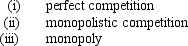
(Multiple Choice)
4.8/5 (77)
(77) The government of Italy will not allow any Hard Rock Cafe restaurants to open in Italy.Defenders of the efficiency of brand-name markets would argue that this has hindered restaurant market efficiency in Italy.
(True/False)
4.8/5 (77)
(77) A firm has the following cost structure:
 If this firm is in a typical monopolistically competitive market,in the long run it will likely produce
 (Multiple Choice)
4.7/5 (76)
(76) When a firm operates with excess capacity,it must be in a monopolistically competitive market.
(True/False)
4.8/5 (82)
(82) A monopolistically competitive firm is currently earning a positive economic profit.If other firms enter the market,we would expect that the added competition will cause this firm to adjust its output such that it
(Multiple Choice)
4.8/5 (87)
(87) Which two curves are tangent to each other in a monopolistically competitive market with zero economic profit?
(Multiple Choice)
4.8/5 (81)
(81) 
Filters
- Essay(0)
- Multiple Choice(0)
- Short Answer(0)
- True False(0)
- Matching(0)