



 Chat with AI
Exam 16: Monopolistic Competition

Exam 1: Ten Principles of Economics281 Questions
Exam 2: Thinking Like an Economist451 Questions
Exam 3: Interdependence and the Gains From Trade353 Questions
Exam 4: The Market Forces of Supply and Demand467 Questions
Exam 5: Elasticity and Its Application409 Questions
Exam 6: Supply, Demand, and Government Policies459 Questions
Exam 7: Consumers, Producers, and the Efficiency of Markets363 Questions
Exam 8: Application: The Costs of Taxation353 Questions
Exam 9: Application: International Trade333 Questions
Exam 10: Externalities352 Questions
Exam 11: Public Goods and Common Resources270 Questions
Exam 12: The Design of the Tax System397 Questions
Exam 13: The Costs of Production434 Questions
Exam 14: Firms in Competitive Markets381 Questions
Exam 15: Monopoly427 Questions
Exam 16: Monopolistic Competition416 Questions
Exam 17: Oligopoly325 Questions
Exam 18: The Markets for the Factors of Production361 Questions
Exam 19: Earnings and Discrimination335 Questions
Exam 20: Income Inequality and Poverty312 Questions
Exam 21: The Theory of Consumer Choice354 Questions
Exam 22: Frontiers of Microeconomics262 Questions
Exam 23: Measuring a Nations Income343 Questions
Exam 24: Measuring the Cost of Living358 Questions
Exam 25: Production and Growth335 Questions
Exam 26: Saving, investment, and the Financial System381 Questions
Exam 27: The Basic Tools of Finance336 Questions
Exam 28: Unemployment533 Questions
Exam 29: The Monetary System366 Questions
Exam 30: Money Growth and Inflation312 Questions
Exam 31: Open-Economy Macroeconomics: Basic Concepts346 Questions
Exam 32: A Macroeconomic Theory of the Open Economy300 Questions
Exam 33: Aggregate Demand and Aggregate Supply386 Questions
Exam 34: The Influence of Monetary and Fiscal Policy on Aggregate Demand334 Questions
Exam 35: The Short-Run Trade-Off Between Inflation and Unemployment306 Questions
Exam 36: Five Debates Over Macroeconomic Policy179 Questions
Select questions type


Figure 16-3  -Refer to Figure 16-3.The maximum total short-run economic profit for the monopolistically competitive firm in this figure is
 (Multiple Choice)
4.9/5  (64)
(64) In a small college town,four microbreweries have opened in the last two years.Demonstrate the effect of new market entrants on demand for existing firms (microbreweries)that already served this market.Assume that the local community now places a moratorium on new liquor licenses for microbreweries.How will this moratorium affect the long-run profitability of incumbent firms?
(Essay)
4.8/5 (75)
(75) Firm A is a perfectly competitive firm.Firm B is a monopolistically competitive firm.Both firms are currently maximizing their respective profits.Which of the following statements is correct?
(Multiple Choice)
4.8/5 (86)
(86) Cecilia's Café operates in a monopolistically competitive market.Cecilia's is currently producing where its average total cost is minimized.In the long run we would expect Cecilia's output to
(Multiple Choice)
4.9/5 (80)
(80) Figure 16-4  -Refer to Figure 16-4.Which of the panels depicts a firm in a monopolistically competitive market earning positive economic profits?
 (Multiple Choice)
4.9/5 (84)
(84) A firm in a monopolistically competitive market can earn both short-run and long-run profits.
(True/False)
4.9/5 (79)
(79) Crude oil is primarily supplied to the world market by a few Middle Eastern countries.Such a market is an example of a(n)
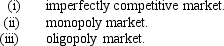
(Multiple Choice)
4.8/5 (91)
(91) Suppose the point of tangency that characterizes long-run equilibrium for a monopolistically competitive firm occurs at Q1 units of output.This level of output,Q1,
(Multiple Choice)
4.9/5 (89)
(89) Scenario 16-3
Consider the problem facing two firms,Firm A and Firm B,in the fast-food restaurant market.Each firm has just come up with an idea for a new fast-food menu item which it would sell for $4.Assume that the marginal cost for each new menu item is a constant $2,and the only fixed cost is for advertising.Each company knows that if it spends $12 million on advertising it will get 2 million consumers to try its new product.Firm A has done market research which suggests that its product does not have any "staying" power in the market.Even though it could get 2 million consumers to buy the product once,it is unlikely that they will continue to buy the product in the future.Firm B's market research suggests that its product is very good,and consumers who try the product will continue to be consumers over the ensuing year.On the basis of its market research,Firm B estimates that its initial 2 million customers will buy one unit of the product each month in the coming year,for a total of 24 million units.
-Refer to Scenario 16-3.If firm B decides to advertise its product it can expect to
(Multiple Choice)
4.8/5 (89)
(89) Eunice consumes Coke exclusively.She claims that there is a clear taste difference and that competing brands of cola leave an unsavory taste in her mouth.However,in a blind taste test,Eunice is found to prefer generic store-brand cola to Coke eight out of ten times.The results of Eunice's taste test would reinforce claims by critics of brand names that
(Multiple Choice)
4.8/5 (71)
(71) In a monopolistically competitive market,the demand curves faced by incumbent firms are unaffected by the entry of new firms into the market.
(True/False)
4.9/5 (79)
(79) When a market is monopolistically competitive,the typical firm in the market can earn
(Multiple Choice)
4.8/5 (87)
(87) Figure 16-1.The figure is drawn for a monopolistically competitive firm.  -Refer to Figure 16-1.If the average variable cost is $12 at the profit-maximizing quantity,and if the firm's fixed costs amount to $30,then the firm's maximum profit is
 (Multiple Choice)
4.9/5 (82)
(82) Which of the following is not an argument made by critics of advertising?
(Multiple Choice)
4.7/5 (66)
(66) A monopolistically competitive firm faces the following demand curve for its product:
 The firm has total fixed costs of $40 and a constant marginal cost of $2 per unit.We can conclude that
 (Multiple Choice)
4.8/5 (79)
(79) If firms in a monopolistically competitive market are earning positive profits,then
(Multiple Choice)
4.8/5 (82)
(82) A monopolistically competitive firm has the following cost structure:
 The firm faces the following demand curve:
 To maximize profit (or minimize losses),the firm will produce
The firm faces the following demand curve:
To maximize profit (or minimize losses),the firm will produce (Multiple Choice)
4.8/5 (80)
(80) Which of the following is not a characteristic of monopolistic competition?
(Multiple Choice)
4.8/5 (67)
(67) A market is comprised of many firms as opposed to just one firm or a few firms
(Multiple Choice)
4.9/5 (90)
(90) 
Filters
- Essay(0)
- Multiple Choice(0)
- Short Answer(0)
- True False(0)
- Matching(0)