



 Chat with AI
Exam 16: Monopolistic Competition

Exam 1: Ten Principles of Economics281 Questions
Exam 2: Thinking Like an Economist451 Questions
Exam 3: Interdependence and the Gains From Trade353 Questions
Exam 4: The Market Forces of Supply and Demand467 Questions
Exam 5: Elasticity and Its Application409 Questions
Exam 6: Supply, Demand, and Government Policies459 Questions
Exam 7: Consumers, Producers, and the Efficiency of Markets363 Questions
Exam 8: Application: The Costs of Taxation353 Questions
Exam 9: Application: International Trade333 Questions
Exam 10: Externalities352 Questions
Exam 11: Public Goods and Common Resources270 Questions
Exam 12: The Design of the Tax System397 Questions
Exam 13: The Costs of Production434 Questions
Exam 14: Firms in Competitive Markets381 Questions
Exam 15: Monopoly427 Questions
Exam 16: Monopolistic Competition416 Questions
Exam 17: Oligopoly325 Questions
Exam 18: The Markets for the Factors of Production361 Questions
Exam 19: Earnings and Discrimination335 Questions
Exam 20: Income Inequality and Poverty312 Questions
Exam 21: The Theory of Consumer Choice354 Questions
Exam 22: Frontiers of Microeconomics262 Questions
Exam 23: Measuring a Nations Income343 Questions
Exam 24: Measuring the Cost of Living358 Questions
Exam 25: Production and Growth335 Questions
Exam 26: Saving, investment, and the Financial System381 Questions
Exam 27: The Basic Tools of Finance336 Questions
Exam 28: Unemployment533 Questions
Exam 29: The Monetary System366 Questions
Exam 30: Money Growth and Inflation312 Questions
Exam 31: Open-Economy Macroeconomics: Basic Concepts346 Questions
Exam 32: A Macroeconomic Theory of the Open Economy300 Questions
Exam 33: Aggregate Demand and Aggregate Supply386 Questions
Exam 34: The Influence of Monetary and Fiscal Policy on Aggregate Demand334 Questions
Exam 35: The Short-Run Trade-Off Between Inflation and Unemployment306 Questions
Exam 36: Five Debates Over Macroeconomic Policy179 Questions
Select questions type


A monopolistically competitive firm faces the following demand schedule for its product:
 The firm has total fixed costs of $20 and a constant marginal cost of $2 per unit.The firm will maximize profit with
 (Multiple Choice)
4.9/5  (75)
(75) Table 16-3
This table shows the demand schedule,marginal cost,and average total cost for a monopolistically competitive firm.
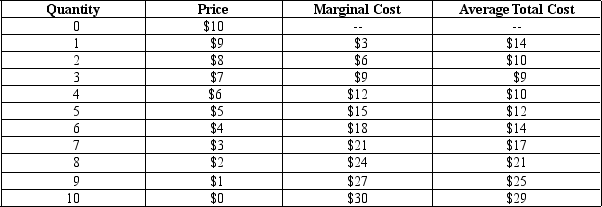 -Refer to Table 16-3.Which of the following is likely to happen in the long run in this market?
 (Multiple Choice)
4.9/5 (79)
(79) Table 16-5
Traci's Hairstyling is one salon among many in the market for hairstyling.The following table presents cost and revenue data for hair cuts at Traci's Hairstyling.
 -Refer to Table 16-5.When maximizing profit,what price does Traci's charge for a haircut?
 (Multiple Choice)
4.8/5 (70)
(70) In which of the following product markets are we likely to observe the largest amount of advertising?
(Multiple Choice)
4.9/5 (80)
(80) When a firm's demand curve is tangent to its average total cost curve,the
(Multiple Choice)
4.8/5 (83)
(83) In which of the following market structures is(are)there a large number of sellers?
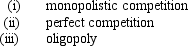
(Multiple Choice)
4.9/5 (62)
(62) When advertising is used to relay information about price,each firm is able to enhance market power.
(True/False)
4.9/5 (73)
(73) Use a graph to demonstrate why a profit-maximizing monopolistically competitive firm must operate at excess capacity.Explain why a perfectly competitive firm is not subject to the same constraint.
(Essay)
4.8/5 (80)
(80) A profit-maximizing firm in a monopolistically competitive market is characterized by which of the following?
(Multiple Choice)
4.9/5 (71)
(71) Which of the following is an example of a monopolistically competitive industry?
(Multiple Choice)
4.9/5 (77)
(77) Critics of markets that are characterized by firms that sell brand name products argue that brand names encourage consumers to pay more for branded products that
(Multiple Choice)
4.8/5 (68)
(68) Monopolistic competition and monopoly are examples of a market structure called imperfect competition.
(True/False)
4.7/5 (80)
(80) "In a long-run equilibrium,price is equal to average total cost." This statement applies to
(Multiple Choice)
4.7/5 (82)
(82) A firm operating in a monopolistically competitive market can earn economic profits in
(Multiple Choice)
4.8/5 (91)
(91) As new firms enter a monopolistically competitive market,profits of existing firms
(Multiple Choice)
4.9/5 (70)
(70) Scenario 16-3
Consider the problem facing two firms,Firm A and Firm B,in the fast-food restaurant market.Each firm has just come up with an idea for a new fast-food menu item which it would sell for $4.Assume that the marginal cost for each new menu item is a constant $2,and the only fixed cost is for advertising.Each company knows that if it spends $12 million on advertising it will get 2 million consumers to try its new product.Firm A has done market research which suggests that its product does not have any "staying" power in the market.Even though it could get 2 million consumers to buy the product once,it is unlikely that they will continue to buy the product in the future.Firm B's market research suggests that its product is very good,and consumers who try the product will continue to be consumers over the ensuing year.On the basis of its market research,Firm B estimates that its initial 2 million customers will buy one unit of the product each month in the coming year,for a total of 24 million units.
-Refer to Scenario 16-3.Which of the following is most likely?
(Multiple Choice)
4.9/5 (76)
(76) Which of the following is a commonly-cited benefit of advertising?
(Multiple Choice)
4.8/5 (88)
(88) 
Filters
- Essay(0)
- Multiple Choice(0)
- Short Answer(0)
- True False(0)
- Matching(0)