



 Chat with AI
Exam 14: Firms in Competitive Markets

Exam 1: Ten Lessons From Economics149 Questions
Exam 2: Thinking Like an Economist147 Questions
Exam 3: Interdependence and the Gains From Trade153 Questions
Exam 4: The Market Forces of Supply and Demand222 Questions
Exam 5: Elasticity and Its Application181 Questions
Exam 6: Supply, Demand and Government Policies148 Questions
Exam 7: Consumers, Producers and the Efficiency of Markets177 Questions
Exam 8: Application: The Costs of Taxation141 Questions
Exam 9: Application: International Trade161 Questions
Exam 10: Externalities199 Questions
Exam 11: Public Goods and Common Resources182 Questions
Exam 12: The Design of the Tax System154 Questions
Exam 13: The Costs of Production191 Questions
Exam 14: Firms in Competitive Markets200 Questions
Exam 15: Monopoly214 Questions
Exam 16: Business Strategy184 Questions
Exam 17: Competition Policy104 Questions
Exam 18: Monopolistic Competition214 Questions
Exam 19: The Markets for the Factors of Production215 Questions
Exam 20: Earnings, Unions and Discrimination206 Questions
Exam 21: Income Inequity and Poverty111 Questions
Exam 22: The Theory of Consumer Choice161 Questions
Exam 23: Frontiers of Microeconomics120 Questions
Exam 24: Measuring a Nations Income51 Questions
Exam 25: Measuring the Cost of Living52 Questions
Exam 26: Production and Growth62 Questions
Exam 27: Saving, Investment and the Financial System62 Questions
Exam 28: The Natural Rate of Unemployment59 Questions
Exam 29: The Monetary System66 Questions
Exam 30: Inflation: Its Causes and Costs74 Questions
Exam 31: Open-Economy Macroeconomics: Basic Concepts68 Questions
Exam 32: A Macroeconomic Theory of the Open Economy64 Questions
Exam 33: Aggregate Demand and Aggregate Supply82 Questions
Exam 34: The Influence of Monetary and Fiscal Policy on Aggregate Demand73 Questions
Exam 35: The Short-Run Trade-Off Between Inflation and Unemployment58 Questions
Exam 36: Five Debates Over Macroeconomic Policy38 Questions
Select questions type


It is possible for firms in a competitive market to earn positive accounting profits in the long-run.
(True/False)
4.8/5  (76)
(76) Graph 14-7
 In this graph, panel (a) depicts the linear marginal cost of a firm in a competitive market, and panel (b) depicts the linear market supply curve for a market with a fixed number of identical firms. Use the graph to answer the following question(s).
-Refer to Graph 14-7. If at a market price of $1.75, 52 500 units of output are supplied to this market, how many identical firms are participating in this market?
In this graph, panel (a) depicts the linear marginal cost of a firm in a competitive market, and panel (b) depicts the linear market supply curve for a market with a fixed number of identical firms. Use the graph to answer the following question(s).
-Refer to Graph 14-7. If at a market price of $1.75, 52 500 units of output are supplied to this market, how many identical firms are participating in this market? (Multiple Choice)
4.9/5 (83)
(83) When you buy a product from a firm in a competitive market, the price you pay for the product is likely to be:
(Multiple Choice)
4.7/5 (93)
(93) In a perfectly competitive market, the process of entry and exit will end when firms in the market:
(Multiple Choice)
4.7/5 (85)
(85) Graph 14-5
 The graph depicts the cost structure of a firm in a competitive market. Use the graph to answer the following question(s).
-Refer to Graph 14-5. When market price is P5, a profit-maximising firm's profits can be represented by the area:
The graph depicts the cost structure of a firm in a competitive market. Use the graph to answer the following question(s).
-Refer to Graph 14-5. When market price is P5, a profit-maximising firm's profits can be represented by the area: (Multiple Choice)
4.9/5 (69)
(69) When entry and exit behaviour of firms in an industry does not affect a firm's cost structure:
(Multiple Choice)
4.8/5 (82)
(82) Graph 14-8
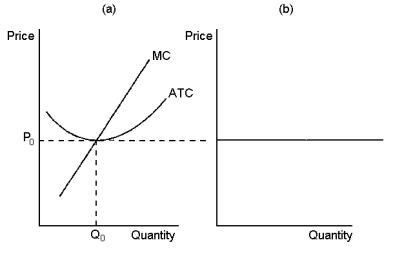 -Refer to Graph 14-8. If the figure in panel (a) reflects the long-run equilibrium of a profit-maximising firm in a competitive market, the figure in panel (b) is most likely to reflect long-run market:
 (Multiple Choice)
4.8/5 (73)
(73) The supply curve of a firm in a competitive market is equal to average variable cost, above the minimum of marginal cost.
(True/False)
4.8/5 (86)
(86) Suppose a movie theatre stays open late at night even though few people attend screenings this late. Which of the following principles are being demonstrated? (i) fixed costs are sunk in the short-run
(ii) in the short-run, only variable costs are important to the decision to stay open for late evening showings
(iii) if variable exceeds revenue, the theatre owner is making a profitable strategic decision to remain open late into the night
(Multiple Choice)
4.8/5 (96)
(96) Table 14-2
The price of each David Butterfly a butterfly farmer in Greytown sells is:
 -Refer to Table 14-2. Marginal revenue is declining over the range:
 (Multiple Choice)
4.9/5 (90)
(90) A firm in a competitive market will maximise profit when the level of production is such that marginal cost equals price.
(True/False)
4.8/5 (87)
(87) For a farmer facing a long-run decision about whether to exit the market or not, the cost of her land is considered to be sunk.
(True/False)
4.8/5 (75)
(75) When firms in a competitive market have different costs, it is likely that:
(Multiple Choice)
4.9/5 (84)
(84) NARRBEGIN 14-2
Graph 14-2
 This graph depicts the cost structure for a firm in a competitive market. Use the graph to answer the following question(s).
-Refer to Graph 14-2. When price falls from P3 to P1, the firm finds that:
This graph depicts the cost structure for a firm in a competitive market. Use the graph to answer the following question(s).
-Refer to Graph 14-2. When price falls from P3 to P1, the firm finds that: (Multiple Choice)
5.0/5 (78)
(78) A market is competitive if which of the following are true? (i) each buyer is small compared to the market
(ii) a single firm has a significant impact on the market price
(iii) the good offered for sale is largely the same
(Multiple Choice)
5.0/5 (84)
(84) If a perfectly competitive firm in equilibrium increases output by 25 per cent marginal revenue will fall and marginal costs will rise.
(True/False)
4.8/5 (71)
(71) Table 14-1
This table shows the revenue and costs of a parrot farmer.
 -Refer to Table 14-1. Average revenue will equal to marginal cost when harvest is equal to:
 (Multiple Choice)
4.9/5 (80)
(80) Table 14-1
This table shows the revenue and costs of a parrot farmer.
-Refer to Table 14-1. If the farmer determines that marginal cost is $11, harvest of parrots should:
-Refer to Table 14-1. If the farmer determines that marginal cost is $11, harvest of parrots should: (Multiple Choice)
4.7/5 (74)
(74) A firm will exit in the short run if total revenue is less than total costs.
(True/False)
4.7/5 (75)
(75) 
Filters
- Essay(0)
- Multiple Choice(0)
- Short Answer(0)
- True False(0)
- Matching(0)