



 Chat with AI
Exam 14: Firms in Competitive Markets

Exam 1: Ten Lessons From Economics149 Questions
Exam 2: Thinking Like an Economist147 Questions
Exam 3: Interdependence and the Gains From Trade153 Questions
Exam 4: The Market Forces of Supply and Demand222 Questions
Exam 5: Elasticity and Its Application181 Questions
Exam 6: Supply, Demand and Government Policies148 Questions
Exam 7: Consumers, Producers and the Efficiency of Markets177 Questions
Exam 8: Application: The Costs of Taxation141 Questions
Exam 9: Application: International Trade161 Questions
Exam 10: Externalities199 Questions
Exam 11: Public Goods and Common Resources182 Questions
Exam 12: The Design of the Tax System154 Questions
Exam 13: The Costs of Production191 Questions
Exam 14: Firms in Competitive Markets200 Questions
Exam 15: Monopoly214 Questions
Exam 16: Business Strategy184 Questions
Exam 17: Competition Policy104 Questions
Exam 18: Monopolistic Competition214 Questions
Exam 19: The Markets for the Factors of Production215 Questions
Exam 20: Earnings, Unions and Discrimination206 Questions
Exam 21: Income Inequity and Poverty111 Questions
Exam 22: The Theory of Consumer Choice161 Questions
Exam 23: Frontiers of Microeconomics120 Questions
Exam 24: Measuring a Nations Income51 Questions
Exam 25: Measuring the Cost of Living52 Questions
Exam 26: Production and Growth62 Questions
Exam 27: Saving, Investment and the Financial System62 Questions
Exam 28: The Natural Rate of Unemployment59 Questions
Exam 29: The Monetary System66 Questions
Exam 30: Inflation: Its Causes and Costs74 Questions
Exam 31: Open-Economy Macroeconomics: Basic Concepts68 Questions
Exam 32: A Macroeconomic Theory of the Open Economy64 Questions
Exam 33: Aggregate Demand and Aggregate Supply82 Questions
Exam 34: The Influence of Monetary and Fiscal Policy on Aggregate Demand73 Questions
Exam 35: The Short-Run Trade-Off Between Inflation and Unemployment58 Questions
Exam 36: Five Debates Over Macroeconomic Policy38 Questions
Select questions type


The entry and exit decisions of firms in a competitive market are signalled by:
(Multiple Choice)
4.7/5  (75)
(75) By comparing marginal revenue and marginal cost, a firm in a competitive market is able to adjust production to the level that:
(Multiple Choice)
4.7/5 (87)
(87) Suppose a firm in a competitive market receives $1200 in total revenue, it has a marginal revenue of $30. What is the average revenue, and how many units were sold?
(Multiple Choice)
4.7/5 (64)
(64) Sunk costs are relevant to decisions about business strategy, as huge amounts of time have been invested in ensuring that the business is set up for success.
(True/False)
4.9/5 (83)
(83) Graph 14-9
 -Refer to Graph 14-9. Assume that the market starts in equilibrium at point A in panel (b). An increase in demand from Demand0 to Demand1 will result in:
 (Multiple Choice)
4.8/5 (68)
(68) Table 14-1
This table shows the revenue and costs of a parrot farmer.
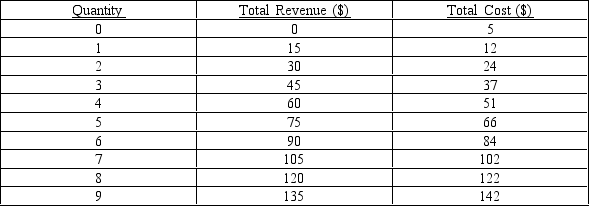 -Refer to Table 14-1. If the farmer chooses to maximise profit, the appropriate output level is where marginal cost is equal to:
 (Multiple Choice)
4.9/5 (91)
(91) In the long-run, a profit-maximising firm will choose to exit a market when:
(Multiple Choice)
4.9/5 (79)
(79) To answer the question 'How much revenue does the farm receive for the typical gallon of milk'?, a dairy farmer must be able to calculate sunk cost.
(True/False)
4.9/5 (82)
(82) Suppose a profit-maximising firm is actually ends up minimising losses. This task is accomplished by producing the quantity at which price is equal to the:
(Multiple Choice)
4.8/5 (78)
(78) Whenever a perfectly competitive firm chooses to change its level of output, its marginal revenue:
(Multiple Choice)
4.9/5 (86)
(86) When price is below average variable cost, a firm in a competitive market will:
(Multiple Choice)
4.7/5 (81)
(81) In a market that allows free entry and exit, the process of entry and exit ends when:
(Multiple Choice)
4.8/5 (87)
(87) The average total cost becomes downward sloping when it is crossed by the marginal cost curve.
(True/False)
4.8/5 (76)
(76) When individual firms in competitive markets increase their production, it is likely that market price will fall.
(True/False)
4.9/5 (82)
(82) By comparing the marginal revenue and marginal cost from each unit produced, a firm in a competitive market can determine the profit-maximising level of production.
(True/False)
4.9/5 (80)
(80) The Wheeler Wheat Farm has a long-term lease on 5000 acres of land in New South Wales. The annual lease payment is $250,000. Prior to planting in the spring of 2001, the Wheeler Farm accountant predicted that the Farm would have $135 000 left after paying all of its costs except the annual lease payment. In this case, the Wheeler Wheat Farm should:
(Multiple Choice)
4.9/5 (86)
(86) NARRBEGIN 14-2
Graph 14-2
 This graph depicts the cost structure for a firm in a competitive market. Use the graph to answer the following question(s).
-Refer to Graph 14-2. When price rises from P2 to P3, the firm finds that:
This graph depicts the cost structure for a firm in a competitive market. Use the graph to answer the following question(s).
-Refer to Graph 14-2. When price rises from P2 to P3, the firm finds that: (Multiple Choice)
4.8/5 (82)
(82) When new firms have an incentive to enter a competitive market, their entry will:
(Multiple Choice)
4.8/5 (91)
(91) Sarah places a $110 value on seeing the Richmond Tigers play in the Grand Final. She purchases a ticket to the game for $60 but when she arrives at the game she discovers that her ticket is missing. A ticket scalper outside the stadium is selling tickets for $76 dollars. If Sarah purchases a ticket from one of the scalpers for $95, she is best demonstrating the principle that:
(Multiple Choice)
4.9/5 (80)
(80) When a competitive market experiences an increase in demand that induces an increase in producer costs, which of the following is most likely to occur?
(Multiple Choice)
4.8/5 (86)
(86) 
Filters
- Essay(0)
- Multiple Choice(0)
- Short Answer(0)
- True False(0)
- Matching(0)