



 Chat with AI
Exam 14: Firms in Competitive Markets

Exam 1: Ten Lessons From Economics149 Questions
Exam 2: Thinking Like an Economist147 Questions
Exam 3: Interdependence and the Gains From Trade153 Questions
Exam 4: The Market Forces of Supply and Demand222 Questions
Exam 5: Elasticity and Its Application181 Questions
Exam 6: Supply, Demand and Government Policies148 Questions
Exam 7: Consumers, Producers and the Efficiency of Markets177 Questions
Exam 8: Application: The Costs of Taxation141 Questions
Exam 9: Application: International Trade161 Questions
Exam 10: Externalities199 Questions
Exam 11: Public Goods and Common Resources182 Questions
Exam 12: The Design of the Tax System154 Questions
Exam 13: The Costs of Production191 Questions
Exam 14: Firms in Competitive Markets200 Questions
Exam 15: Monopoly214 Questions
Exam 16: Business Strategy184 Questions
Exam 17: Competition Policy104 Questions
Exam 18: Monopolistic Competition214 Questions
Exam 19: The Markets for the Factors of Production215 Questions
Exam 20: Earnings, Unions and Discrimination206 Questions
Exam 21: Income Inequity and Poverty111 Questions
Exam 22: The Theory of Consumer Choice161 Questions
Exam 23: Frontiers of Microeconomics120 Questions
Exam 24: Measuring a Nations Income51 Questions
Exam 25: Measuring the Cost of Living52 Questions
Exam 26: Production and Growth62 Questions
Exam 27: Saving, Investment and the Financial System62 Questions
Exam 28: The Natural Rate of Unemployment59 Questions
Exam 29: The Monetary System66 Questions
Exam 30: Inflation: Its Causes and Costs74 Questions
Exam 31: Open-Economy Macroeconomics: Basic Concepts68 Questions
Exam 32: A Macroeconomic Theory of the Open Economy64 Questions
Exam 33: Aggregate Demand and Aggregate Supply82 Questions
Exam 34: The Influence of Monetary and Fiscal Policy on Aggregate Demand73 Questions
Exam 35: The Short-Run Trade-Off Between Inflation and Unemployment58 Questions
Exam 36: Five Debates Over Macroeconomic Policy38 Questions
Select questions type


Graph 14-7
 In this graph, panel (a) depicts the linear marginal cost of a firm in a competitive market, and panel (b) depicts the linear market supply curve for a market with a fixed number of identical firms. Use the graph to answer the following question(s).
-Refer to Graph 14-7. When 100 identical firms participate in this market, at what price will 15 000 units be supplied to this market?
In this graph, panel (a) depicts the linear marginal cost of a firm in a competitive market, and panel (b) depicts the linear market supply curve for a market with a fixed number of identical firms. Use the graph to answer the following question(s).
-Refer to Graph 14-7. When 100 identical firms participate in this market, at what price will 15 000 units be supplied to this market? (Multiple Choice)
5.0/5  (83)
(83) A profit-maximising firm that is showing losses (negative profit) most likely faces which of the following conditions?
(Multiple Choice)
4.8/5 (77)
(77) When a profit-maximising firm in a competitive market experiences rising prices, it will respond with an increase in production.
(True/False)
4.7/5 (84)
(84) Graph 14-5
 The graph depicts the cost structure of a firm in a competitive market. Use the graph to answer the following question(s).
-Refer to Graph 14-5. Firms would be encouraged to enter this market for all prices that exceed:
The graph depicts the cost structure of a firm in a competitive market. Use the graph to answer the following question(s).
-Refer to Graph 14-5. Firms would be encouraged to enter this market for all prices that exceed: (Multiple Choice)
4.9/5 (86)
(86) Use a graph to demonstrate the circumstances that would prevail in a competitive market where firms are earning economic profits. Can this scenario be maintained in the long-run? Carefully explain your answer.
(Essay)
4.8/5 (72)
(72) If a firm in a competitive market sells 25 per cent less, then its total revenue will fall by 25 per cent.
(True/False)
4.9/5 (87)
(87) Under what conditions would a firm choose to shut down? When would it decide to exit the market?
(Essay)
4.9/5 (84)
(84) Suppose a firm in a competitive market notices that its marginal cost is greater than its price. This means that:
(Multiple Choice)
4.8/5 (77)
(77) Lee had invested $100 000 in a risk-free unit trust, on which she earned $10 000 each year. She used that money to buy a prawn farm. She also quit her job as a salesperson to devote all of her time to her prawn business. Her salary as a salesperson was $25 000 per year.
-According to the information provided, what would Lee's accounting profits need to be to allow her to reach the zero economic profit equilibrium?
(Multiple Choice)
5.0/5 (74)
(74) The exit of existing firms from a competitive market will:
(Multiple Choice)
4.8/5 (81)
(81) Explain the relationship between a firm's supply curve and its costs.
(Essay)
4.7/5 (78)
(78) In a competitive market, the actions of any single buyer or seller will:
(Multiple Choice)
4.8/5 (77)
(77) The long-run equilibrium in a competitive market characterised by firms with identical costs is generally characterised by firms operating at efficient scale.
(True/False)
4.9/5 (81)
(81) The additional revenue a firm in a competitive market receives if it increases its production by one unit is equal to:
(Multiple Choice)
4.7/5 (71)
(71) At its current level of production, a profit-maximising firm in a competitive market receives $12.50 for each unit it produces, and faces an average total cost of $10. At the market price of $12.50 per unit, the firm's marginal cost curve crosses the marginal revenue curve at an output level of 1000 units. What is the firm's current profit? What is likely to occur in this market and why?
(Essay)
4.9/5 (83)
(83) Graph 14-8
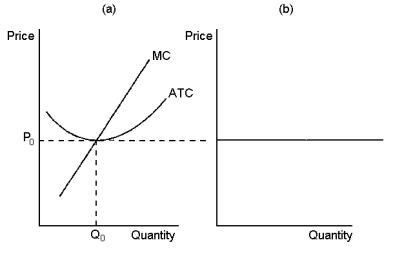 -Refer to Graph 14-8. If the figure in panel (a) reflects the long-run equilibrium of a profit-maximising firm in a competitive market, the figure in panel (b) most likely reflects:
 (Multiple Choice)
4.8/5 (77)
(77) Suppose a perfectly competitive firm reduces its output by 10 per cent. This means that its:
(Multiple Choice)
4.8/5 (95)
(95) A long-run supply curve that is more elastic than a short-run supply curve results from which of the following circumstances?
(Multiple Choice)
5.0/5 (84)
(84) A firm's incentive to compare marginal revenue and marginal cost is an application of the principle that rational people think at the margin.
(True/False)
4.8/5 (75)
(75) The long-run supply curve in a competitive market must be more inelastic than the short-run supply curve.
(True/False)
4.7/5 (84)
(84) 
Filters
- Essay(0)
- Multiple Choice(0)
- Short Answer(0)
- True False(0)
- Matching(0)