



 Chat with AI
Exam 14: Firms in Competitive Markets

Exam 1: Ten Lessons From Economics149 Questions
Exam 2: Thinking Like an Economist147 Questions
Exam 3: Interdependence and the Gains From Trade153 Questions
Exam 4: The Market Forces of Supply and Demand222 Questions
Exam 5: Elasticity and Its Application181 Questions
Exam 6: Supply, Demand and Government Policies148 Questions
Exam 7: Consumers, Producers and the Efficiency of Markets177 Questions
Exam 8: Application: The Costs of Taxation141 Questions
Exam 9: Application: International Trade161 Questions
Exam 10: Externalities199 Questions
Exam 11: Public Goods and Common Resources182 Questions
Exam 12: The Design of the Tax System154 Questions
Exam 13: The Costs of Production191 Questions
Exam 14: Firms in Competitive Markets200 Questions
Exam 15: Monopoly214 Questions
Exam 16: Business Strategy184 Questions
Exam 17: Competition Policy104 Questions
Exam 18: Monopolistic Competition214 Questions
Exam 19: The Markets for the Factors of Production215 Questions
Exam 20: Earnings, Unions and Discrimination206 Questions
Exam 21: Income Inequity and Poverty111 Questions
Exam 22: The Theory of Consumer Choice161 Questions
Exam 23: Frontiers of Microeconomics120 Questions
Exam 24: Measuring a Nations Income51 Questions
Exam 25: Measuring the Cost of Living52 Questions
Exam 26: Production and Growth62 Questions
Exam 27: Saving, Investment and the Financial System62 Questions
Exam 28: The Natural Rate of Unemployment59 Questions
Exam 29: The Monetary System66 Questions
Exam 30: Inflation: Its Causes and Costs74 Questions
Exam 31: Open-Economy Macroeconomics: Basic Concepts68 Questions
Exam 32: A Macroeconomic Theory of the Open Economy64 Questions
Exam 33: Aggregate Demand and Aggregate Supply82 Questions
Exam 34: The Influence of Monetary and Fiscal Policy on Aggregate Demand73 Questions
Exam 35: The Short-Run Trade-Off Between Inflation and Unemployment58 Questions
Exam 36: Five Debates Over Macroeconomic Policy38 Questions
Select questions type


The market for arts and crafts used in home decoration is a very competitive market. In this market, costs vary since some people work faster than others and have more artistic talent in producing arts and crafts. In this competitive market, we would expect to observe:
(Multiple Choice)
4.8/5  (83)
(83) The implication of a firm being a price taker is that, if it increases its price then:
(Multiple Choice)
4.8/5 (90)
(90) Why would a profit-maximising firm in a competitive market set a price higher than the market price?
(Multiple Choice)
4.8/5 (72)
(72) New Zealand possums produce the highest quality fur, due to the large pelts per body size. Demand for New Zealand possums products has risen dramatically. This is partly a result of the conservation benefits of harvesting New Zealand possums. This has made the product seem more environment-friendly than other fur products and boosted sales to concerned consumers.
Assume that the possums market satisfies all of the attributes of a competitive market. Further assume that high grade possum furs are the most expensive input into the possum fur production function.
a. Use a graph of the market for possum fur to demonstrate the effect of its environmentally friendly status on the market equilibrium.
b. Graph the reaction of an individual incumbent firm to the increase in market demand. In your graph, identify the firm's revenue and cost structures.
c. What would you predict would happen to long-run industry supply if the price of possum fur increased as possum culling increased their production of possum furs? Use a graph to demonstrate the validity of your prediction.
(Essay)
4.9/5 (84)
(84) Graph 14-4
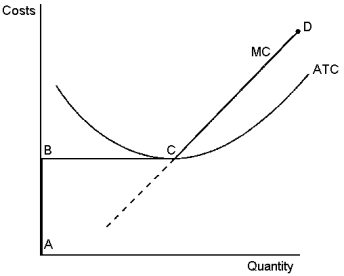 This graph depicts the cost structure of a profit-maximising firm in a competitive market. Use the graph to answer the following question(s).
-Refer to Graph 14-4. This firm will exit the market for any price on the line segment:
This graph depicts the cost structure of a profit-maximising firm in a competitive market. Use the graph to answer the following question(s).
-Refer to Graph 14-4. This firm will exit the market for any price on the line segment: (Multiple Choice)
4.9/5 (88)
(88) When a profit-maximising firm is earning profits, those profits can be identified as:
(Multiple Choice)
4.9/5 (62)
(62) When firms in a perfectly competitive market face the same costs, in the long-run they must be operating:
(Multiple Choice)
4.8/5 (78)
(78) From the perspective of a price-taking competitive firm, what is the relationship between price, average revenue and marginal revenue?
(Essay)
4.8/5 (85)
(85) When firms have an incentive to exit a competitive market, their exit will:
(Multiple Choice)
4.8/5 (87)
(87) Table 14-1
This table shows the revenue and costs of a parrot farmer.
 -Refer to Table 14-1. If the farmer harvested three parrots then:
 (Multiple Choice)
5.0/5 (83)
(83) Restaurants often remain open for lunch even if they attract few customers because, the variable costs are small relative to the revenue, even if the fixed costs are large.
(True/False)
4.8/5 (72)
(72) NARRBEGIN 14-2
Graph 14-2
 This graph depicts the cost structure for a firm in a competitive market. Use the graph to answer the following question(s).
-Refer to Graph 14-2. When price rises from P3 to P4, the firm finds that:
This graph depicts the cost structure for a firm in a competitive market. Use the graph to answer the following question(s).
-Refer to Graph 14-2. When price rises from P3 to P4, the firm finds that: (Multiple Choice)
4.9/5 (70)
(70) Table 14-1
This table shows the revenue and costs of a parrot farmer.
-Refer to Table 14-1. If the farmer finds that its marginal cost is $20, the best response would be to:
-Refer to Table 14-1. If the farmer finds that its marginal cost is $20, the best response would be to: (Multiple Choice)
4.8/5 (62)
(62) Graph 14-9
 -Refer to Graph 14-9. An increase in market supply from Supply0 to Supply1 is most likely the result of:
 (Multiple Choice)
4.9/5 (75)
(75) A profit-maximising firm in a competitive market will always make marginal adjustments to production as long as:
(Multiple Choice)
4.7/5 (87)
(87) As a general rule, when accountants calculate profit they account for explicit costs but miss:
(Multiple Choice)
4.8/5 (80)
(80) In the long run, all of a firm's costs are variable. In this case the exit criterion for a profit-maximising firm is:
(Multiple Choice)
4.9/5 (78)
(78) In a market with 1000 identical firms, the market supply is equal to the:
(Multiple Choice)
4.7/5 (85)
(85) Graph 14-1
 This graph depicts the cost structure for a firm in a competitive market. Use the graph to answer the following question(s).
-Refer to Graph 14-1. When market price is at MC4, a profit-maximising firm will produce what level of output?
This graph depicts the cost structure for a firm in a competitive market. Use the graph to answer the following question(s).
-Refer to Graph 14-1. When market price is at MC4, a profit-maximising firm will produce what level of output? (Multiple Choice)
4.9/5 (87)
(87) 
Filters
- Essay(0)
- Multiple Choice(0)
- Short Answer(0)
- True False(0)
- Matching(0)