



 Chat with AI
Exam 15: International Trade and Trade Policy

Exam 1: Thinking Like an Economist142 Questions
Exam 2: Comparative Advantage163 Questions
Exam 3: Supply and Demand181 Questions
Exam 4: Elasticity154 Questions
Exam 5: Demand144 Questions
Exam 6: Perfectly Competitive Supply159 Questions
Exam 7: Efficiency, Exchange, and the Invisible Hand in Action159 Questions
Exam 8: Monopoly, Oligopoly, and Monopolistic Competition147 Questions
Exam 9: Games and Strategic Behavior150 Questions
Exam 10: An Introduction to Behavioral Economics111 Questions
Exam 11: Externalities, Property Rights, and the Environment184 Questions
Exam 12: The Economics of Information127 Questions
Exam 13: Labor Markets, Poverty, and Income Distribution138 Questions
Exam 14: Public Goods and Tax Policy142 Questions
Exam 15: International Trade and Trade Policy164 Questions
Exam 16: Macroeconomics: The Birds Eye View of the Economy154 Questions
Exam 17: Measuring Economic Activity: GDP and Unemployment210 Questions
Exam 18: Measuring the Price Level and Inflation160 Questions
Exam 19: Economic Growth, Productivity, and Living Standards158 Questions
Exam 20: The Labor Market: Workers, Wages, and Unemployment121 Questions
Exam 21: Saving and Capital Formation144 Questions
Exam 22: Money Prices and the Federal Reserve107 Questions
Exam 23: Financial Markets and International Capital Flows104 Questions
Exam 24: Short-Term Economic Fluctuations: An Introduction124 Questions
Exam 25: Spending and Output in the Short Run146 Questions
Exam 26: Stabilizing the Economy: The Role of the Fed162 Questions
Exam 27: Aggregate Demand, Aggregate Supply, and Inflation159 Questions
Exam 28: Exchange Rates and the Open Economy157 Questions
Select questions type


Amy can produce either 5,000 pounds of cheese or 20 cars per year. Mike can produce either 5,000 pounds of cheese or 10 cars per year. Amy has a comparative advantage in producing ________, and Mike has a comparative advantage in producing ________.
(Multiple Choice)
4.9/5  (70)
(70) In an open economy, how many TVs will this country import? 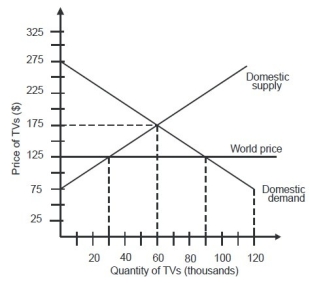
(Multiple Choice)
4.9/5 (75)
(75) Australia is a net exporter of wool, free trade will benefit the ________.
(Multiple Choice)
4.9/5 (89)
(89) Amy can produce either 5,000 pounds of cheese or 20 cars per year. Mike can produce either 5,000 pounds of cheese or 10 cars per year. Amy's opportunity cost of producing one car is ________ pounds of cheese.
(Multiple Choice)
4.8/5 (88)
(88) Refer to the following graph. 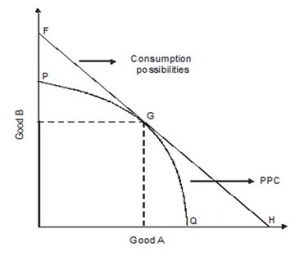 If this country is producing between point P and G, it will gain by ________ its production of good A and importing more ________.
 (Multiple Choice)
4.9/5 (85)
(85) The slope of a many-worker consumption possibilities is determined by the relative price of
(Multiple Choice)
4.8/5 (84)
(84) Protectionism is the view that free trade is ________ and should be ________.
(Multiple Choice)
4.8/5 (75)
(75) Consider a many-worker economy with two goods. With access to international trade, a country can consume the greatest amount of both goods by producing at the point where the
(Multiple Choice)
4.8/5 (87)
(87) The following graph shows the production possibilities curve for the economy with only two members, Silvia and Art. Silvia can produce either 50 pounds of beef or 2 computers per week, and Art can produce 100 pounds of beef or 1 computer per week. Both of them work 40 weeks per year. 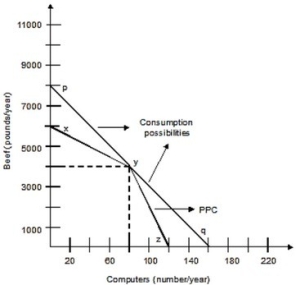 If this country has an open economy, Silvia and Art can get ________ pounds of beef in exchange of a computer.
 (Multiple Choice)
4.8/5 (80)
(80) If the United States is a net importer of bananas, free trade will benefit the
(Multiple Choice)
4.8/5 (82)
(82) Refer to the accompanying figure, which shows the annual domestic supply and annual domestic demand for jeans in a small country. 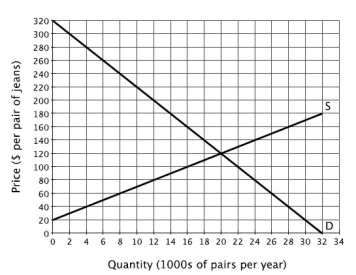 Suppose this country initially does not trade with the rest of the world. If the world price of a pair of jeans is $40, and this country opens itself to trade, then the annual domestic production of jeans will:
 (Multiple Choice)
4.8/5 (77)
(77) The United States imports garments from third world countries. This means that if the U.S. economy were closed, the domestic price of goods would be ________ the world price of garments.
(Multiple Choice)
4.9/5 (76)
(76) Refer to the following graph. 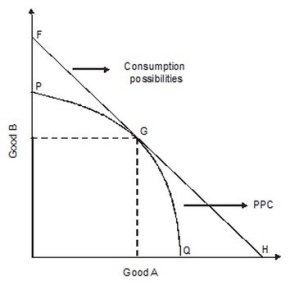 The maximum amount of good B can be consumed in this economy with international trade is
 (Multiple Choice)
4.9/5 (74)
(74) An economy has two workers, Paula and Ricardo. Every day they work, Paula can produce 4 computers or 16 shirts, and Ricardo can produce 6 computers or 12 shirts. To maximize total output, Paula should specialize in producing ________ while Ricardo should specialize in producing ________.
(Multiple Choice)
4.7/5 (88)
(88) If the United States consumption possibilities are greater than its production possibilities, then the United States must have
(Multiple Choice)
4.8/5 (76)
(76) The following graph shows the production possibilities curve for the economy with only two members, Silvia and Art. Silvia can produce either 50 pounds of beef or 2 computers per week, and Art can produce 100 pounds of beef or 1 computer per week. Both of them work 40 weeks per year. 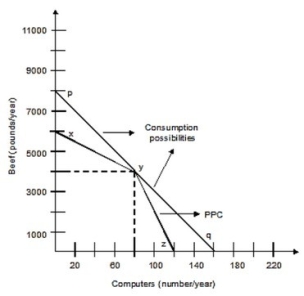 How much of each good is produced if each worker fully specializes according to comparative advantage?
 (Multiple Choice)
4.9/5 (73)
(73) The price at which a good or service is traded on international markets is called the ________ price.
(Multiple Choice)
4.9/5 (88)
(88) 
Filters
- Essay(0)
- Multiple Choice(0)
- Short Answer(0)
- True False(0)
- Matching(0)