



 Chat with AI
Exam 15: International Trade and Trade Policy

Exam 1: Thinking Like an Economist142 Questions
Exam 2: Comparative Advantage163 Questions
Exam 3: Supply and Demand181 Questions
Exam 4: Elasticity154 Questions
Exam 5: Demand144 Questions
Exam 6: Perfectly Competitive Supply159 Questions
Exam 7: Efficiency, Exchange, and the Invisible Hand in Action159 Questions
Exam 8: Monopoly, Oligopoly, and Monopolistic Competition147 Questions
Exam 9: Games and Strategic Behavior150 Questions
Exam 10: An Introduction to Behavioral Economics111 Questions
Exam 11: Externalities, Property Rights, and the Environment184 Questions
Exam 12: The Economics of Information127 Questions
Exam 13: Labor Markets, Poverty, and Income Distribution138 Questions
Exam 14: Public Goods and Tax Policy142 Questions
Exam 15: International Trade and Trade Policy164 Questions
Exam 16: Macroeconomics: The Birds Eye View of the Economy154 Questions
Exam 17: Measuring Economic Activity: GDP and Unemployment210 Questions
Exam 18: Measuring the Price Level and Inflation160 Questions
Exam 19: Economic Growth, Productivity, and Living Standards158 Questions
Exam 20: The Labor Market: Workers, Wages, and Unemployment121 Questions
Exam 21: Saving and Capital Formation144 Questions
Exam 22: Money Prices and the Federal Reserve107 Questions
Exam 23: Financial Markets and International Capital Flows104 Questions
Exam 24: Short-Term Economic Fluctuations: An Introduction124 Questions
Exam 25: Spending and Output in the Short Run146 Questions
Exam 26: Stabilizing the Economy: The Role of the Fed162 Questions
Exam 27: Aggregate Demand, Aggregate Supply, and Inflation159 Questions
Exam 28: Exchange Rates and the Open Economy157 Questions
Select questions type


An economy has two workers, Jen and Rich. Every day they work, Jen can produce 2 TVs or 10 radios, and Rich can produce 4 TVs or 12 radios. What is the opportunity cost for Jen to produce one TV?
(Multiple Choice)
4.9/5  (76)
(76) A legal limit on the quantity of a good that may be imported is called a(n)________.
(Multiple Choice)
4.8/5 (84)
(84) The following graph is the production possibility curve for a three-person economy, with workers Janna, Drew, and Kari. 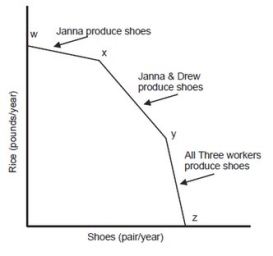 Who has the greatest comparative advantage in rice production?
 (Multiple Choice)
4.8/5 (66)
(66) Refer to the accompanying figure, which shows the annual domestic supply and annual domestic demand for jeans in a small country. 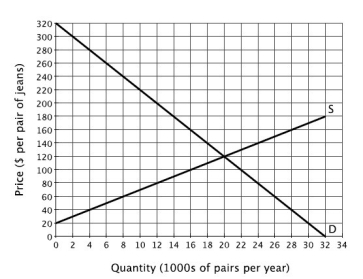 Suppose this country is open to trade with the rest of the world, and the world price of a pair of jeans is $40. If the government imposes a quota on imported jeans of 12,000 pairs per year, then the new equilibrium price of jeans in this country will be:
 (Multiple Choice)
4.7/5 (73)
(73) If this is a closed economy, how many bushels of corn will be produced? 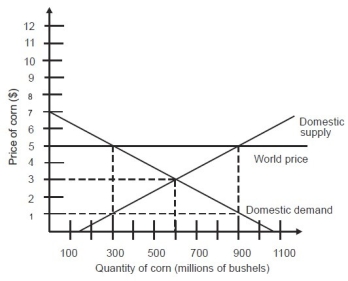
(Multiple Choice)
4.9/5 (79)
(79) In a many-worker economy the consumption possibilities line touches the production possibility curve
(Multiple Choice)
4.8/5 (89)
(89) The demand for microwaves in a certain country is given by: D = 8,000 -30P, where P is the price of a microwave. Supply by domestic microwave producers is: S = 4,000 + 10P. Suppose the economy is closed. The equilibrium price of a microwave is ________ and equilibrium quantity is ________.
(Multiple Choice)
4.8/5 (66)
(66) In an open economy, the quantity supplied of bushels of corn is ________. 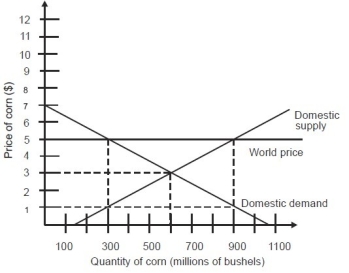
(Multiple Choice)
4.7/5 (94)
(94) The demand for cars in a certain country is given by: D = 20,000 - P, where P is the price of a car. Supply by domestic car producers is: S = 5,000 + 0.5P. Suppose the economy is closed. The equilibrium price of a car is ________ and equilibrium quantity is ________.
(Multiple Choice)
4.8/5 (79)
(79) If this is a closed economy, what will the price of a bike be? 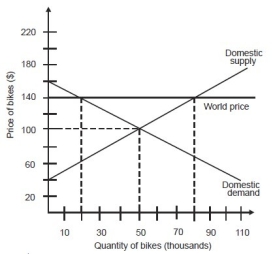
(Multiple Choice)
4.9/5 (69)
(69) The demand for microwaves in a certain country is given by: D = 8,000 - 30P, where P is the price of a microwave. Supply by domestic microwave producers is: S = 4,000 + 10P. If this economy opens to trade while the world price of a microwave is $50, and the government imposes a tariff of $30 per microwave, then the domestic quantity supplied will be ________ microwaves.
(Multiple Choice)
4.9/5 (84)
(84) The demand for microwaves in a certain country is given by: D = 8,000 - 30P, where P is the price of a microwave. Supply by domestic microwave producers is: S = 4,000 + 10P. If this economy opens to trade while the world price of a microwave is $50, and the government imposes a tariff of $30 per microwave, then the tariff revenue collected by the government will be ________.
(Multiple Choice)
4.9/5 (78)
(78) The following graph shows the production possibilities curve for the economy with only two members, Silvia and Art. Silvia can produce either 50 pounds of beef or 2 computers per week, and Art can produce 100 pounds of beef or 1 computer per week. Both of them work 40 weeks per year. 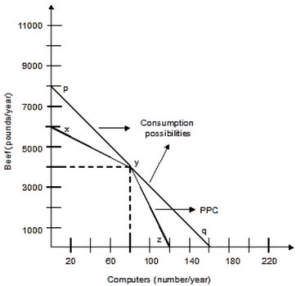 Silvia's opportunity cost of producing one computer is ________ pounds of beef.
 (Multiple Choice)
4.9/5 (76)
(76) 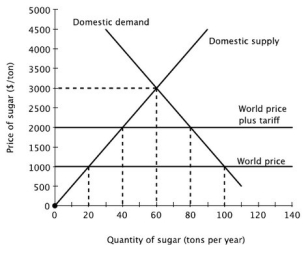
An economy that does NOT trade with the rest of the world is a(n)
(Multiple Choice)
4.8/5 (88)
(88) 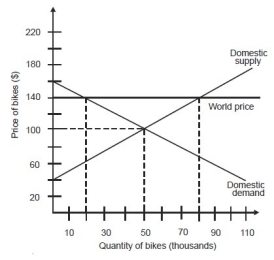
Japan exports cars to the other countries of the world. In an open economy Japan is most likely to have a domestic price that is ________ the world price of cars.
(Multiple Choice)
4.9/5 (88)
(88) There is 5 percent average tax on imported goods in the United States. This tax is known as a(n)________.
(Multiple Choice)
4.9/5 (78)
(78) Refer to the accompanying figure, which shows the annual domestic supply and annual domestic demand for jeans in a small country. 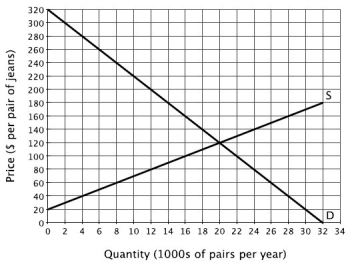 If the world price of a pair of jeans is $40, and this country is open to trade with the rest of the world, then it will ________ pairs of jeans each year.
 (Multiple Choice)
4.9/5 (83)
(83) If the price of a good in a closed economy is greater than the world price, then if the country opens its markets to world trade the country will be a ________ of that good.
(Multiple Choice)
4.9/5 (67)
(67) 
Filters
- Essay(0)
- Multiple Choice(0)
- Short Answer(0)
- True False(0)
- Matching(0)