



 Chat with AI
Exam 15: International Trade and Trade Policy

Exam 1: Thinking Like an Economist142 Questions
Exam 2: Comparative Advantage163 Questions
Exam 3: Supply and Demand181 Questions
Exam 4: Elasticity154 Questions
Exam 5: Demand144 Questions
Exam 6: Perfectly Competitive Supply159 Questions
Exam 7: Efficiency, Exchange, and the Invisible Hand in Action159 Questions
Exam 8: Monopoly, Oligopoly, and Monopolistic Competition147 Questions
Exam 9: Games and Strategic Behavior150 Questions
Exam 10: An Introduction to Behavioral Economics111 Questions
Exam 11: Externalities, Property Rights, and the Environment184 Questions
Exam 12: The Economics of Information127 Questions
Exam 13: Labor Markets, Poverty, and Income Distribution138 Questions
Exam 14: Public Goods and Tax Policy142 Questions
Exam 15: International Trade and Trade Policy164 Questions
Exam 16: Macroeconomics: The Birds Eye View of the Economy154 Questions
Exam 17: Measuring Economic Activity: GDP and Unemployment210 Questions
Exam 18: Measuring the Price Level and Inflation160 Questions
Exam 19: Economic Growth, Productivity, and Living Standards158 Questions
Exam 20: The Labor Market: Workers, Wages, and Unemployment121 Questions
Exam 21: Saving and Capital Formation144 Questions
Exam 22: Money Prices and the Federal Reserve107 Questions
Exam 23: Financial Markets and International Capital Flows104 Questions
Exam 24: Short-Term Economic Fluctuations: An Introduction124 Questions
Exam 25: Spending and Output in the Short Run146 Questions
Exam 26: Stabilizing the Economy: The Role of the Fed162 Questions
Exam 27: Aggregate Demand, Aggregate Supply, and Inflation159 Questions
Exam 28: Exchange Rates and the Open Economy157 Questions
Select questions type


If the opportunity cost of producing a good domestically exceeds the opportunity cost of purchasing it on the world market, a country can gain by
(Multiple Choice)
4.8/5  (85)
(85) Compared to an open economy without a tariff, the amount of imported sugar will drop from ________ tons to ________ tons after the tariff is imposed. 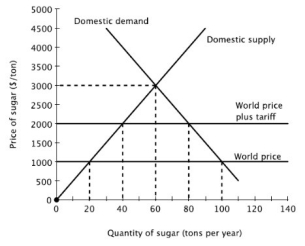
(Multiple Choice)
5.0/5 (76)
(76) In an open economy, the price of a bushel of corn is ________. 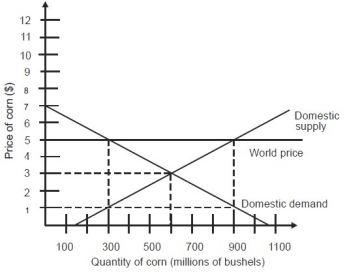
(Multiple Choice)
4.8/5 (76)
(76) The following graph shows the production possibilities curve for the economy with only two members, Silvia and Art. Silvia can produce either 50 pounds of beef or 2 computers per week, and Art can produce 100 pounds of beef or 1 computer per week. Both of them work 40 weeks per year. 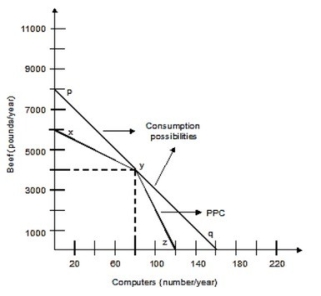 With the open trade economy, Silvia and Art can consume any combination of beef and computers from the line
 (Multiple Choice)
5.0/5 (83)
(83) An economy has two workers, Paula and Ricardo. Every day they work, Paula can produce 4 computers or 16 shirts, and Ricardo can produce 6 computers or 12 shirts. What is the opportunity cost for Ricardo to produce one computer?
(Multiple Choice)
4.8/5 (70)
(70) In an open economy, this country will ________ million bushels of corn. 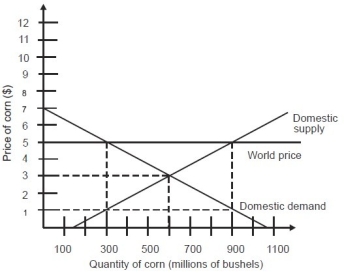
(Multiple Choice)
4.8/5 (96)
(96) Refer to the following graph. 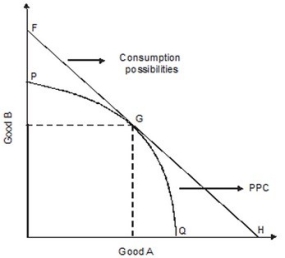 FH is the ________, which tells us how much of good B must be exchanged on ________ market to obtain an additional good A
 (Multiple Choice)
4.8/5 (66)
(66) The following graph is the production possibility curve for a three-person economy, with workers Janna, Drew, and Kari.
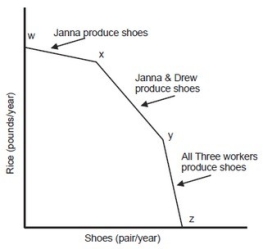 Who has the greatest comparative advantage in shoe production?
 (Multiple Choice)
4.8/5 (82)
(82) An economy has two workers, Paula and Ricardo. Every day they work, Paula can produce 4 computers or 16 shirts, and Ricardo can produce 6 computers or 12 shirts. ________ has the comparative advantage in computers and ________ has the comparative advantage in shirts.
(Multiple Choice)
4.7/5 (84)
(84) 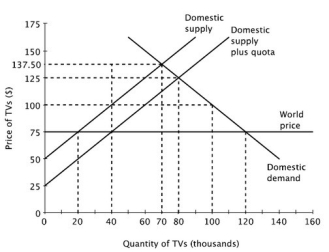
Free trade is ________, because it ________ the size of the pie available to the economy.
(Multiple Choice)
4.9/5 (74)
(74) What is the price of a TV in an open economy without a quota? 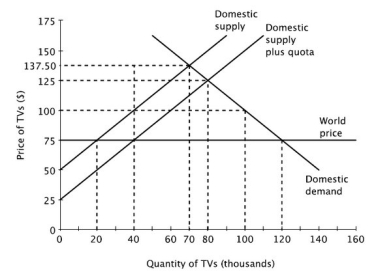
(Multiple Choice)
4.9/5 (83)
(83) The demand for cars in a certain country is given by: D = 20,000 - P, where P is the price of a car. Supply by domestic car producers is: S = 5,000 + 0.5P.If this economy is open to trade, and the world price of a car is $6,000, the domestic quantity demanded will be ________ and quantity supplied will be ________.
(Multiple Choice)
4.9/5 (64)
(64) Refer to the following graph. 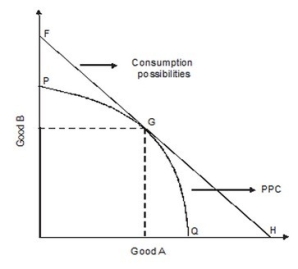 With free trade, this country's citizens can consume the greatest amount of both good A and good B if the country produces at point
 (Multiple Choice)
4.7/5 (75)
(75) Amy can produce either 5,000 pounds of cheese or 20 cars per year. Mike can produce either 5,000 pounds of cheese or 10 cars per year. If both Amy and Mike produce the good in which they have comparative advantage, the total annual output of this economy will be ________.
(Multiple Choice)
4.8/5 (88)
(88) The following graph is the production possibility curve for a three-person economy, with workers Janna, Drew, and Karl. 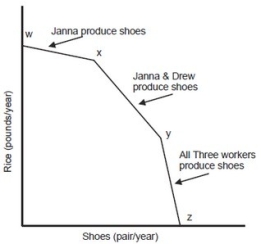 Who has the highest opportunity cost of producing rice?
 (Multiple Choice)
4.9/5 (91)
(91) Sheila and Jim live in an island where they are the only two workers. Sheila can either catch 10 fish or gather 40 pounds of berries each day, and Jim can either catch 8 fish or gather 24 pounds of berries each day. Both of them work 200 days per year. At current world prices 1 fish trades for 3.5 pounds of berries. How much of each good can be produced if each worker fully specializes according to comparative advantage?
(Multiple Choice)
4.8/5 (79)
(79) Amy can produce either 5,000 pounds of cheese or 20 cars per year. Mike can produce either 5,000 pounds of cheese or 10 cars per year. By the principle of comparative advantage, Mike should specialize in producing
(Multiple Choice)
4.9/5 (81)
(81) 
Filters
- Essay(0)
- Multiple Choice(0)
- Short Answer(0)
- True False(0)
- Matching(0)