



 Chat with AI
Exam 15: International Trade and Trade Policy

Exam 1: Thinking Like an Economist142 Questions
Exam 2: Comparative Advantage163 Questions
Exam 3: Supply and Demand181 Questions
Exam 4: Elasticity154 Questions
Exam 5: Demand144 Questions
Exam 6: Perfectly Competitive Supply159 Questions
Exam 7: Efficiency, Exchange, and the Invisible Hand in Action159 Questions
Exam 8: Monopoly, Oligopoly, and Monopolistic Competition147 Questions
Exam 9: Games and Strategic Behavior150 Questions
Exam 10: An Introduction to Behavioral Economics111 Questions
Exam 11: Externalities, Property Rights, and the Environment184 Questions
Exam 12: The Economics of Information127 Questions
Exam 13: Labor Markets, Poverty, and Income Distribution138 Questions
Exam 14: Public Goods and Tax Policy142 Questions
Exam 15: International Trade and Trade Policy164 Questions
Exam 16: Macroeconomics: The Birds Eye View of the Economy154 Questions
Exam 17: Measuring Economic Activity: GDP and Unemployment210 Questions
Exam 18: Measuring the Price Level and Inflation160 Questions
Exam 19: Economic Growth, Productivity, and Living Standards158 Questions
Exam 20: The Labor Market: Workers, Wages, and Unemployment121 Questions
Exam 21: Saving and Capital Formation144 Questions
Exam 22: Money Prices and the Federal Reserve107 Questions
Exam 23: Financial Markets and International Capital Flows104 Questions
Exam 24: Short-Term Economic Fluctuations: An Introduction124 Questions
Exam 25: Spending and Output in the Short Run146 Questions
Exam 26: Stabilizing the Economy: The Role of the Fed162 Questions
Exam 27: Aggregate Demand, Aggregate Supply, and Inflation159 Questions
Exam 28: Exchange Rates and the Open Economy157 Questions
Select questions type


The following graph shows the production possibilities curve for the economy with only two members, Silvia and Art. Silvia can produce either 50 pounds of beef or 2 computers per week, and Art can produce 100 pounds of beef or 1 computer per week. Both of them work 40 weeks per year. 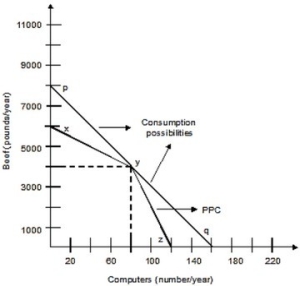 Silvia has a comparative advantage in producing ________, and Art has a comparative advantage in producing ________.
 (Multiple Choice)
4.8/5  (93)
(93) 
The accompanying figure shows the annual production possibilities curve for a small country that is open to trade with the rest of the world. Suppose the world price of cashews is $12 per pound, and the world price of mangos is $4 per pound. As indicated in the figure, at these prices, this country will produce 21,000 pounds of mangos and 5,000 pounds of cashews each year. 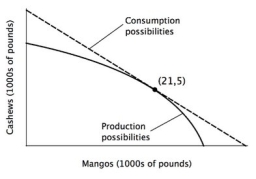 Suppose that the residents of this country are allergic to cashews and only want to consume mangos. Given that this country is open to trade with the rest of the world, how many mangos in total can its residents consume each year?
 (Multiple Choice)
4.9/5 (71)
(71) One means of enforcing a quota is to require importers to ________.
(Multiple Choice)
4.8/5 (85)
(85) The amount of revenue the government collects after imposing the tariff is ________. 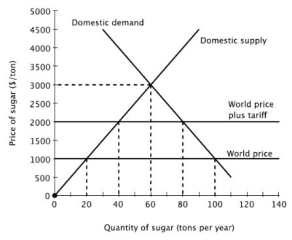
(Multiple Choice)
4.9/5 (82)
(82) The following graph shows the production possibilities curve for the economy with only two members, Silvia and Art. Silvia can produce either 50 pounds of beef or 2 computers per week, and Art can produce 100 pounds of beef or 1 computer per week. Both of them work 40 weeks per year. 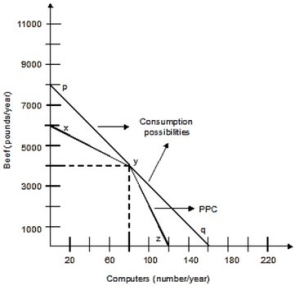 Silvia's opportunity cost of producing one pound of beef is ________ computer(s).
 (Multiple Choice)
4.9/5 (88)
(88) If Fredonia has a closed economy, it ________ with other countries.
(Multiple Choice)
4.9/5 (83)
(83) 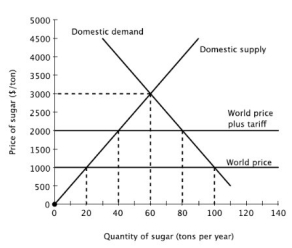
Taiwan exports tools to the United States. Consumers in Taiwan will probably pay a(n)________ price for tools with free trade than they would with a closed economy.
(Multiple Choice)
4.9/5 (86)
(86) An economy has two workers, Paula and Ricardo. Every day they work, Paula can produce 4 computers or 16 shirts, and Ricardo can produce 6 computers or 12 shirts. What is the opportunity cost for Paula to produce one computer?
(Multiple Choice)
4.8/5 (83)
(83) If this is a closed economy, the number of TVs exchanged will be ________. 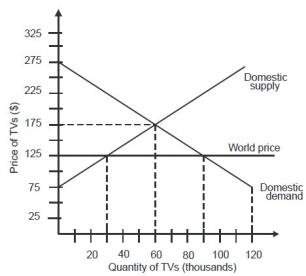
(Multiple Choice)
4.9/5 (81)
(81) 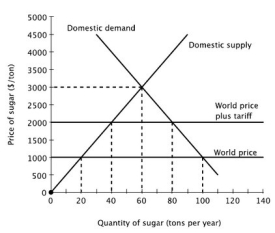
Suppose this economy is currently closed. ________ is/are most likely to want open trade, and ________ is/are most likely to oppose opening the economy to trade. 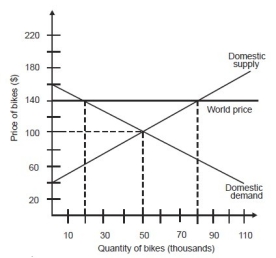
(Multiple Choice)
4.9/5 (83)
(83) In an open economy, the quantity demanded of bikes in the domestic market is ________. 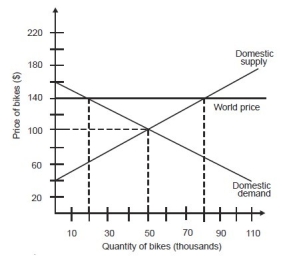
(Multiple Choice)
4.8/5 (79)
(79) Refer to the following graph. 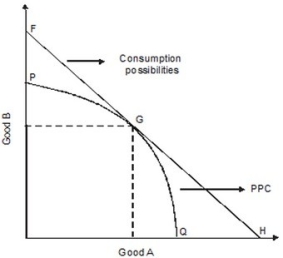 If this country is producing between point G and Q, it will gain by ________ its production of good A and importing more ________.
 (Multiple Choice)
4.8/5 (87)
(87) In an open economy, the quantity supplied of TVs in the domestic market will be ________. 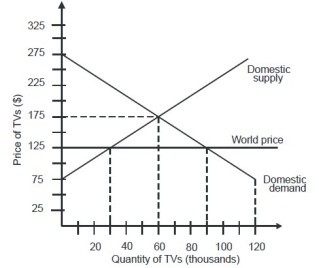
(Multiple Choice)
4.8/5 (86)
(86) Opening this economy to trade would benefit ________ and harm ________. 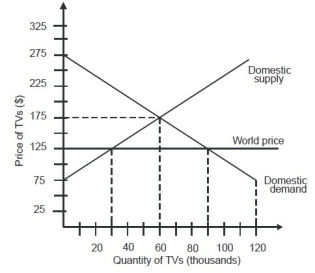
(Multiple Choice)
4.9/5 (78)
(78) If a country is a net importer of a good, domestic suppliers will supply ________ of that good after it opens itself to international trade.
(Multiple Choice)
4.8/5 (78)
(78) If a country is net exporter, free trade will hurt the ________.
(Multiple Choice)
4.9/5 (74)
(74) Amy can produce either 5,000 pounds of cheese or 20 cars per year. Mike can produce either 5,000 pounds of cheese or 10 cars per year. Mike's opportunity cost of producing one car is ________ pound(s)of cheese.
(Multiple Choice)
4.7/5 (79)
(79) 
Filters
- Essay(0)
- Multiple Choice(0)
- Short Answer(0)
- True False(0)
- Matching(0)