



 Chat with AI
Exam 1: Thinking Like an Economist

Exam 1: Thinking Like an Economist142 Questions
Exam 2: Comparative Advantage163 Questions
Exam 3: Supply and Demand181 Questions
Exam 4: Elasticity154 Questions
Exam 5: Demand144 Questions
Exam 6: Perfectly Competitive Supply159 Questions
Exam 7: Efficiency, Exchange, and the Invisible Hand in Action159 Questions
Exam 8: Monopoly, Oligopoly, and Monopolistic Competition147 Questions
Exam 9: Games and Strategic Behavior150 Questions
Exam 10: An Introduction to Behavioral Economics111 Questions
Exam 11: Externalities, Property Rights, and the Environment184 Questions
Exam 12: The Economics of Information127 Questions
Exam 13: Labor Markets, Poverty, and Income Distribution138 Questions
Exam 14: Public Goods and Tax Policy142 Questions
Exam 15: International Trade and Trade Policy164 Questions
Exam 16: Macroeconomics: The Birds Eye View of the Economy154 Questions
Exam 17: Measuring Economic Activity: GDP and Unemployment210 Questions
Exam 18: Measuring the Price Level and Inflation160 Questions
Exam 19: Economic Growth, Productivity, and Living Standards158 Questions
Exam 20: The Labor Market: Workers, Wages, and Unemployment121 Questions
Exam 21: Saving and Capital Formation144 Questions
Exam 22: Money Prices and the Federal Reserve107 Questions
Exam 23: Financial Markets and International Capital Flows104 Questions
Exam 24: Short-Term Economic Fluctuations: An Introduction124 Questions
Exam 25: Spending and Output in the Short Run146 Questions
Exam 26: Stabilizing the Economy: The Role of the Fed162 Questions
Exam 27: Aggregate Demand, Aggregate Supply, and Inflation159 Questions
Exam 28: Exchange Rates and the Open Economy157 Questions
Select questions type


Frank owns an apple farm and plans to spend 4 hours today picking apples. The number of apples he can pick per hour depends on the total number of hours he spends working in either the east orchard or the west orchard in the manner shown in the accompanying table below. Muurs in East Orchard Number af Apples Per Hour Hours in West Orchard Number d Apples Per Hour 1 40 1 10 2 32 2 10 3 25 3 10 4 20 4 10
If Frank spends 2 hours picking apples in the east orchard and 2 hours picking apples in the west orchard, how many apples in total will Frank be able to pick today?
(Multiple Choice)
4.8/5  (80)
(80) If one fails to account for implicit costs in decision making, then applying the cost-benefit rule will be flawed because:
(Multiple Choice)
4.8/5 (72)
(72) For the fall semester, you had to pay a nonrefundable fee of $600 for your meal plan, which gives you up to 150 meals. If you eat 100 meals, your average cost for a meal is:
(Multiple Choice)
4.8/5 (88)
(88) The accompanying table below shows how total donations, average donations, total labor costs and average labor costs vary depending on the number of employees State U hires for its fundraising activities.
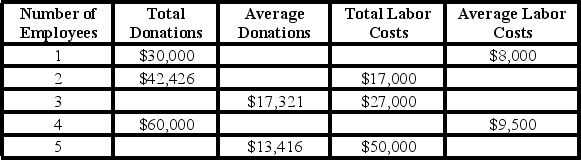 The marginal cost of the 4ᵗʰ employee is:
 (Multiple Choice)
4.8/5 (78)
(78) The following accompanying table shows the relationship between the speed of a computer's CPU and its benefits and costs. Assume that all other features of the computer are the same (that is, CPU speed is the only source of variation), and only the CPU speeds listed below are available for purchase.
CPU GHz Total Benefit Marginal Benefit Total Cost Marginal Costs 2.0 \ 1,000 \ 900 2.5 \ 1,400 \ 100 3.0 \ 300 \ 1,200 3.5 \ 1,900 \ 1,500 4.0 \ 2,000 \ 400
Choosing a 3.5GHz computer would be irrational because:
(Multiple Choice)
4.9/5 (76)
(76) The Scarcity Principle tells us ________, and the Cost-Benefit Principle tells us ________.
(Multiple Choice)
4.8/5 (91)
(91) The following accompanying table shows the relationship between the speed of a computer's CPU and its benefits and costs. Assume that all other features of the computer are the same (that is, CPU speed is the only source of variation), and only the CPU speeds listed below are available for purchase.
CPU GHz Total Benefit Marginal Benefit Total Cost Marginal Costs 2.0 \ 1,000 \ 900 2.5 \ 1,400 \ 100 3.0 \ 300 \ 1,200 3.5 \ 1,900 \ 1,500 4.0 \ 2,000 \ 400
The marginal benefit of upgrading from a 2.0GHz computer to a 2.5GHz computer is:
(Multiple Choice)
4.8/5 (75)
(75) Larry was accepted at three different graduate schools, and must choose one. Elite U costs $50,000 per year and did not offer Larry any financial aid. Larry values attending Elite U at $60,000 per year. State College costs $30,000 per year, and offered Larry an annual $10,000 scholarship. Larry values attending State College at $40,000 per year. NoName U costs $20,000 per year, and offered Larry a full $20,000 annual scholarship. Larry values attending NoName at $15,000 per year. What is Larry's economic surplus from attending State College instead of his next best alternative?
(Multiple Choice)
4.9/5 (98)
(98) The following accompanying table shows the relationship between the speed of a computer's CPU and its benefits and costs. Assume that all other features of the computer are the same (that is, CPU speed is the only source of variation), and only the CPU speeds listed below are available for purchase. CPU GHz Total Benefit Marginal Benefit Total Cost Marginal Costs 2.0 \ 1,000 \ 900 2.5 \ 1,400 \ 100 3.0 \ 300 \ 1,200 3.5 \ 1,900 \ 1,500 4.0 \ 2,000 \ 400 The marginal cost of upgrading from a 2.5GHz to 3.0GHz computer is:
(Multiple Choice)
4.8/5 (66)
(66) Pat earns $25,000 per year (after taxes), and Pat's spouse, Chris, earns $35,000 (after taxes). They have two pre-school-aged children. Childcare for their children costs $12,000 per year. Given that Chris doesn't want to stay home with the kids, regardless of what Pat does, Pat should stay home with the kids if, and only if, the value of Pat spending more time with the kids is greater than:
(Multiple Choice)
4.9/5 (82)
(82) The following accompanying table shows the relationship between the speed of a computer's CPU and its benefits and costs. Assume that all other features of the computer are the same (that is, CPU speed is the only source of variation), and only the CPU speeds listed below are available for purchase. CPU GHz Total Benefit Marginal Benefit Total Cost Marginal Costs 2.0 \ 1,000 \ 900 2.5 \ 1,400 \ 100 3.0 \ 300 \ 1,200 3.5 \ 1,900 \ 1,500 4.0 \ 2,000 \ 400
Application of the Cost-Benefit Principle would lead one to purchase a ________ computer.
(Multiple Choice)
4.8/5 (78)
(78) Larry was accepted at three different graduate schools, and must choose one. Elite U costs $50,000 per year and did not offer Larry any financial aid. Larry values attending Elite U at $60,000 per year. State College costs $30,000 per year, and offered Larry an annual $10,000 scholarship. Larry values attending State College at $40,000 per year. NoName U costs $20,000 per year, and offered Larry a full $20,000 annual scholarship. Larry values attending NoName at $15,000 per year. Larry's opportunity cost of attending State College is:
(Multiple Choice)
4.8/5 (73)
(73) Frank owns an apple farm and plans to spend 4 hours today picking apples. The number of apples he can pick per hour depends on the total number of hours he spends working in either the east orchard or the west orchard in the manner shown in the accompanying table below. Muurs in East Orchard Number af Apples Per Hour Hours in West Orchard Number d Apples Per Hour 1 40 1 10 2 32 2 10 3 25 3 10 4 20 4 10
How should Frank divide his time between the east and the west orchard?
(Multiple Choice)
4.9/5 (85)
(85) Suppose there are two parallel highways between two cities with approximately equal traffic. What would you expect to happen if the state began charging tolls to drive on one of those highways?
(Multiple Choice)
4.8/5 (65)
(65) During times of high unemployment, colleges often observe an increase in enrollment even if tuition remains unchanged. Why?
(Multiple Choice)
4.8/5 (84)
(84) You save $10 on gas every week because you take the bus to school. You have class 5 days a week. What is your average benefit per day of taking the bus to school?
(Multiple Choice)
4.9/5 (83)
(83) An editorial in the paper argues that a person only should be allowed to attend school if the marginal cost of educating that person is less than the marginal benefit of educating that person. The writer's reasoning is an application of:
(Multiple Choice)
4.9/5 (83)
(83) 
Filters
- Essay(0)
- Multiple Choice(0)
- Short Answer(0)
- True False(0)
- Matching(0)