



 Chat with AI
Exam 1: Thinking Like an Economist

Exam 1: Thinking Like an Economist142 Questions
Exam 2: Comparative Advantage163 Questions
Exam 3: Supply and Demand181 Questions
Exam 4: Elasticity154 Questions
Exam 5: Demand144 Questions
Exam 6: Perfectly Competitive Supply159 Questions
Exam 7: Efficiency, Exchange, and the Invisible Hand in Action159 Questions
Exam 8: Monopoly, Oligopoly, and Monopolistic Competition147 Questions
Exam 9: Games and Strategic Behavior150 Questions
Exam 10: An Introduction to Behavioral Economics111 Questions
Exam 11: Externalities, Property Rights, and the Environment184 Questions
Exam 12: The Economics of Information127 Questions
Exam 13: Labor Markets, Poverty, and Income Distribution138 Questions
Exam 14: Public Goods and Tax Policy142 Questions
Exam 15: International Trade and Trade Policy164 Questions
Exam 16: Macroeconomics: The Birds Eye View of the Economy154 Questions
Exam 17: Measuring Economic Activity: GDP and Unemployment210 Questions
Exam 18: Measuring the Price Level and Inflation160 Questions
Exam 19: Economic Growth, Productivity, and Living Standards158 Questions
Exam 20: The Labor Market: Workers, Wages, and Unemployment121 Questions
Exam 21: Saving and Capital Formation144 Questions
Exam 22: Money Prices and the Federal Reserve107 Questions
Exam 23: Financial Markets and International Capital Flows104 Questions
Exam 24: Short-Term Economic Fluctuations: An Introduction124 Questions
Exam 25: Spending and Output in the Short Run146 Questions
Exam 26: Stabilizing the Economy: The Role of the Fed162 Questions
Exam 27: Aggregate Demand, Aggregate Supply, and Inflation159 Questions
Exam 28: Exchange Rates and the Open Economy157 Questions
Select questions type


Refer to the accompanying table below. The marginal cost of the 4ᵗʰ unit of activity is: 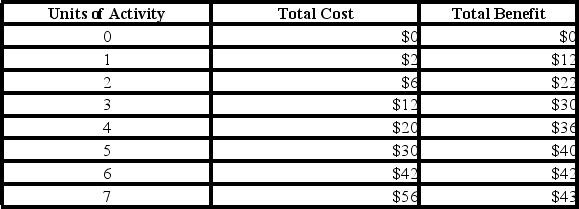
(Multiple Choice)
4.8/5  (98)
(98) Chris has a one-hour break between classes every Wednesday. Chris can either stay at the library and study or go to the gym and work out. The decision Chris must make is:
(Multiple Choice)
4.8/5 (63)
(63) The extra benefit that results from carrying out one additional unit of an activity is the ________ of the activity.
(Multiple Choice)
4.8/5 (82)
(82) A study that deals with the salaries of university professors would be considered:
(Multiple Choice)
4.7/5 (80)
(80) Normative economic principles are concerned with how people ________ make decisions while positive economic principles are concerned with how people ________ make decisions.
(Multiple Choice)
4.9/5 (88)
(88) You paid $35 for a ticket (which is non-refundable)to see SPAM, a local rock band, in concert on Saturday. Assume that $35 is the most you would have been willing to pay for a ticket. Your boss called, and she is looking for someone to cover a shift on Saturday at the same time as the concert. You would have to work 4 hours and she would pay you $11/hr. The psychic cost to you of working is $2/hr. Should you go to the concert instead of working Saturday?
(Multiple Choice)
4.8/5 (82)
(82) You want to buy a TV that regularly costs $250. You can either buy the TV from a nearby store or from a store that's downtown. Relative to going to the nearby store, driving downtown involves additional time and gas. The downtown store, however, has a 10 percent off sale this week. Last week you drove downtown to save $20 on some concert tickets, a 15 percent savings. Should you drive downtown to buy the TV?
(Multiple Choice)
4.9/5 (89)
(89) The Cost-Benefit Principle indicates that an action should be taken if:
(Multiple Choice)
4.9/5 (70)
(70) If a person takes an action if, and only if, the extra benefits from taking that action are at least as great as the extra costs, then that person is:
(Multiple Choice)
4.9/5 (73)
(73) A firm pays Pam $40 per hour to assemble personal computers. Each day, Pam can assemble 4 computers if she works 1 hour, 7 computers if she works 2 hours, 9 computers if she works 3 hours, and 10 computers if she works 4 hours. Pam cannot work more than 4 hours day. Each computer consists of a motherboard, a hard drive, a case, a monitor, a keyboard, and a mouse. The total cost of these parts is $600 per computer. What is the marginal cost of producing the computers that Pam can assemble during her 2ⁿᵈ hour of work?
(Multiple Choice)
4.7/5 (62)
(62) Which of the following would not be studied in microeconomics?
(Multiple Choice)
4.8/5 (80)
(80) Dean should play golf instead of preparing for tomorrow's exam in economics if:
(Multiple Choice)
4.8/5 (77)
(77) According to the Cost-Benefit Principle, you should go see the latest Star Wars movie with your friends this weekend if:
(Multiple Choice)
4.7/5 (78)
(78) You paid $35 for a ticket (which is non-refundable)to see SPAM, a local rock band, in concert on Saturday. Assume that $35 is the most you would have been willing to pay for a ticket. Your boss called, and she is looking for someone to cover a shift on Saturday at the same time as the concert. You would have to work 4 hours and she would pay you $11/hr. The psychic cost to you of working is $2/hr. What is your opportunity cost of going to work on Saturday?
(Multiple Choice)
4.8/5 (85)
(85) By convention, there are two major divisions of economics, called:
(Multiple Choice)
4.7/5 (84)
(84) You have two options for how to spend the afternoon. You can either go see a movie with your roommate or work as a tutor for the Math Department. From experience, you know that going to see a movie gives you $20 worth of enjoyment, and with your student discount, a movie ticket only costs $12. If you spend the afternoon working as a math tutor, you will get paid $45. On a typical day, you wouldn't be willing to spend the afternoon working as a math tutor for less than $35. Should you go see a movie or work as a math tutor?
(Multiple Choice)
4.9/5 (90)
(90) 
Filters
- Essay(0)
- Multiple Choice(0)
- Short Answer(0)
- True False(0)
- Matching(0)