



 Chat with AI
Exam 1: Thinking Like an Economist

Exam 1: Thinking Like an Economist142 Questions
Exam 2: Comparative Advantage163 Questions
Exam 3: Supply and Demand181 Questions
Exam 4: Elasticity154 Questions
Exam 5: Demand144 Questions
Exam 6: Perfectly Competitive Supply159 Questions
Exam 7: Efficiency, Exchange, and the Invisible Hand in Action159 Questions
Exam 8: Monopoly, Oligopoly, and Monopolistic Competition147 Questions
Exam 9: Games and Strategic Behavior150 Questions
Exam 10: An Introduction to Behavioral Economics111 Questions
Exam 11: Externalities, Property Rights, and the Environment184 Questions
Exam 12: The Economics of Information127 Questions
Exam 13: Labor Markets, Poverty, and Income Distribution138 Questions
Exam 14: Public Goods and Tax Policy142 Questions
Exam 15: International Trade and Trade Policy164 Questions
Exam 16: Macroeconomics: The Birds Eye View of the Economy154 Questions
Exam 17: Measuring Economic Activity: GDP and Unemployment210 Questions
Exam 18: Measuring the Price Level and Inflation160 Questions
Exam 19: Economic Growth, Productivity, and Living Standards158 Questions
Exam 20: The Labor Market: Workers, Wages, and Unemployment121 Questions
Exam 21: Saving and Capital Formation144 Questions
Exam 22: Money Prices and the Federal Reserve107 Questions
Exam 23: Financial Markets and International Capital Flows104 Questions
Exam 24: Short-Term Economic Fluctuations: An Introduction124 Questions
Exam 25: Spending and Output in the Short Run146 Questions
Exam 26: Stabilizing the Economy: The Role of the Fed162 Questions
Exam 27: Aggregate Demand, Aggregate Supply, and Inflation159 Questions
Exam 28: Exchange Rates and the Open Economy157 Questions
Select questions type


The accompanying table below shows the relationship between the number of times you get your car washed each month and your total monthly benefit from car washes. Each car wash costs $15. Number af Car Washes Per Month Tatal Munthly Benefit fram Car Washes 0 \ 0 1 \ 20 2 \ 36 3 \ 48 4 \ 56 5 \ 60
What is the marginal cost of the 5?? car wash each month?
(Multiple Choice)
5.0/5  (84)
(84) The accompanying table below shows how total donations, average donations, total labor costs and average labor costs vary depending on the number of employees State U hires for its fundraising activities. 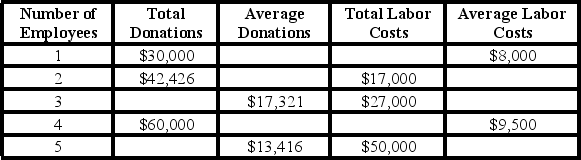 The net benefit of hiring fundraisers is largest when ________ employees are hired.
 (Multiple Choice)
4.8/5 (75)
(75) Suppose a retail store was offering 10 percent off list prices on all goods. The benefit of the 10 percent savings is:
(Multiple Choice)
4.9/5 (74)
(74) You paid $35 for a ticket (which is non-refundable)to see SPAM, a local rock band, in concert on Saturday. Assume that $35 is the most you would have been willing to pay for a ticket. Your boss called, and she is looking for someone to cover a shift on Saturday at the same time as the concert. You would have to work 4 hours and she would pay you $11/hr. The psychic cost to you of working is $2/hr. What is the opportunity cost of going to the concert?
(Multiple Choice)
4.7/5 (69)
(69) Moe has a big exam tomorrow. He considered studying this evening, but decided to hang out with Curly instead. If neither activity involves any explicit costs, and Moe always chooses rationally, it must be true that:
(Multiple Choice)
4.8/5 (87)
(87) If Jane works for 6 hours she can rent out 9 apartments, and if she works for 7 hours she can rent out 12 apartments. The marginal benefit of Jane's 7ᵗʰ hour of work equals:
(Multiple Choice)
4.9/5 (77)
(77) The accompanying table below shows how total donations, average donations, total labor costs and average labor costs vary depending on the number of employees State U hires for its fundraising activities. 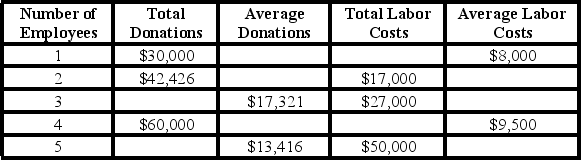 The Chair of the Economics Department at State U says that fundraising employees should be hired as long as their marginal benefit exceeds their marginal cost. If the University follows this advice, then ________ employee(s)will hired, and the net benefit (total donations minus total labor costs)will be ________.
 (Multiple Choice)
4.7/5 (76)
(76) Your classmates from the University of Chicago are planning to go to Miami for spring break, and you are undecided about whether you should go with them. The round-trip airfare is $600, but you have a frequent-flyer coupon worth $500 that you could use to pay part of the airfare. All other costs for the vacation are exactly $900. The most you would be willing to pay for the trip is $1,400. Your only alternative use for your frequent-flyer coupon is for your trip to Atlanta two weeks after the break to attend your sister's graduation, which your parents are forcing you to attend. The Chicago-Atlanta round-trip airfare is $450. Should you use the frequent flyer coupon to go to Miami?
(Multiple Choice)
4.7/5 (76)
(76) According to the Incentive Principle, people will be less likely to smoke if the government:
(Multiple Choice)
5.0/5 (88)
(88) Matt has decided to purchase his textbooks for the semester. His options are to purchase the books online with next day delivery at a cost of $175, or to drive to campus tomorrow to buy the books at the university bookstore at a cost of $170. Last week he drove to campus to buy a concert ticket because they offered 25 percent off the regular price of $16. The benefit to Matt of buying his books at the university bookstore instead of online is:
(Multiple Choice)
4.9/5 (85)
(85) For the fall semester, you had to pay a nonrefundable fee of $600 for your meal plan, which gives you up to 150 meals. If you eat all of the meals, your average cost for a meal is:
(Multiple Choice)
4.8/5 (86)
(86) Larry was accepted at three different graduate schools, and must choose one. Elite U costs $50,000 per year and did not offer Larry any financial aid. Larry values attending Elite U at $60,000 per year. State College costs $30,000 per year, and offered Larry an annual $10,000 scholarship. Larry values attending State College at $40,000 per year. NoName U costs $20,000 per year, and offered Larry a full $20,000 annual scholarship. Larry values attending NoName at $15,000 per year. Larry's opportunity cost of attending State NoName U is:
(Multiple Choice)
4.8/5 (83)
(83) If all the world's resources were to magically increase one hundredfold, then:
(Multiple Choice)
4.8/5 (78)
(78) Refer to the accompanying table below. The average cost of 4 units of this activity is: Units of Activity Tatal Cast Tatal Benefit 0 \ 0 \ 0 1 \ 30 \ 100 2 \ 40 \ 160 3 \ 60 \ 190 4 \ 100 \ 210 5 \1 50 \ 220 6 \2 10 \ 225
(Multiple Choice)
4.8/5 (61)
(61) Suppose that the extra cost to Tim of a third glass of soda is zero because he's at a restaurant that gives free refills. According to the Cost-Benefit Principle Tim should:
(Multiple Choice)
4.8/5 (80)
(80) Ginger bought a phone that came with a $10 rebate. Ginger should fill out and mail in the rebate form if:
(Multiple Choice)
4.8/5 (83)
(83) Refer to the accompanying table below. According to the Cost-Benefit Principle, how many units of this activity should be carried out? 
(Multiple Choice)
4.9/5 (63)
(63) The extra cost that results from carrying out one additional unit of an activity is the ________ of the activity.
(Multiple Choice)
4.9/5 (73)
(73) Your classmates from the University of Chicago are planning to go to Miami for spring break, and you are undecided about whether you should go with them. The round-trip airfare is $600, but you have a frequent-flyer coupon worth $500 that you could use to pay part of the airfare. All other costs for the vacation are exactly $900. The most you would be willing to pay for the trip is $1,400. Your only alternative use for your frequent-flyer coupon is for your trip to Atlanta two weeks after the break to attend your sister's graduation, which your parents are forcing you to attend. The Chicago-Atlanta round-trip airfare is $450. If you do not use the frequent-flyer coupon to fly to Miami, should you go to Miami?
(Multiple Choice)
4.8/5 (86)
(86) 
Filters
- Essay(0)
- Multiple Choice(0)
- Short Answer(0)
- True False(0)
- Matching(0)